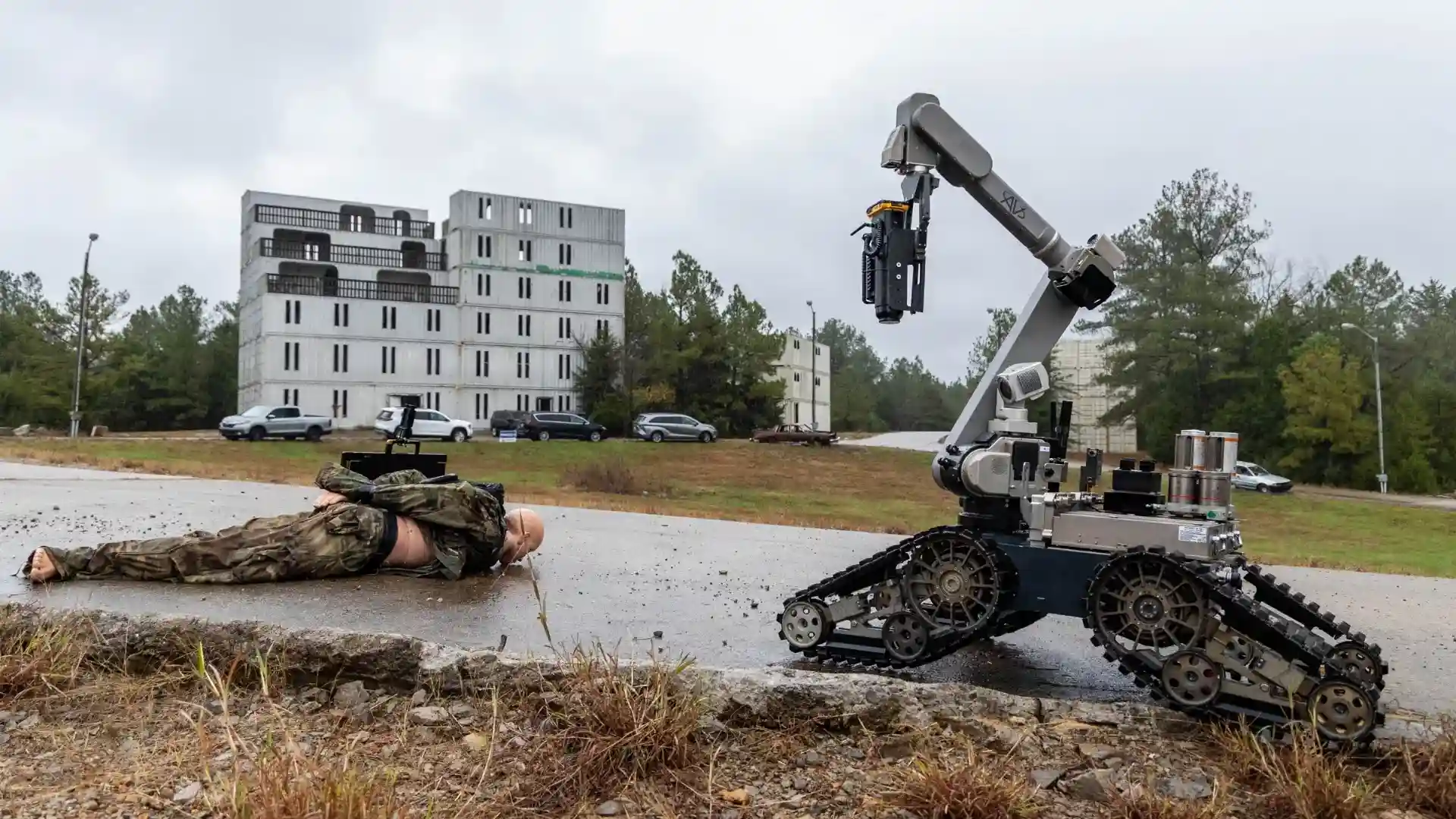
Military personnel, hazardous materials specialists and civilian public safety bomb technicians have completed Operation Total Containment, a three-day technology training and evaluation exercise at Fort Knox, Kentucky, designed to put emerging bomb disposal equipment in operators’ hands and route field feedback directly to industry developers. The pilot event was hosted by the U.S. Bomb Technician Association (USBTA) to mark the organization’s 10th anniversary, according to a Fort Knox Public Affairs story published by the Department of War on November 20, 2026.
Eric Gahagan, the association’s chief business officer, said putting equipment in operators’ hands has been central to the group since its founding. “What was the USBTA focus 10 years ago, and remains a cornerstone of the organization, is getting technology in the hands of operators so we can close gaps in real time, and in turn, close gaps moving forward on things that don’t yet exist,” he said.
The USBTA is a nonprofit founded on October 19, 2016, with an office in Indian Head, Maryland. In December 2024, it signed a public-private partnership agreement with Naval Surface Warfare Center Indian Head Division, and from April 27 to May 1, 2026, it partnered with the Air Force’s 1st Special Operations Wing for Operation Emerald Coast III at Hurlburt Field, Florida. The Fort Knox story did not specify the exact dates of the exercise or the number of participants.
Five Modules Push Bomb Technicians Through Real-World Scenarios
Participants rotated through five modules built to replicate real-world emergencies: emerging technology and innovation, multihazard response, international cooperation, current operational technology, and screening and detection. Tasks included inspecting suspicious packages through barriers, operating inside simulated contamination zones, clearing booby-trapped spaces and rigging pulley systems to lower devices safely from elevated floors.
Gahagan framed the exercise as a bridge between system operators and developers. “The whole goal of what we’re trying to do is to get feedback back to industry developers so we can expedite changes during further development,” he said.
Evaluation centered on three questions: how easily the equipment could be used, how it performed in the field and where capabilities fell short. To keep participants from defaulting to familiar kit, organizers required every operator to work with every system. “One unique thing we do is force everyone to use all the technology, whether they like it or not, because we want all the feedback,” Gahagan said.
One system tested this year was a drone that deployed an X-ray system, allowing operators to scan cargo from a distance, Gahagan said. The manufacturer, airframe, imaging hardware, standoff range and performance data were not disclosed.
Foreign Threat Data From Israel, Slovakia and Hungary Shapes Scenarios
The international cooperation module brought in specialists from Israel, Slovakia and Hungary, who helped build field challenges around threats U.S. teams may not yet have encountered. “They outlined some of the threats they’re seeing so that we could build them into the scenarios,” Gahagan said, adding that U.S. bomb technicians could then evaluate emerging technology “against a foreign threat that they may not have seen yet, putting us ahead of the threat a little bit.”
The specific threat profiles they contributed were not described. Slovakia and Hungary are both NATO members that share a border with Ukraine.
Fort Knox supplied the range infrastructure and range management personnel for the high-stakes, complex scenarios. “The environment and the infrastructure are just great,” Gahagan said. “You know it’s going to be safe, and you know you’re going to get a lot of good support.” He added that the USBTA counts explosive ordnance disposal (EOD) veterans among its members and that organizers wanted to ensure the military was represented.
Analysis: The exercise’s value lies less in any single system than in its feedback architecture. A forced-use format that puts military personnel and civilian bomb technicians on the same prototypes, against scenarios seeded with foreign threat data, gives developers a broader set of operator feedback than a single user community would. For a Department of War that has pushed faster adoption of drone technology since the July 10, 2025, memo “Unleashing U.S. Military Drone Dominance,” events of this kind offer a way to surface capability gaps early. The limitation is transparency: without published performance metrics, the exercise’s influence on procurement will be difficult to measure.
Insights from Operation Total Containment will be distributed to participating public safety departments, military branches and manufacturing partners to guide development of next-generation bomb disposal technology. Key unknowns include which other systems were evaluated, what shortfalls operators flagged and whether the pilot will become a recurring event at Fort Knox. The next indicator will be whether manufacturers fold the findings into product updates or submissions to military EOD modernization programs.