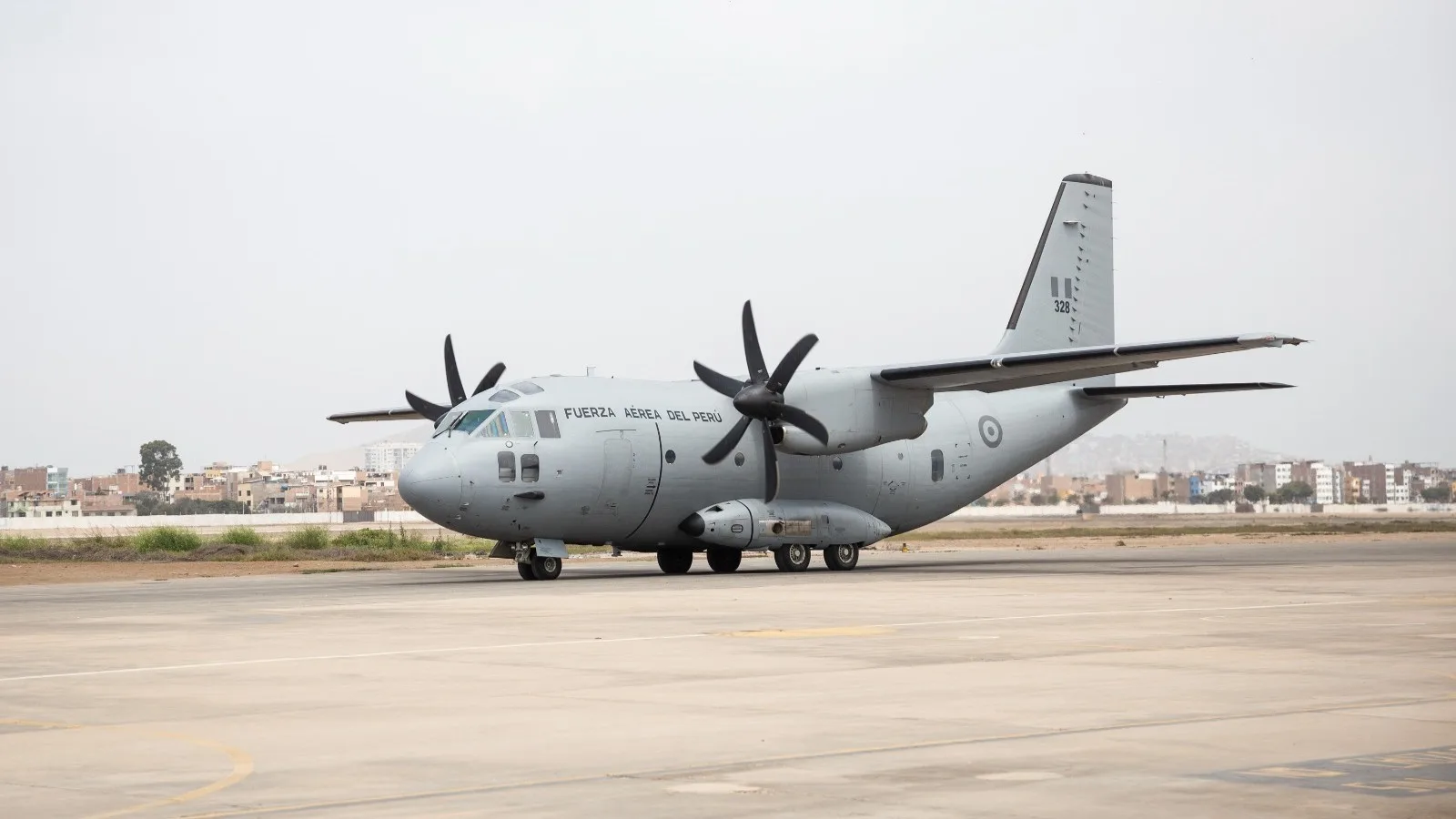
Leonardo has signed a long-term Follow-On Support (FOS) agreement for the Peruvian Air Force’s C-27J Spartan fleet, the Italian manufacturer announced in Lima on November 23, 2026. The deal with the Fuerza Aérea del Perú (FAP) places spare parts, repair and overhaul, engineering and fleet monitoring under a single manufacturer-led package intended to raise operational readiness. Neither party disclosed the contract value or its duration.
The agreement comes six months after Leonardo announced, on May 14, 2026, that Peru had ordered a fifth C-27J, the 100th Spartan sold worldwide. Since entering FAP service in 2015, the Peruvian fleet has logged nearly 16,000 flight hours, carried about 240,000 passengers and 9,000 tonnes of cargo, and flown close to 600 medical evacuation missions, according to manufacturer figures released with that order. Sustaining that tempo across the Pacific coast, the Andes and the Amazon basin is now the central requirement.
Inside the Peru C-27J Spartan Follow-On Support Package
Under the agreement, Leonardo will provide technical and field service support, spare parts, repair and overhaul services, maintenance planning, engineering support, fleet status monitoring, training activities and logistics management. The stated objective is faster technical response and a more efficient supply chain, two factors that determine aircraft availability far more than airframe count in a fleet this small.
The package pairs the original equipment manufacturer’s design authority with the FAP’s operating experience. Peru’s Spartans fly with Grupo Aéreo N° 8 at Callao, the service’s main transport unit, and routinely operate from short and unprepared strips in high-altitude Andean terrain and humid Amazonian conditions. Both environments place heavy demands on the aircraft, which makes fleet status monitoring and maintenance planning the most consequential elements of the deal.
Leonardo tied the agreement directly to Peru’s disaster exposure. In 2025, heavy rain and flooding affected more than 57,000 people, damaged infrastructure and cut access to remote communities, while an earthquake in the Lima-Callao area underlined the need for rapid response airlift. The C-27J supported relief flights, medical evacuations and the deployment of government emergency teams to isolated areas during those events.
Peru’s relationship with the type dates to December 2013, when the Ministry of Defense ordered two aircraft. A second contract, signed on December 31, 2014 and valued at around €100 million, added two more airframes along with integrated logistic support and technical assistance. The company, then operating as Alenia Aermacchi, handed over the first aircraft at Las Palmas Air Base in Lima in March 2015, with the four-aircraft program valued at $240 million.
C-27J Spartan Specifications and the Next Generation Standard
The C-27J is a twin-turboprop tactical airlifter derived from the Aeritalia G.222, powered by two Rolls-Royce AE 2100-D2A turboprops rated at 4,637 shp (3,458 kW) each and driving Dowty R391 six-blade propellers. The engine belongs to the same AE 2100 family that equips the C-130J Super Hercules, and the Spartan shares much of that aircraft’s systems, including its glass cockpit.
Publicly available manufacturer specifications indicate a maximum takeoff weight of 31,800 kg, a maximum payload of 11,300 kg, and capacity for 46 troops, or up to 60 in high-density configuration. Top cruise speed is 325 knots true airspeed, the service ceiling is 30,000 ft, and the airframe is cleared for tactical maneuvers up to 3 g. Its cargo hold has adjustable height and inclination for loading, a practical advantage at Andean and Amazonian airfields with minimal ground handling equipment.
The fifth Peruvian aircraft, due for delivery to Grupo 8 in 2027, will be the first in the country built to the C-27J Next Generation standard. That configuration adds a new avionics suite and aerodynamic refinements, including winglets, aimed at better efficiency and performance. A mixed fleet of legacy and Next Generation airframes will add configuration management workload, which the agreement’s engineering and maintenance planning elements are positioned to absorb.
Analysis: For a four-aircraft fleet growing to five, availability is the capability. A single airframe grounded for parts removes a quarter of Peru’s current Spartan fleet, so a manufacturer-backed sustainment pipeline carries more operational weight than an additional hull would. The deal also fits a wider pattern. Italy signed a 2026 to 2028 performance-based logistics contract for its 12 C-27Js in December 2025, while Australia’s April 16, 2026 decision to retire its 10 Spartans in favor of commercial aircraft showed how exposed small fleets become when their support case weakens. For Leonardo, long-term support contracts protect an installed base of more than 100 aircraft ordered, operated by 22 countries and close to 300,000 flight hours, at a moment when sustainment revenue matters as much as new orders.
The next milestone is the 2027 delivery of Peru’s first C-27J Next Generation, which will test how the FOS framework handles a mixed-standard fleet. Key unknowns remain the contract’s value and duration, whether it includes contractual availability targets, and whether Lima intends to upgrade the avionics of its four legacy aircraft, as Italy, Romania, US Special Operations Command and the US Coast Guard have contracted Leonardo to do with their own fleets.