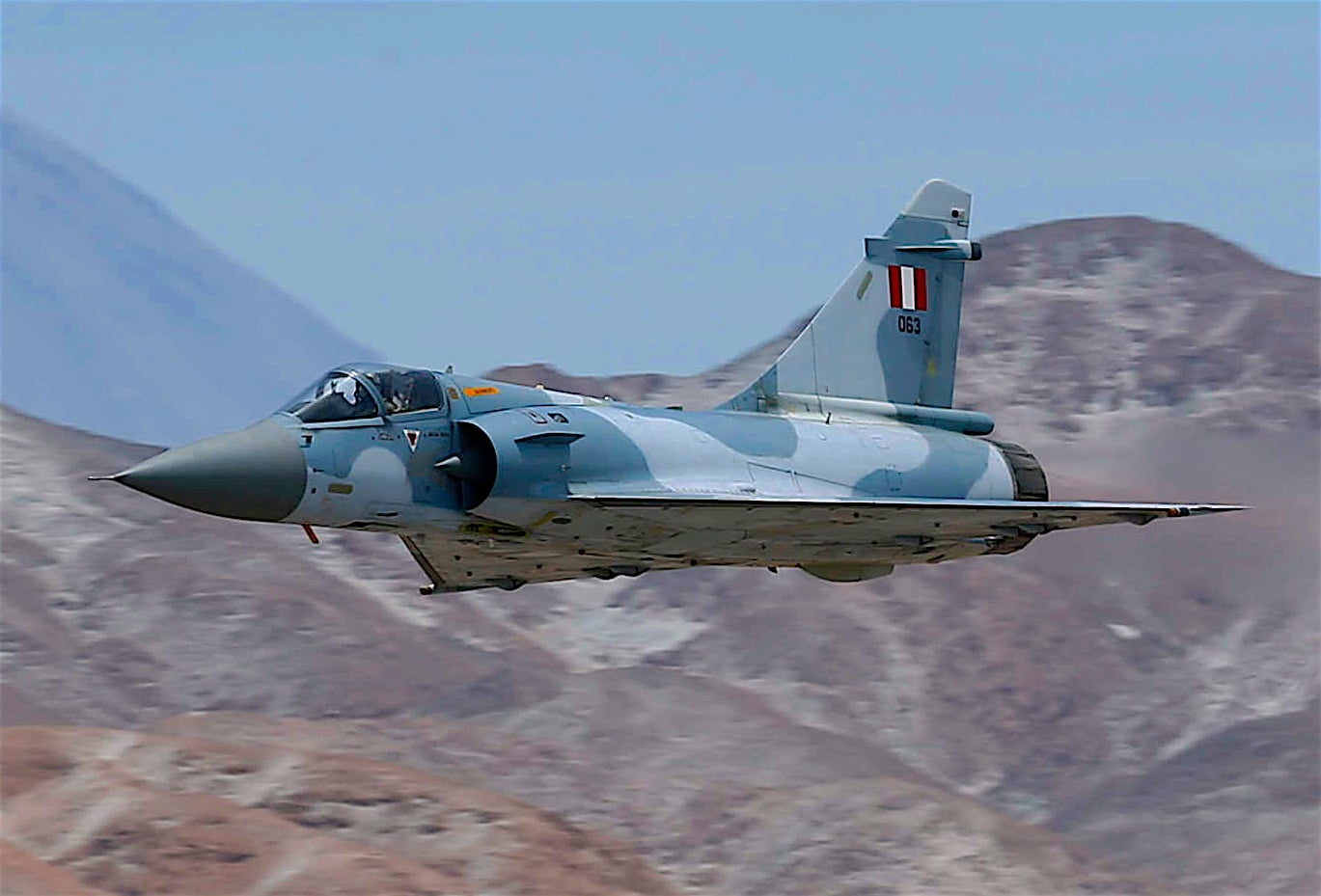
The Peruvian Air Force (Fuerza Aérea del Perú, FAP) will keep its Dassault Mirage 2000P/DP fighters flying beyond 2030 in the air defense role and as a transition aircraft for pilots bound for the Lockheed Martin F-16 Block 70. Major General Juan Pablo Tryon Carbone, the FAP’s Director General of Education and Doctrine, disclosed the plan in early October 2026 during the seventh Strategic Management Program for Aerospace and Cyberspace Power (PROGEPAC) at the Peruvian Aeronautical Center in San Isidro, Lima.
The decision reverses the logic of Peru’s fighter recapitalization. When Lima signed for 12 new F-16 Block 70 aircraft on April 20, 2026, the jets were presented as replacements for both the Mirage 2000 and the MiG-29. The FAP has since retired its MiG-29 fleet for good, leaving the Mirage as its most capable air defense asset. With first F-16 deliveries expected in 2029 or 2030 and a planned second batch of 12 aircraft still unsecured, the Mirage is Peru’s only fighter for the rest of the decade.
Peru Mirage 2000 Fleet Extension: Airframes, Sensors, and Weapons
Peru became one of the Mirage 2000’s earliest export customers with a December 1982 order. The original plan called for 24 single-seat and two two-seat aircraft at a cost of $650 million, but economic pressure cut the buy to 10 Mirage 2000P single-seaters and two Mirage 2000DP trainers. The first four aircraft arrived on November 23, 1986. The fleet flies with Air Squadron 412 of Air Group No. 4 at La Joya Air Base in Arequipa.
Publicly available specifications indicate the aircraft is powered by a single SNECMA M53-P2 turbofan producing roughly 95 kN with afterburner, for a top speed of about Mach 2.2. Peru’s jets were delivered with the Thomson-CSF RDM multimode pulse-Doppler radar. Their publicly reported armament includes R550 Magic 2 infrared air-to-air missiles, AS30 air-to-surface missiles, AM39 Exocet anti-ship missiles and laser-guided bombs, a mix that covers air defense, strike and maritime denial.
Between 2009 and 2012, the fleet went through a major inspection under a contract worth about $140 million with Dassault Aviation, Snecma and Thales. The work covered engines, navigation and a full airframe overhaul, restoring original capability without adding new functions. In November 2024, the FAP ruled out a Mirage modernization. That position has now shifted. According to the FAP, the fleet retains substantial remaining flight hours, and funding has been programmed to sustain readiness, including targeted upgrades whose content has not been disclosed.
A Mirage 2000P from Air Group No. 4 crashed on April 11, 2024, during low-level navigation training near the Pichu Pichu volcano in Arequipa, killing its pilot, Major Ramiro Rondón Medina. Open-source counts of the remaining fleet range from 10 to 11 aircraft.
F-16 Block 70 Delivery Timeline and the FAP Pilot Training Gap
The F-16 award closed a competition in which the Saab Gripen E/F and Dassault Rafale F4 were also evaluated. Lockheed Martin was notified of its selection in writing on April 14, 2026, and the technical signing followed on April 20 amid a political dispute that saw the defense and foreign ministers resign. Peru’s Ministry of Economy and Finance confirmed a first payment of $462 million on April 22. The aircraft will be built at Lockheed Martin’s Greenville, South Carolina, plant, and the US ambassador to Peru has placed first arrivals in 2029 or 2030.
The Defense Security Cooperation Agency notification of September 15, 2025, covered 10 F-16C and two F-16D Block 70 aircraft, 14 F110-GE-129 engines, 12 AIM-120C-8 Advanced Medium-Range Air-to-Air Missiles, 12 AIM-9X Block II Sidewinders, 52 LAU-129 launchers and 12 M61A1 20mm cannons, for an estimated $3.42 billion. On August 18, 2026, L3Harris announced that Peru had selected the AN/ALQ-254(V)1 Viper Shield electronic warfare suite, becoming its eighth customer. The Block 70 standard also brings the AN/APG-83 active electronically scanned array (AESA) radar, a center pedestal display and a 12,000-hour structural service life.
FAP student pilots move straight from the KAI KT-1P turboprop trainer to the Mirage 2000P/DP, with no jet lead-in trainer in between. The FAP is seeking a jet aircraft to fill that gap, but no program or candidate has been announced. Until one arrives, the Mirage fleet and its two-seat 2000DP variant serve as the FAP’s only bridge into high-performance jet flying.
Analysis: With the MiG-29 gone and the F-16 at least three years out, Peruvian air sovereignty rests on roughly 10 Mirages through 2029, and an unfunded second F-16 tranche could keep the type on the flight line into the 2030s. Running French and US fighter logistics in parallel will raise sustainment costs, and a 1980s pulse-Doppler cockpit offers limited preparation for an AESA-equipped, datalink-centric F-16. The sharper risk is the pilot pipeline: without a jet lead-in trainer, the FAP will struggle to generate F-16 crews fast enough to absorb the first 12 aircraft.
The next decision points are the scope and cost of the Mirage upgrades, the choice of a jet lead-in trainer, and financing for the second batch of 12 F-16s. The final configuration of the F-16 weapons package has not been made public. Until the first Block 70 jets reach La Joya, the Mirage remains Peru’s front-line fighter.