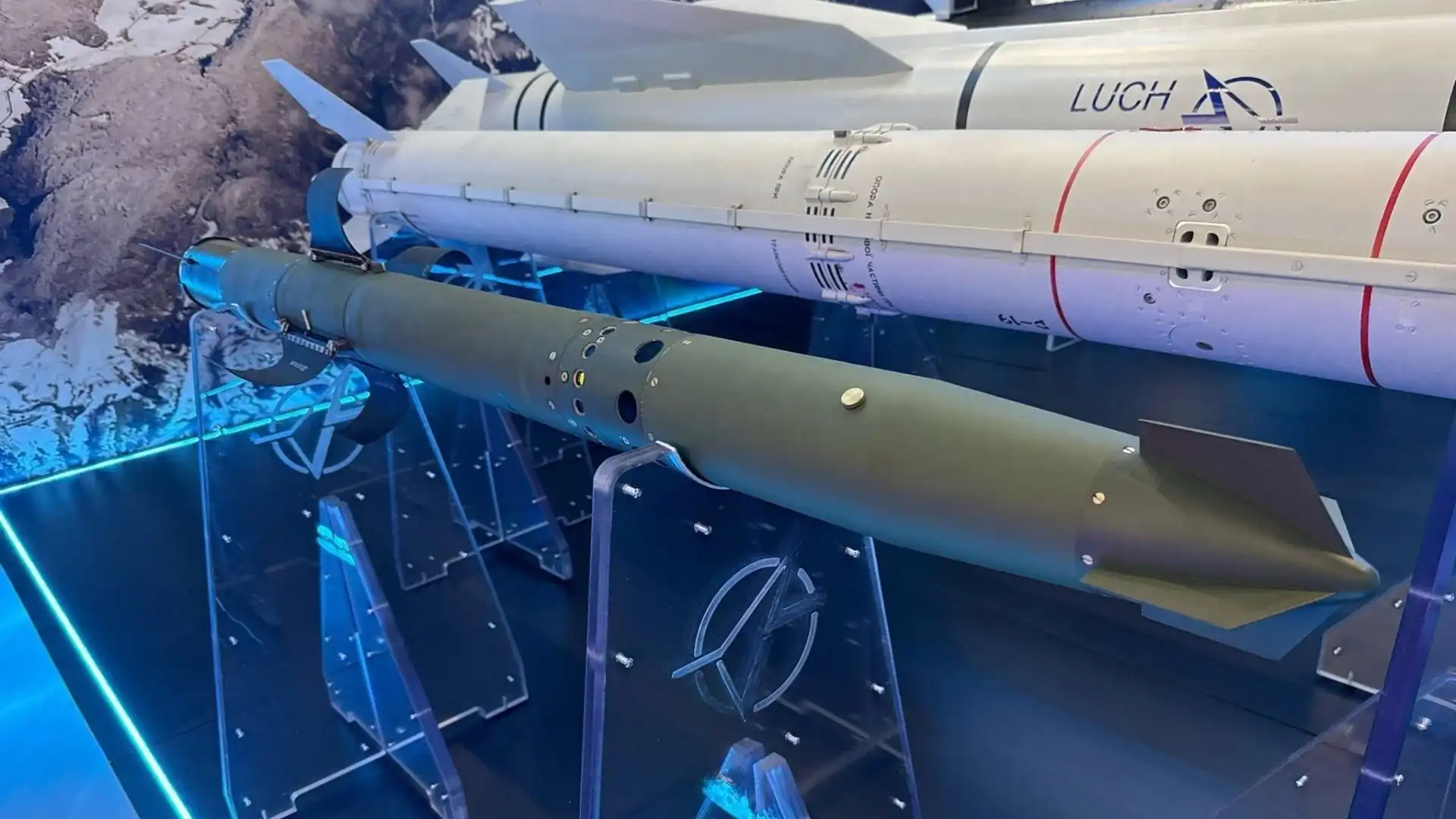
Kongsberg Gruppen announced on November 24, 2026, that it has delivered the DESNA air defense system to Ukraine, a counter-drone capability pairing Ukrainian-made interceptor missiles and launchers with Kongsberg’s fire command and control center. The systems are already in operation, and Norwegian Defense Minister Tore O. Sandvik said Norway has acquired and donated several of them to Ukraine in recent months.
The delivery comes as Russia steps up drone and missile attacks on Kyiv and other Ukrainian cities, according to Sandvik. Kyiv’s binding constraint is interceptors, not launchers: Western surface-to-air missiles, including the AIM-120 Advanced Medium-Range Air-to-Air Missile (AMRAAM) that arms the National Advanced Surface-to-Air Missile System (NASAMS), remain in short supply worldwide. Ukrainian Defense Minister Evgeniy Khmara has repeatedly pressed Oslo for more interceptor missiles and for the integration of additional missile types into NASAMS.
How the DESNA Air Defense System Is Built
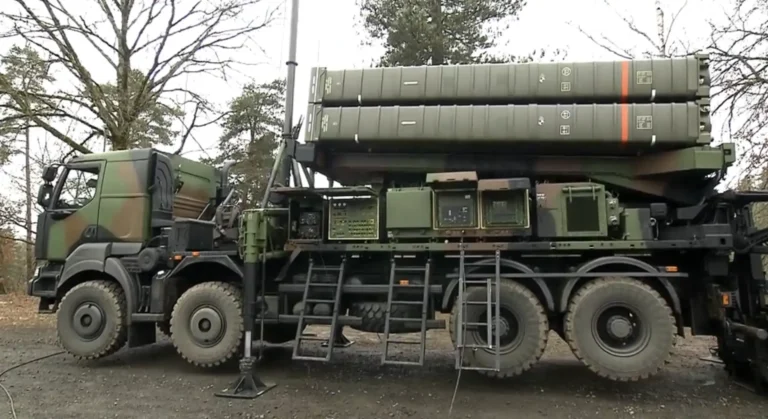
According to Kongsberg, DESNA was developed by the company and an unnamed Ukrainian industrial partner, together with Norwegian and Ukrainian authorities. The architecture splits along national lines. The effector layer, meaning the missiles and launcher units, is Ukrainian. The command layer is Norwegian: a Kongsberg fire command and control center drawn from the same command-and-control (C2) family that underpins NASAMS. The Ukrainian name refers to the Desna River, which joins the Dnipro just north of Kyiv.
Kongsberg has released no performance data and has not named the missile, but Ukraine’s Luch design bureau presented the RK-2PZ, derived from an anti-tank guided missile, at MSPO 2026 in Poland as an interceptor for the Desna system. According to Luch, the 29-kilogram missile rides a laser beam, like the anti-tank weapon it derives from, and carries a 6.1-kilogram high-explosive fragmentation warhead. Its range and unit cost remain undisclosed, as do the sensor feeding the fire control center and the number of launchers per fire unit. The company states only that the missiles can be produced in large quantities at a lower unit cost.
Publicly available specifications for NASAMS offer a reference point. A standard NASAMS fire unit links a Fire Distribution Center to AN/MPQ-64 Sentinel radars and canister launchers carrying six missiles each, typically the AIM-120, with the AIM-9X Sidewinder and the extended-range AMRAAM-ER as options. The Fire Distribution Center handles track management, threat evaluation, and weapon assignment, and its open architecture is built to accept new sensors and effectors. Whether DESNA relies on the Sentinel or on a Ukrainian radar has not been disclosed.
The program appears to trace back to June 22, 2025, when Kongsberg Defence & Aerospace signed a memorandum of understanding in Kyiv with a large, unnamed Ukrainian company to co-develop and mass-produce cost-effective air defense missiles able to engage drones and integrate with NASAMS. Norway agreed to finance development. Kongsberg has not formally linked DESNA to that agreement, but the scope matches closely. If the two are the same effort, the system went from signature to operational use in less than 17 months.
DESNA and NASAMS: A Layered Cost Model for Ukraine
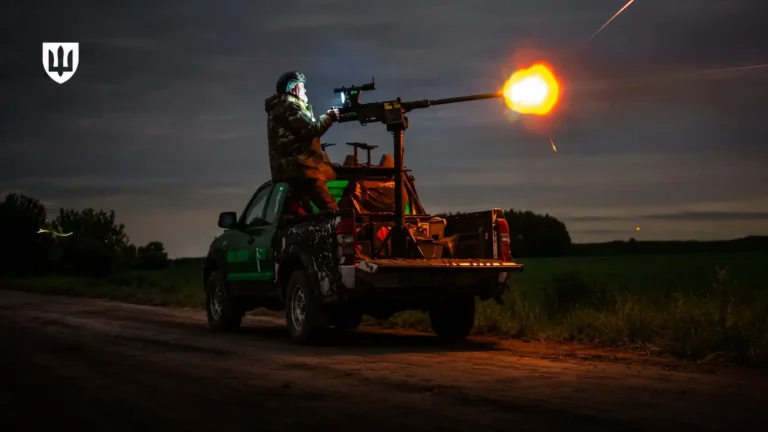
Kongsberg positions DESNA as a complement to NASAMS, operational in Ukraine since 2022, rather than a replacement. The logic is cost exchange. Firing an AMRAAM, a missile designed to kill fighter aircraft, at a one-way attack drone such as the Shahed spends a scarce, expensive round on a cheap target. A mass-produced Ukrainian interceptor cued by the same C2 backbone lets operators reserve AMRAAM-class missiles for cruise missiles and manned aircraft. Sandvik made the same point in Oslo on November 24, saying air defense missiles are in short supply worldwide because of very high demand and that the missiles used in DESNA are cheaper than traditional ones.
“DESNA shows what is possible when we make systems and technology work together,” said Kongsberg CEO Eirik Lie, adding that company employees, working with Ukrainian partners and the armed forces, “have created new air defence capacity in a short time.” Lie described the system as one layer in a Kongsberg portfolio offering protection “against everything from drones to ballistic missiles.”
The industrial model matters as much as the hardware. Interceptor production sits inside Ukraine, outside Western missile production queues. On November 19, Kongsberg also joined Brave Prime, the initiative run by Ukraine’s government-backed Brave1 defense technology cluster, becoming its third foreign member after Airbus and Saab. The agreement opens access to the Brave1 Test in Ukraine framework and to matchmaking with Ukrainian component suppliers.
Analysis: DESNA formalizes a division of labor that is likely to spread: Western primes supply the network, Ukrainian industry supplies magazine depth. For NATO, the model offers a path to lower cost per intercept without waiting on US production lines, and Norway’s plan, announced days earlier, to buy roughly NOK 22 billion worth of NASAMS-compatible air defense missiles for its own forces shows Oslo treating interceptor stocks as a national priority too. The open question is performance. Without disclosed range or engagement data, there is no basis yet to judge how DESNA copes with jet-powered Shahed variants, which Kyiv has identified as a key challenge for its air defense.
Norway’s Ministry of Defense said the next step is to extend DESNA coverage to more parts of Ukraine, without giving numbers or a timeline. During Khmara’s visit to Oslo on November 24, the two ministers also signed a letter of intent allowing the Norwegian Armed Forces to test Delta, Ukraine’s situational awareness and battle management platform. Delta fuses intelligence and surveillance data into real-time maps for military command posts and is already in use with Ukraine’s armed forces; according to NRK, the letter does not involve any exchange of operational data between the two countries. The key unknowns remain the number of systems delivered, the interceptor production rate, and whether the DESNA missile will be offered to other NASAMS operators.