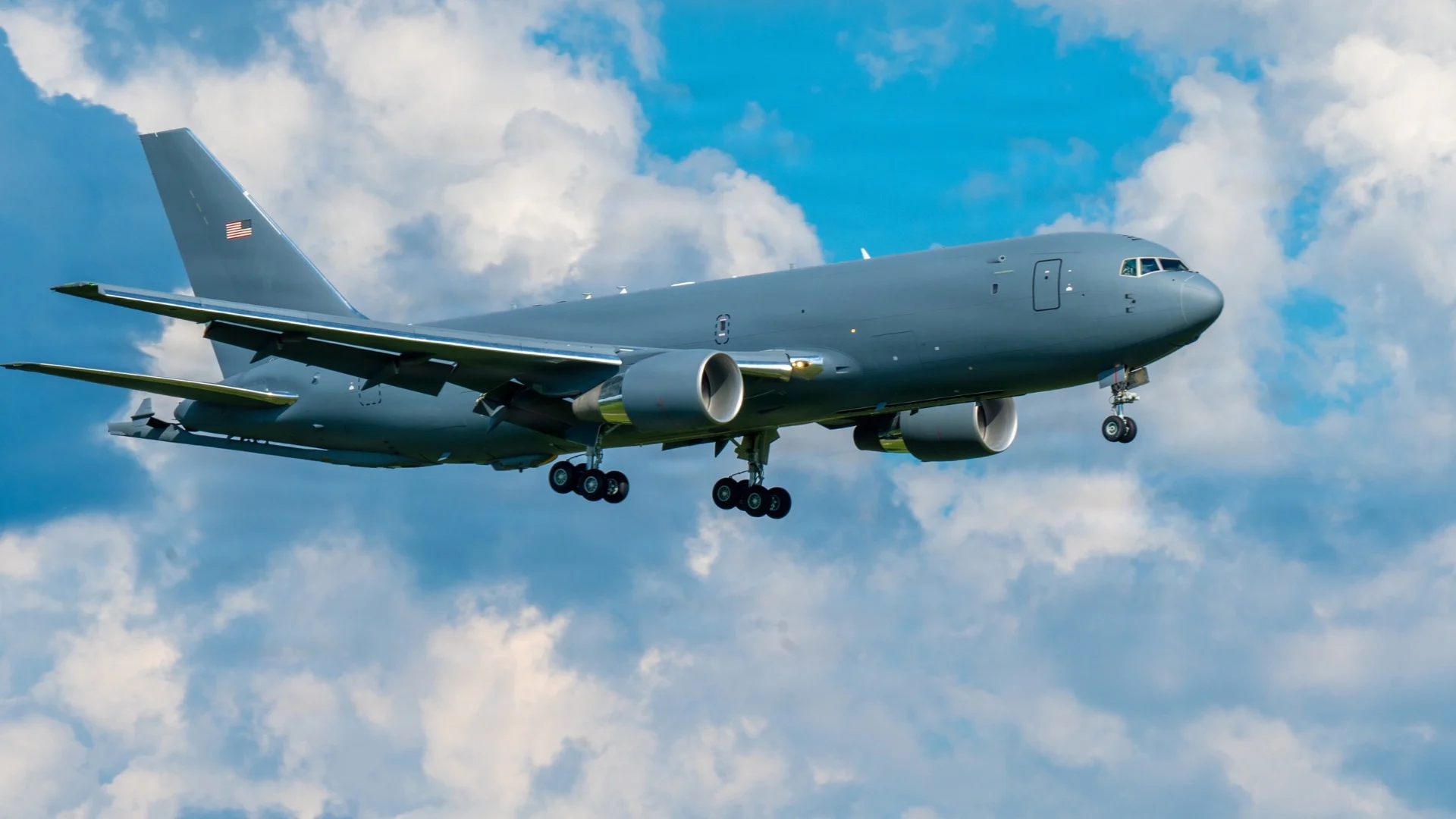
The U.S. Air Force awarded Boeing a $2,819,046,560 contract modification on November 24, 2026, for 15 KC-46A Pegasus tankers under production Lot 13, together with G081 maintenance system support, subscriptions and licenses. Work will be performed in Seattle, Washington, and is expected to be completed by June 30, 2030. The full value comes from fiscal 2027 aircraft procurement funds and was obligated at the time of award, according to the Pentagon contract announcement.
Lot 13 is the final production lot of the original KC-46 program of record, which the Air Force raised from 179 to 188 aircraft, 184 production jets and four test aircraft, the maximum allowed under the 2011 contract. With the award, Boeing counts 203 KC-46As on contract or in service worldwide, including 116 delivered to the Air Force, six to the Japan Air Self-Defense Force and two to the Israeli Air Force. The order arrives as Congress requires the service to grow its tanker inventory from 466 to 502 aircraft by October 1, 2028, while the aging KC-135 fleet absorbs combat losses, including a crash in western Iraq on March 12, 2026, during Operation Epic Fury that killed six crew members.
Inside the KC-46A Lot 13 Contract: Cost, Scope, and Schedule
The award modifies FA8625-11-C-6600, the engineering and manufacturing development contract signed in 2011 that carries the program’s production options. It was issued administratively under new contract FA8609-27-C-B002. The Air Force Life Cycle Management Center at Wright-Patterson Air Force Base, Ohio, is the contracting activity.
Lot 12, awarded in November 2025, was valued at $2,469,937,348 for 15 aircraft, or about $164.7 million per tanker. Lot 13 works out to about $187.9 million per aircraft, an increase of roughly 14% in one year. Both awards bundle aircraft with G081 support, subscriptions and licenses, so neither figure represents a pure flyaway cost, and the announcement does not break out the share of each element.
Boeing has absorbed more than $7 billion in losses on the fixed-price KC-46 development contract, including a $565 million charge reported in January 2026 and linked to higher supply chain costs and production support. Boeing delivered 14 KC-46s in 2025 and targets 19 in 2026. Budget documents show the Air Force expects to receive 20 KC-46s in fiscal 2027 while retiring 20 KC-135s; aircraft bought with fiscal 2027 funds are not expected to begin delivering before October 2029.
767-2C Airframe, Boom, and RVS 2.0: Where the Pegasus Stands
The KC-46A is derived from the Boeing 767-2C, a militarized 767-200 freighter airframe built in Everett, Washington. Publicly available specifications indicate two Pratt & Whitney PW4062 turbofans rated at about 62,000 lbf of thrust each, a maximum takeoff weight of 415,000 lb and a fuel capacity of 212,299 lb. The fly-by-wire boom offloads up to 1,200 gallons per minute, while a centerline drogue system and Wing Aerial Refueling Pods allow the same sortie to serve boom-equipped Air Force receivers and probe-equipped Navy, Marine Corps and allied aircraft. The main deck carries up to 18 463L pallets or 58 passengers. According to Boeing, the Air Force fleet has logged more than 180,000 flight hours since the first delivery in 2019.
The weak point remains the boom operator’s station. The KC-46 still carries five Category 1 deficiencies, two tied to the original Remote Vision System (RVS), which can wash out or distort the image under certain lighting. RVS 2.0, developed with Collins Aerospace, uses 4K cameras and new displays to produce a full-color 3D image; Boeing completed its first phase of flight testing on June 3, 2026. A recovery plan announced in May 2026 targets a gain of more than 20% in aircraft availability by 2030 and converts five early-build aircraft into spare parts sources, but pushes RVS 2.0 fleet arrival to 2028. A redesigned boom telescope actuator is meant to cure the stiff boom that prevents refueling of light receivers such as the A-10.
Analysis: Lot 13 closes the original KC-46 buy without settling the question that matters most for the tanker force: the timing of the Tanker Production Extension, the follow-on purchase of up to 75 additional KC-46s planned at 18 aircraft per year from fiscal 2028 through fiscal 2031. Air Force leaders have told lawmakers they will not sign that extension until Boeing fixes the outstanding deficiencies, starting with RVS 2.0 and the boom actuator. Any further slip opens a funding gap after Lot 13 that would pressure Everett production rates and the long-lead supply chain precisely when Congress is demanding a larger tanker fleet. The 14% unit price increase also signals that the extension will be negotiated from a higher cost baseline.
The next milestones are RVS 2.0 full contact testing with receiver aircraft, expected in 2027, and the extension contract decision, currently targeted for 2028. On the export side, the Air Force raised the ceiling of its 2019 KC-46 post-production support contract from $5.7 billion to $19.1 billion on September 11, 2026, adding Foreign Military Sales scope for Japan, Israel and future partner countries through April 2035. The Lot 13 delivery sequence and actual flyaway cost per aircraft remain undisclosed.