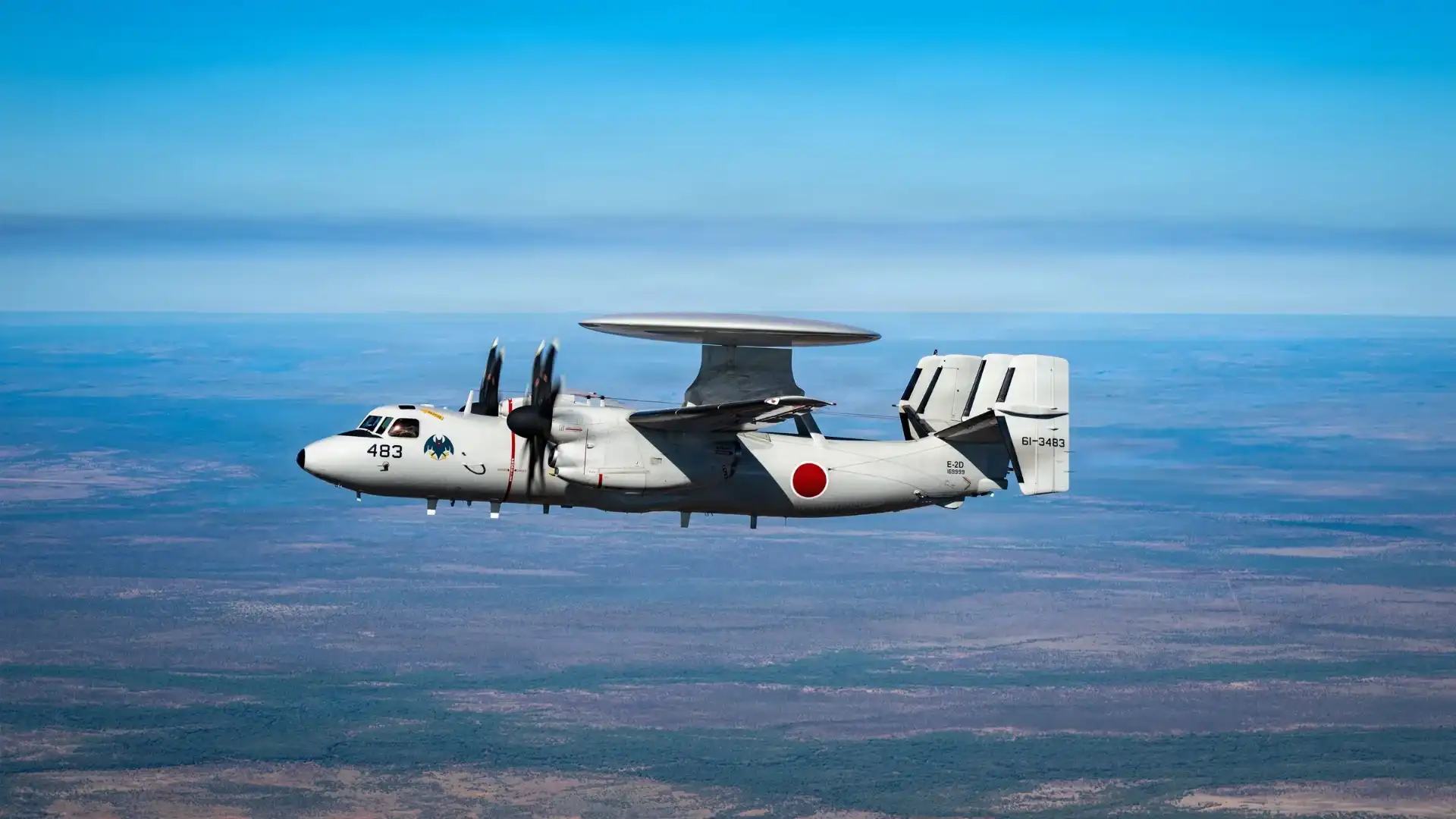
Naval Air Systems Command (NAVAIR) has awarded Northrop Grumman Systems Corp. a $16.4 million Hawkeye sustainment contract for E-2C and E-2D aircraft flown by France, Japan, Taiwan, and Egypt, the Pentagon announced on November 24, 2026. The cost-plus-fixed-fee order, N0001927F1065, is valued at $16,407,820 and issued under basic ordering agreement N0001925G0003, according to the Pentagon contract announcement. It covers in-service and technical support, obligates $6,651,875 in Foreign Military Sales (FMS) funds at award, and runs through October 2033.
The award covers both common and unique requirements, meaning engineering and logistics work shared across the export Hawkeye fleet as well as tasks tied to each customer’s configuration. It arrives as the four operators sit at very different points in the aircraft’s lifecycle. France and Japan are transitioning to the E-2D Advanced Hawkeye, Taiwan is weighing how to modernize an attrited E-2K fleet, and Egypt has reportedly opened talks on a non-US replacement. A single seven-year support vehicle has to bridge all four trajectories.
Inside the Hawkeye Sustainment Contract Work Split
Northrop Grumman will perform 63.9% of the work in Melbourne, Florida, roughly $10.5 million of the total value. Japan accounts for the largest overseas share, with 12.1% each at Misawa Air Base and Tokyo, or 24.2% combined. France follows with 3.2% each in Lorient and Cuers, then Taiwan with 5.3% at Pingtung and Egypt with 0.2% in Cairo, about $33,000. These percentages describe where the work takes place; the announcement does not break out funding by customer.
The cost-plus-fixed-fee structure fits sustainment engineering, where the scope of technical investigations, obsolescence fixes, and field support cannot be fully defined at award. Ordering under an existing basic ordering agreement also lets NAVAIR issue follow-on tasks without competing each one. Roughly $9.76 million of the order’s value remains unobligated and will depend on future FMS funding releases.
The “E-2C/D” scope matters technically. Publicly available specifications indicate the export E-2C Hawkeye 2000 pairs the mechanically scanned AN/APS-145 radar in its 24-foot rotodome with an upgraded mission computer and Advanced Control Indicator Set workstations, powered by two Rolls-Royce T56-A-427 turboprops. The E-2D replaces that sensor with the Lockheed Martin AN/APY-9 ultra-high-frequency radar, which combines mechanical rotation with electronic scanning, and adds upgraded T56-A-427A engines, an all-glass tactical cockpit, and aerial refueling capability. Supporting both standards under one order means sustaining two generations of mission systems on a shared airframe family.
Four Export Hawkeye Fleets at Different Lifecycle Stages
Japan is the largest E-2 operator outside the United States and has flown the E-2C since 1983. Tokyo initially bought 13 E-2Ds, then signed in August 2023 for five more, with delivery of that batch scheduled for Japan fiscal year 2028. The Japan Air Self-Defense Force flies its E-2Ds with the 601st Squadron at Misawa and the 603rd Squadron at Naha, while its remaining E-2Cs are being phased out as deliveries continue.
France operates three E-2C Hawkeye 2000 aircraft with Flottille 4F at Lann-Bihoué naval air base near Lorient, embarking them on the carrier Charles de Gaulle. Paris signed a Letter of Offer and Acceptance in December 2020 for three E-2Ds valued at up to $2 billion. Production of the first French aircraft began at Northrop Grumman’s St. Augustine facility in December 2024, with first delivery scheduled for 2027. The Cuers share points to naval aviation maintenance work in the Toulon area, though the announcement does not specify the facility.
Taiwan’s Republic of China Air Force received six E-2K aircraft, an export E-2C variant, but wrote one off after a November 2022 gear-up landing at Pingtung deemed too costly to repair. Aerospace Industrial Development Corporation (AIDC) and Northrop Grumman signed a memorandum of understanding in February 2024 on a possible E-2K upgrade, and reports in February 2025 described a plan to acquire six E-2Ds instead. Which path Taipei will take remains unresolved in public reporting.
Egypt has flown the E-2C since the late 1980s and upgraded its fleet to the Hawkeye 2000 export standard. Open-source estimates place seven to eight aircraft at Cairo West. In January 2026, Cairo was reported to be continuing negotiations with Saab over the GlobalEye as a replacement.
Analysis: As US Navy carrier air wings have consolidated on the E-2D, export operators of the E-2C increasingly carry the cost of legacy-unique engineering on their own. Bundling four FMS customers into one order pools the common work, from structural and propulsion issues to shared avionics obsolescence, across a fleet that no single small operator could sustain efficiently. The 2033 end date is the telling detail: it spans France’s full E-2C to E-2D transition, Japan’s final E-2D deliveries, and whatever decision Taiwan and Egypt eventually make. For Northrop Grumman, the order keeps its Melbourne engineering base tied to every export Hawkeye operator through the decade, a position that strengthens its hand when replacement or upgrade competitions arrive.
Near-term milestones include delivery of France’s first E-2D in 2027 and Japan’s final five aircraft in fiscal year 2028. Still unknown are the task orders that will draw down the remaining $9.76 million, whether Taiwan commits to an E-2K upgrade or new E-2Ds, and whether Egypt’s reported GlobalEye talks produce a contract that would end its Hawkeye support requirement before 2033.