Royal Air Force P-8A Poseidon maritime patrol aircraft took part in NATO’s Exercise Dynamic Merlin 26, an anti-submarine warfare (ASW) exercise held off the coast of Sweden from November 9 to 13, 2026, the RAF announced on November 23. RAF crews operated alongside warships, submarines and aircraft from eight Allied nations, tracking German and Swedish submarines in one of the Alliance’s most demanding ASW events in the Baltic Sea.
The exercise marks a structural step for NATO’s undersea posture in the region. Run twice before as Playbook Merlin in 2024 and 2025, Merlin is now formally part of Allied Maritime Command’s (MARCOM) Dynamic series, alongside Dynamic Mongoose in the North Atlantic and Dynamic Manta in the Mediterranean. It follows a string of damage incidents involving Baltic subsea cables and pipelines since 2023, which led NATO to launch its Baltic Sentry activity in January 2025 to protect critical undersea infrastructure.
RAF Poseidon Joins Eight-Nation Submarine Hunt in the Baltic
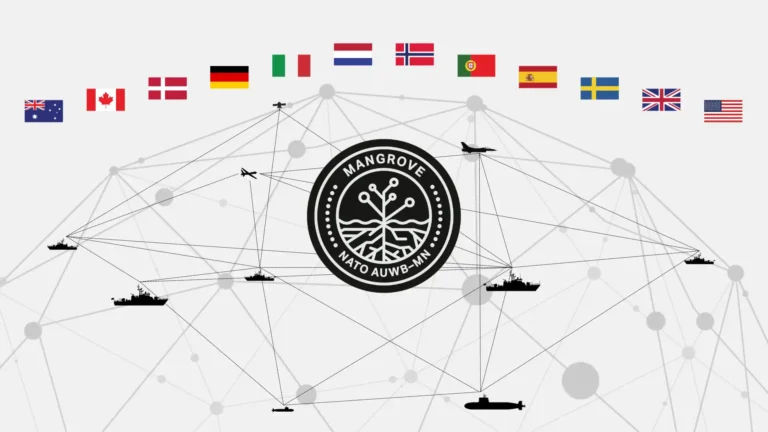
Dynamic Merlin 26 brought together maritime patrol aircraft from the United Kingdom, France, Germany and Sweden with surface units from Canada, Denmark, Finland, Germany, the Netherlands and Sweden. Standing NATO Maritime Group 1 (SNMG1), commanded by French Rear Admiral Nicolas Molitor, sailed with the Dutch combat support ship HNLMS Den Helder as flagship, alongside the German combat support ship FGS Berlin, the Canadian frigate HMCS Ville de Québec, the Danish ASW frigate HDMS Esbern Snare and the Finnish fast attack craft FNS Hamina. One German and one Swedish submarine acted as opposition forces, attempting to evade detection while air and surface units searched for them.
The scenario extended beyond the undersea fight. NATO added counter-drone and counter-missile serials run live and without advance warning: crews knew a threat would come, but not when. The objective was to test how ships of different sizes combine their defenses against threats above, on and below the water at the same time.
For the RAF, the training focused on detecting, monitoring and responding to submarine threats while building the interoperability allied forces need in a crisis. The Officer Commanding 120 Squadron described the event as training with NATO partners “in a challenging and demanding environment.”
“Anti-submarine warfare relies on close cooperation between forces operating in the air, on the surface and beneath the sea.”
Poseidon MRA1 Sensor Suite and the Baltic Acoustic Challenge
The RAF operates nine Poseidon MRA1 aircraft, the UK designation for the Boeing P-8A, from RAF Lossiemouth in Scotland, where 120 and 201 Squadrons fly the type. Publicly available specifications indicate the aircraft is derived from the Boeing 737-800 airframe and powered by two CFM International CFM56-7B turbofans, with a maximum speed of about 490 knots, a service ceiling of 41,000 feet and roughly four hours on station at a radius of 1,200 nautical miles. Its sensor fit includes the Raytheon AN/APY-10 multi-mission radar, an electro-optical and infrared turret and an acoustic processing system fed by up to 129 sonobuoys. Armament carried in the internal weapons bay includes the Mk 54 lightweight torpedo.
That sensor mix matters in the Baltic, among the hardest ASW environments NATO trains in. With an average depth of roughly 55 meters, the seabed enters every acoustic calculation. Cold, fresher river outflow over saltier deep water creates sharp temperature and salinity layers that bend and trap sound, while dense commercial traffic adds noise. Rear Admiral Johan Norlén, Chief of the Royal Swedish Navy, identified the confined geography as the main difficulty. A fast, high-endurance aircraft able to seed and monitor large sonobuoy fields, then hand contacts to frigates and helicopters, partly offsets those limits by covering area quickly and cueing shorter-range sensors.
Analysis: Merlin’s elevation into the Dynamic series signals that NATO now treats the Baltic as a standing ASW theater rather than a seasonal training box, with Sweden’s submarine force and littoral expertise folded into Alliance planning. For the UK, the commitment adds demand on a nine-aircraft Poseidon fleet that also covers the North Atlantic, the Greenland-Iceland-UK gap and the protection of Royal Navy ballistic missile submarines. That pressure explains the value of the cross-servicing arrangement the UK and Norway announced on November 18, 2026, which allows each nation’s technicians to service the other’s P-8As and widens basing options during deployments. The exercise also confirms that ASW forces are now expected to fight through drone and missile threats while hunting submarines, not in isolation from them.
Neither the RAF nor MARCOM has published results from Dynamic Merlin 26, including sortie counts or the number of submarine contacts prosecuted. Commander Task Force Baltic, NATO’s Baltic maritime headquarters led by Germany from Rostock since October 2024, is due to rotate to Poland in 2028 and later to Sweden, whose Navy chief presented the move as a sign of Swedish commitment to the Alliance. The next markers for the RAF fleet are the 2027 cycle of MARCOM’s Dynamic exercises and the first operational use of UK-Norway cross-servicing.