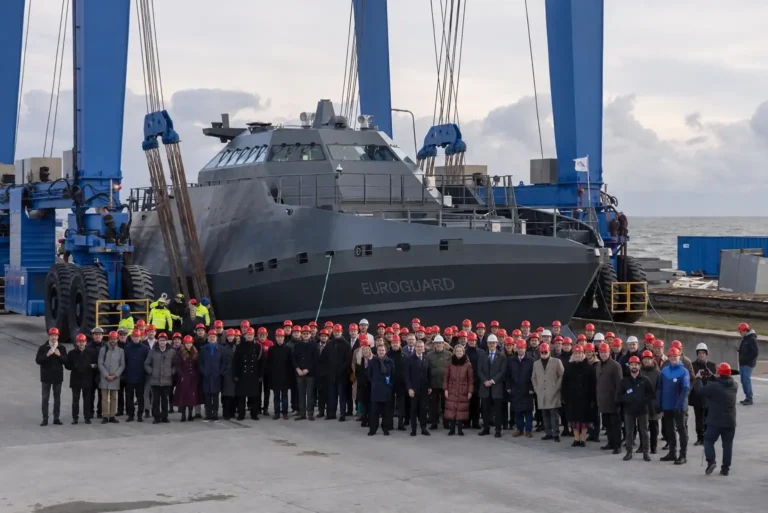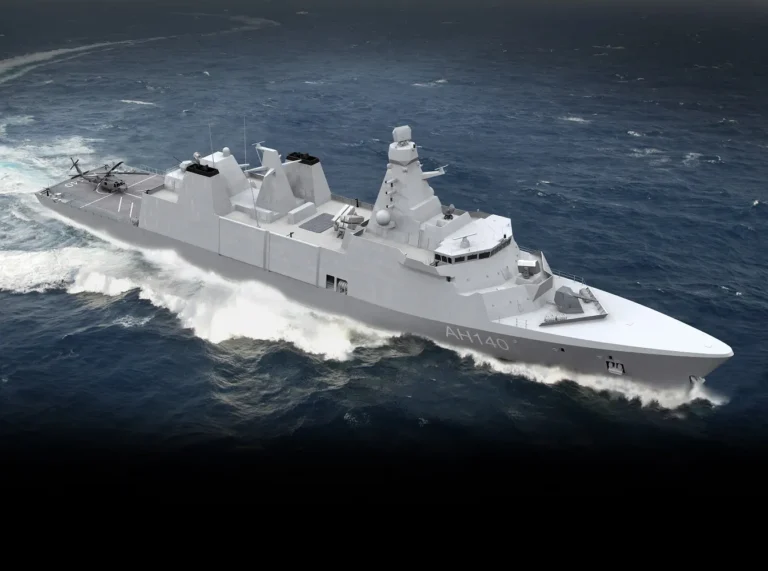
Poland’s PGZ Naval Shipyard (PGZ Stocznia Wojenna) in Gdynia laid the keel of the future ORP Huragan on November 24, 2026, the third and final multi-role frigate of the Polish Navy’s Miecznik (Swordfish) program. Magdalena Sobkowiak-Czarnecka, secretary of state at the Ministry of National Defence, attended the ceremony, which puts all three Project 106 hulls past the keel-laying stage.
The milestone comes seven months after steel was cut for Huragan on April 28, 2026, and three months after the lead ship, the future ORP Wicher, was launched on August 13, 2026. The ministry calls Miecznik the largest shipbuilding undertaking in the history of the Polish Navy. The three frigates will replace a surface force whose backbone remains two former US Navy Oliver Hazard Perry-class frigates transferred in 2000 and 2002. In a letter read at the ceremony, Deputy Prime Minister and Defence Minister Władysław Kosiniak-Kamysz said the Baltic Sea “has special strategic importance today,” tying the program to the security of sea lanes, critical infrastructure, and Poland’s standing in NATO.
Miecznik Frigate Design: Arrowhead 140 Hull and Combat Suite
Miecznik derives from Babcock International’s Arrowhead 140 design, itself based on the Royal Danish Navy’s Iver Huitfeldt-class hull and the parent of the Royal Navy’s Type 31 frigates. Selected in March 2022, the Polish variant has been heavily adapted. Shipyard figures give an overall length of about 138 meters, a beam of about 20 meters, and a maximum displacement of roughly 7,000 tonnes. Propulsion is a combined diesel and diesel (CODAD) plant of four MTU 20V8000 M71 engines delivering about 32.8 megawatts to two shafts, for a top speed of 28 knots and a range of about 8,000 nautical miles. The core crew numbers 120, with berths for roughly 60 additional personnel.
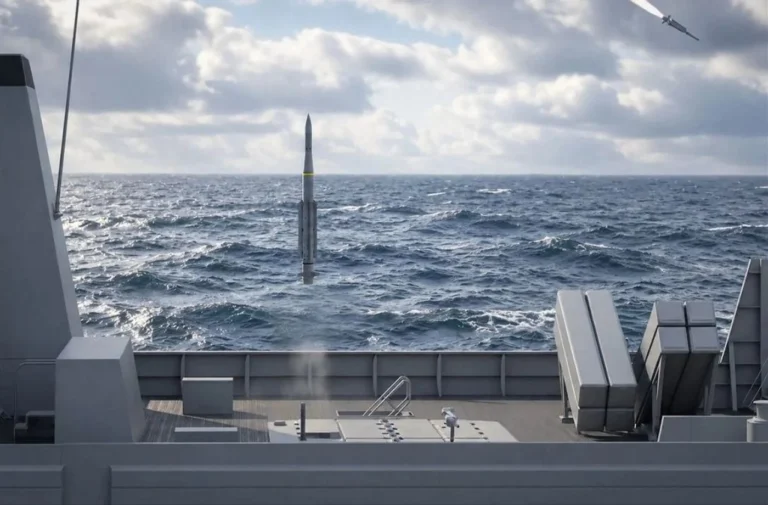
Each frigate will receive an Integrated Mission System covering the bridge, communications, platform management, and the combat system with its sensors and effectors, according to the ministry. Thales supplies the TACTICOS combat management system, air surveillance and fire control radars, sonars, and 360-degree infrared sensors. Air and missile defense centers on a 32-cell Mk 41 vertical launch system able to quad-pack up to 128 MBDA Common Anti-air Modular Missiles (CAMM). CAMM-ER is planned, and a medium-range CAMM-MR is under joint UK-Polish development. Publicly available specifications indicate eight Kongsberg Naval Strike Missiles for anti-ship and land-attack missions, a 76 mm main gun, two 35 mm close-in weapon systems, and lightweight torpedoes for anti-submarine warfare.
Build Schedule to 2031 and the Baltic Threat Backdrop
Huragan, pennant number 276, follows a tightly sequenced build in Gdynia. Wicher (274) had her keel laid on January 31, 2024, and is now fitting out ahead of port trials in September 2028, sea trials in June 2029, and delivery that November. Burza (275) had steel cut on May 5, 2025, and her keel laid on December 18, 2025, with launch targeted for September 2027. Current planning calls for Huragan to launch in 2028 and join the fleet by the end of 2031, closing out the program. The partner CRIST shipyard in Gdynia builds the bow sections. The name revives an improved Grom-class destroyer ordered in 1939 but never completed because of the war.
The ministry lists the frigates’ missions as countering threats at sea, protecting sea lines of communication and critical infrastructure, and operating with allied fleets. That task set mirrors Poland’s offshore exposure, from the Baltic Pipe gas link to offshore wind farms and subsea cables. The air threat was explicit at the ceremony. Sobkowiak-Czarnecka referred to recent violations of Polish airspace, after Russian missiles came down in southeastern Poland on November 20, and urged citizens not to silence government alert messages. “Ignoring such an alert can even cost a life,” she said.
Analysis: The CAMM-centric loadout matters beyond the ship itself. Poland is fielding the same missile family ashore through its Narew and Pilica+ air defense programs, giving the Navy common munitions, logistics, and a production base shared with the Army. Against the low-flying cruise missiles and jet-powered drones that keep crossing into Polish airspace, a deep magazine of quad-packed CAMM is a sound fit. Genuine area air defense, however, depends on CAMM-MR, which remains in development. Until it arrives, Miecznik will be a capable escort and infrastructure guardian rather than a fleet air defense ship.
The next milestones are Burza’s launch in September 2027, Huragan’s launch in 2028, and Wicher’s harbor and sea trials in 2028 and 2029. The open question is whether discussions between PGZ and the Armaments Agency on additional Miecznik-class frigates, disclosed at Wicher’s launch, turn into a firm order before the Gdynia production line runs dry.