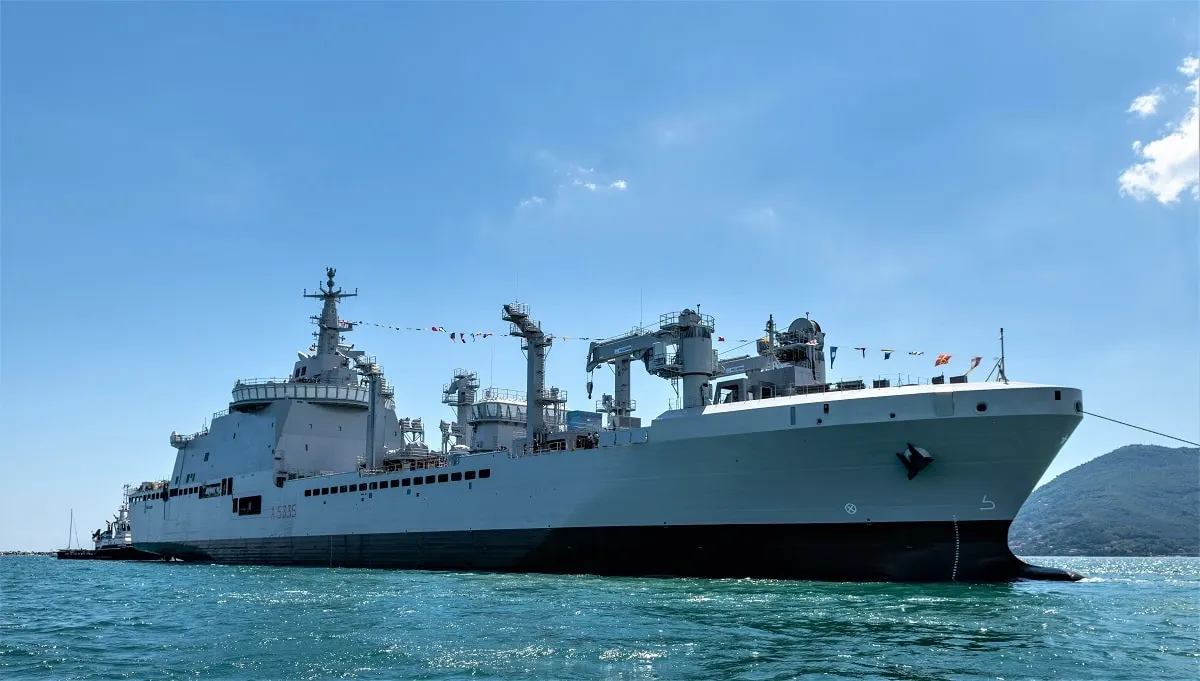
Fincantieri has signed a contract worth approximately €500 million to build a third Logistic Support Ship (LSS) for the Italian Navy, extending the Vulcano class to three hulls. The amendment to the existing LSS program, concluded with the Organisation for Joint Armament Cooperation (OCCAR) on November 26, 2026, at Fincantieri’s Muggiano Integrated Shipyard near La Spezia, includes about €88 million subject to options. The ship will be built entirely at the Castellammare di Stabia shipyard near Naples, with delivery scheduled by 2030.
The order formalizes the third unit foreseen as an option in the December 2021 contract for the second ship, Atlante, which was valued at about €410 million including the combat system. It follows the delivery of lead ship Vulcano (A 5335) in March 2021 and of Atlante on December 19, 2025. Funding comes from the multi-year Naval Law, Italy’s 2014 fleet renewal framework, whose 2015 OCCAR tranche covered six offshore patrol vessels (PPA) and the first LSS.
Italian Navy LSS Contract Structure and Industrial Workshare
The contract is executed by a Temporary Grouping of Companies (Raggruppamento Temporaneo di Imprese, RTI) led by Fincantieri, with Leonardo as partner. Fincantieri’s share amounts to about €414 million, including about €37.5 million in options. Leonardo’s share is about €85 million, of which about €50 million is optional. Neither company has detailed publicly what the optional packages cover; with more than half of Leonardo’s portion held in options, a share of the mission systems content appears to remain subject to later decisions by the Italian Navy.
OCCAR Director Joachim Sucker and Eugenio Santagata, General Manager of Fincantieri’s Naval Vessels Division, signed the amendment in the presence of Admiral Fabio Gregori, Deputy Chief of Staff of the Italian Navy; Vice Admiral Cristiano Nervi, Director of the Naval Armaments Directorate (NAVARM); and Matteo Cardone, Land & Sea Business Deputy Managing Director of Leonardo’s Electronics Division.
Fincantieri will rely heavily on in-house suppliers. Fincantieri NexTech will deliver the ship’s automation systems and cybersecurity infrastructure, while the group’s Mechanical Systems and Components hub will supply shaft lines, steering gear, bow thrusters, stabilizing fins and other handling equipment.
Fincantieri Chief Executive Pierroberto Folgiero said the order confirms “the strength of the growth trajectory” the company has set out for its defense business, and said it gives concrete substance to commercial prospects announced in recent months. For Castellammare di Stabia, which built Atlante and has produced sections for the French Navy’s Jacques Chevallier-class ships, the contract secures a naval workload through the end of the decade.
Vulcano-Class Design: Propulsion, Cargo Capacity, and Combat System
Like the first two units, the third ship will measure about 193 meters in length with a maximum beam of 24 meters, displace about 27,500 tons and reach a maximum speed of about 20 knots, according to Fincantieri. The company says the new unit will draw on developments from other Italian naval renewal programs to provide a more modern platform for coordinating and supporting naval operations.
Publicly available specifications for the class indicate a hybrid propulsion arrangement built around two MAN 20V32/44CR diesel engines rated at a combined 24,000 kW, supplemented by two 1.5 MW electric motors for low-speed transit, driving two shafts. Cargo capacity reaches up to 15,500 tons, including roughly 7,650 tons of F76 naval diesel and about 3,240 tons of JP5 aviation fuel, alongside fresh water, ammunition, food and spare parts. The ships also carry an 800-square-meter hospital facility with operating rooms, a flight deck and hangar for two AW101 helicopters, and workshops for repairs at sea.
The third unit will be fitted with the SADOC5 combat management system, enhanced network protection with a higher security classification, and expanded satellite communications, which require corresponding modifications to the platform. Those upgrades treat the tanker as a networked node of the task group rather than a passive logistics hull. Fincantieri has described Atlante as equipped to recover vehicles and materials from the surface and seabed and to serve as a base for intelligence and electronic warfare operations, roles the class design supports.
Analysis: A third LSS gives the Italian Navy a replenishment fleet built around a single modern design, enough to keep one ship deployed with a carrier or amphibious group around Cavour or Trieste while the others cycle through maintenance and training. Replenishment at sea sets how long a European task group can operate far from home ports. The firm portion of the order, about €412 million, sits close to the 2021 Atlante contract value, although the two packages are not directly comparable from public data. Commonality with France’s four Jacques Chevallier-class ships, also managed through OCCAR, gives the two largest navies on NATO’s southern flank a shared logistics design, easing training, spares support and interoperability.
Key unknowns remain the ship’s name, the scope of the optional packages and the intermediate milestones, including steel cutting and launch. Fincantieri has not said whether the unit will replace a legacy tanker or expand the fleet. Delivery by 2030 would bring Italy’s LSS line to three ships, while France’s third ship, Émile Bertin, is due to join Brest in 2027 and the fourth, Gustave Zédé, has slipped beyond 2030.