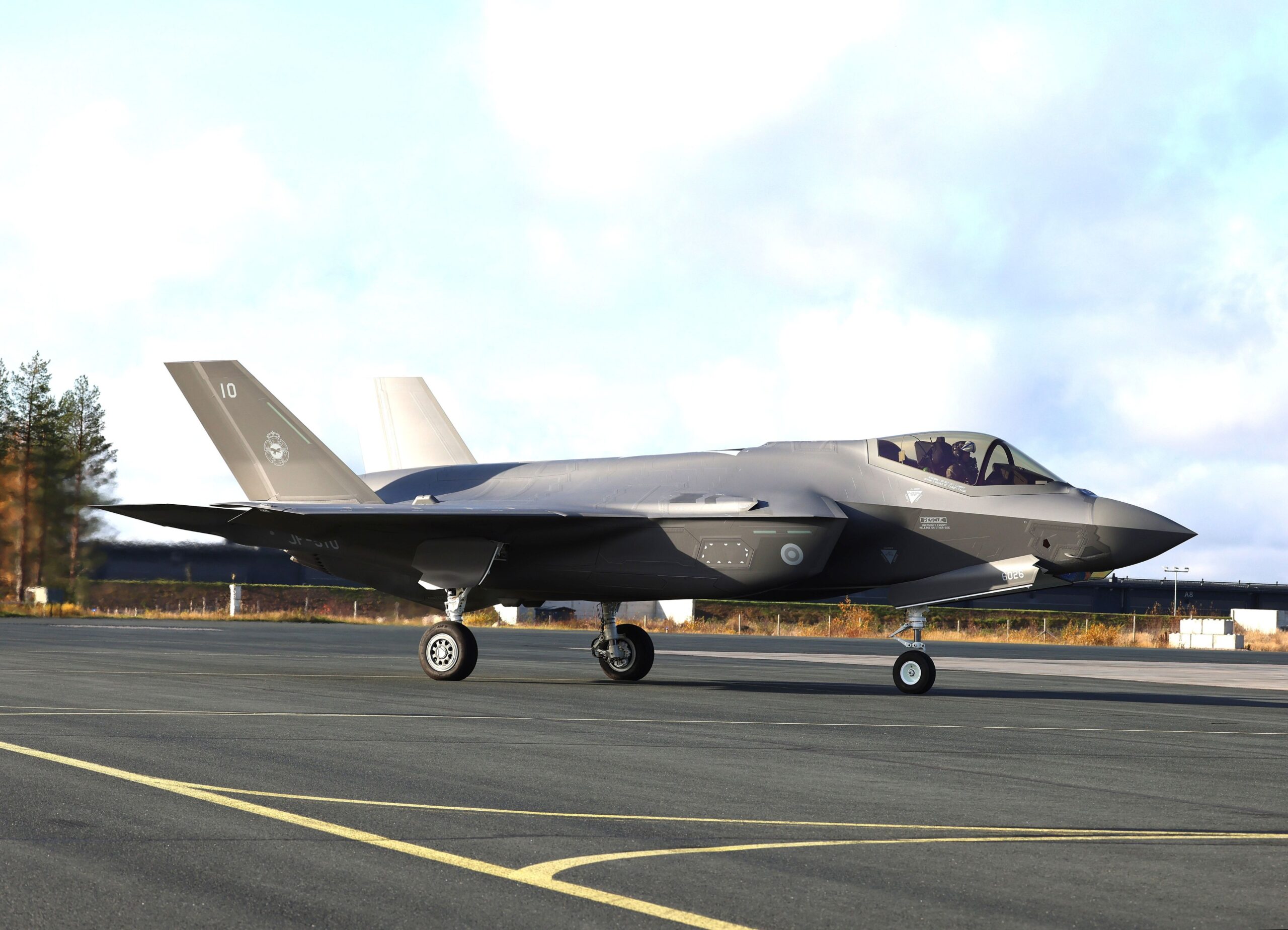
The Finnish Air Force presented its first two F-35A Lightning II fighters to invited guests and media at Lapland Air Wing in Rovaniemi on October 1, 2026, in a ceremony that included the first F-35 flight by a Finnish pilot in Finland. The aircraft, JF-510 and JF-512, are the first of 64 F-35As ordered to replace the service’s F/A-18C/D Hornet fleet.
The event formalizes an arrival completed on September 18, when U.S. Air Force pilots ferried both jets from Lockheed Martin’s Fort Worth, Texas, facility via Lajes Air Base in the Azores, refueling in flight before Finnish Hornets escorted them into Rovaniemi. Finland selected the F-35A under its HX Fighter Program on December 10, 2021, in an €8.378 billion package including €4.703 billion for the aircraft and €754.6 million for an initial AIM-120 AMRAAM and AIM-9X Sidewinder buy. Lockheed Martin says Finland has now received 10 of its 64 jets; the first eight, from Production Lot 17, remain at Ebbing Air National Guard Base, Arkansas, for training.
Finland F-35A Fleet Plan: Rovaniemi First, Rissala in 2028
Lapland Air Wing, whose flying unit is Fighter Squadron 11 (HävLLv 11), is the first Finnish base to operate the type. The Finnish Air Force plans for the wing to fly only F-35s by early 2028, the point it defines as initial operational capability (IOC). Karelia Air Wing at Rissala, near Kuopio, is due to finish most of its infrastructure work in 2027 and receive its first jets during 2028. Deliveries run through the end of 2030, when the service targets full operational capability (FOC); Hornets and F-35As will fly side by side until then. The national designation JF, for Joint Fighter, with serials JF-501 to JF-564, signals its intended role supporting the Army and Navy.
Training moves home on a fixed schedule. U.S.-based instruction began at Eglin Air Force Base, Florida, in 2025 and continues at Eglin and Ebbing until early 2028. Maintainer training opens in Rovaniemi in late 2026 and pilot training in January 2027, led by Finnish instructors qualified in the United States with support from U.S., Norwegian, and Danish personnel.
Infrastructure is the slower constraint. Roughly €150 million was earmarked for new maintenance, training, and storage facilities and airfield works at Rovaniemi, while Satakunta Air Wing at Pirkkala and the Air Force Academy at Tikkakoski are being modified to meet F-35 program security requirements. The HX envelope also reserved €777 million for infrastructure and related costs and €823.8 million for the final optimized weapons package, bringing the program to about €10 billion. Industrially, Patria became the first company other than Lockheed Martin to build the F-35 forward fuselage earlier in 2026 and performs F135 engine final assembly at Linnavuori.
Sensors, Fuel, and Weapons: What the F-35A Adds Over the Hornet
Finland ordered the F-35A in the Block 4 configuration. Publicly available specifications indicate a 15.7 m airframe with a 10.7 m wingspan, powered by a single Pratt & Whitney F135-PW-100 in the 43,000 lbf thrust class with afterburner, for a top speed of Mach 1.6 and a 9 g limit. Internal fuel of 18,250 lb (8,278 kg) is about 70 percent more than the F/A-18C carries internally, and the manufacturer quotes a combat radius above 590 nm (about 1,090 km) on internal fuel. Over Lapland, that means longer combat air patrols without external tanks that add drag and radar signature.
The sensor suite drives the capability case. An active electronically scanned array radar (the AN/APG-81, with the AN/APG-85 introduced on later production lots), the AN/AAQ-37 Distributed Aperture System, the AN/AAQ-40 Electro-Optical Targeting System, and the AN/ASQ-239 electronic warfare suite feed a fused picture that can be shared with ground and naval units. Maj. Gen. Timo Herranen, Commander of the Finnish Air Force, said at the ceremony that the type was chosen because it is designed for an operating environment like Finland’s.
Armament spans a 25 mm GAU-22/A cannon with 180 rounds, roughly 5,700 lb of stores carried internally in stealth configuration, and up to 18,000 lb with external stations. Finland’s 2021 package lists the AIM-120 AMRAAM, AIM-9X, the JDAM family, Small Diameter Bomb I and II, the Joint Strike Missile, and the AGM-158B JASSM-ER, which extends the stand-off reach Finland first gained with the AGM-158A on its upgraded Hornets. The internally carried Joint Strike Missile adds an anti-ship option relevant to Baltic Sea contingencies.
Analysis: Basing the first jets at Rovaniemi is an operational choice. It is Finland’s northernmost fighter base and the closest to Russia’s Northern Fleet installations on the Kola Peninsula, and Norwegian and Danish F-35 operators are already embedded in Finland’s training pipeline. By 2030, Finland, Norway, and Denmark will fly a common fifth-generation fighter, enabling shared weapons stocks, cross-servicing, and dispersed basing inside NATO. The risk sits in the transition: until FOC, Finland must split pilots, maintainers, and budget between two fighter types while keeping Hornets on quick reaction alert.
Colonel Tuukka Elonheimo, who took command of Lapland Air Wing on October 1 after leading Finland’s Foreign Liaison Office to the F-35 Joint Program Office in Washington, will oversee the conversion. The next markers are the first in-country pilot course in January 2027 and IOC in early 2028. The delivery cadence for the remaining 54 jets and program-wide Block 4 software maturity remain the key unknowns.