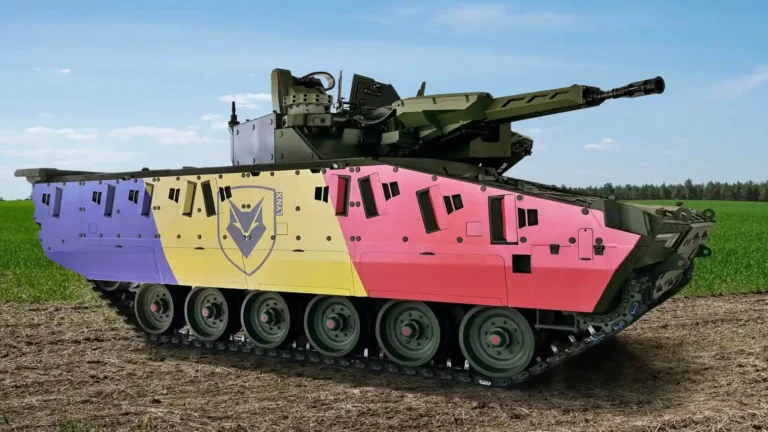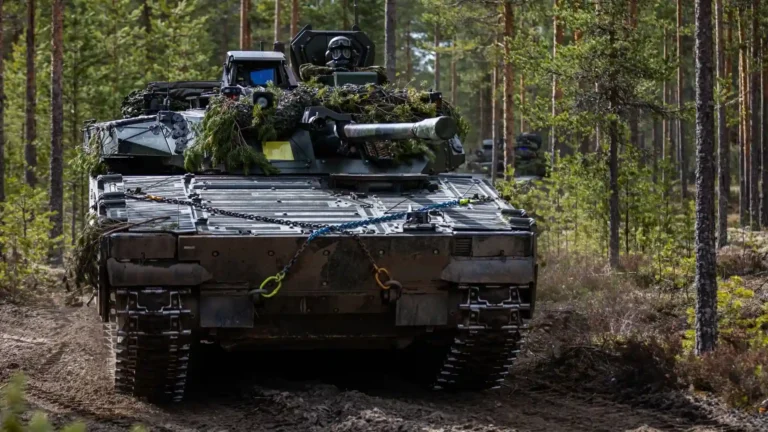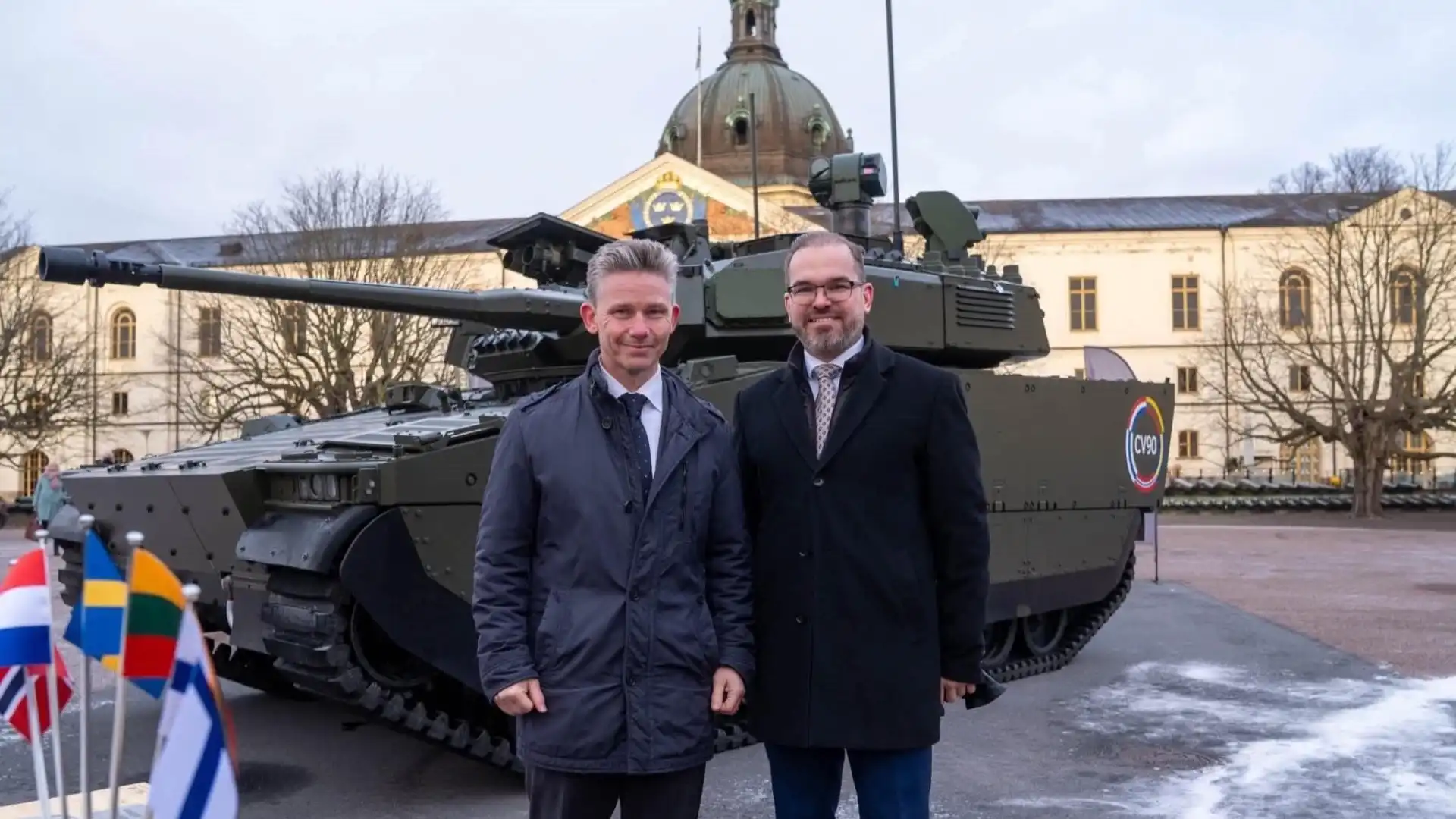
Lithuania signed a €1.3 billion contract on November 27, 2026, for 100 CV90 MkIV infantry fighting vehicles (IFVs) built by BAE Systems Hägglunds, giving the Lithuanian Land Forces their first tracked IFV. Minister of National Defence Robertas Kaunas signed the deal in Stockholm as part of a five-nation joint procurement with Sweden, Finland, Norway and the Netherlands, and Vilnius says it will be the first participant to receive vehicles.
The order is one of several heavy-equipment buys built around the national division Lithuania intends to field by 2030. The Ministry of National Defence said the joint procurement strengthens that division, interoperability with NATO Allies and industrial cooperation, “including CV90 assembly” in Lithuania. Across the five nations, BAE Systems holds contracts for more than 400 vehicles worth about $6 billion (€5.5 billion), placed under separate national purchase order agreements that reference a single framework agreement, with Sweden acting as lead nation. Finland’s share alone covers 160 vehicles for €1.955 billion before VAT, with an option for 100 more.
Lithuania CV90 MkIV Order Measured Against the Current Fleet
Until now, Lithuania’s mechanized infantry has rested on wheels. Its backbone is the Vilkas, the national variant of the ARTEC Boxer 8×8: 89 serial vehicles and two prototypes delivered between 2019 and December 2023 under a programme costed at about €670 million. They equip the Grand Duke Algirdas Mechanised Infantry Battalion and the Grand Duchess Birutė Uhlan Battalion of the Iron Wolf Mechanised Infantry Brigade. A follow-on batch of 27 Vilkas, ordered through the Organisation for Joint Armament Cooperation (OCCAR), is due between 2027 and 2029.
Below that tier sits a fleet of second-hand, US-designed M113 tracked armored personnel carriers, which Chief of Defence General Raimundas Vaikšnoras described in May 2026 as physically and technologically obsolete. Their replacement is the Patria 6×6: the State Defence Council approved up to 936 vehicles through the Common Armoured Vehicle System (CAVS) programme, with a contract expected in 2027, about 300 vehicles by 2030 and funding planned through 2036.
The CV90 adds the tracked tier the army has never had. Planning presented to the State Defence Council in October 2024 called for tracked IFVs to equip two battalions. These will operate alongside 44 Leopard 2A8 main battle tanks ordered from KNDS Deutschland in December 2024 for about €950 million, which form Lithuania’s first armored unit. Under a December 2025 agreement, up to 41 of those tanks will be assembled in Kaunas, with all deliveries due by 2030. Together, the Leopard 2A8 and CV90 give the division a tracked combined-arms core with cross-country mobility that the wheeled Vilkas battalions cannot match in forested, wet terrain.
CV9035 MkIV Nordic Edition Specifications Compared With Vilkas
All five nations are buying a common configuration, the CV9035 MkIV Nordic Edition. Publicly available specifications indicate the MkIV introduces the modular D-series turret, offered with either a 30/40mm Bushmaster II or a 35/50mm Bushmaster III cannon; the CV9035 designation points to the 35mm option. Two anti-tank guided missiles sit in a twin launcher concealed inside the turret. Power comes from a new 1,000 hp Scania engine coupled to an upgraded X300 transmission, and the gross vehicle weight limit rises from 35 to 37 tonnes, margin that can be spent on armor or mission equipment.
The vehicle electronics follow NATO Generic Vehicle Architecture (NGVA) under STANAG 4754, which the manufacturer says will accept machine-learning, augmented-reality and 3D digital mapping applications as they mature. Neither the ministry nor BAE Systems has detailed Lithuania’s armor package, active protection system or missile type, and those choices remain unconfirmed.
Against the Vilkas, the gain is less in raw firepower than in mobility and growth margin. The Vilkas already carries a 30mm Mk44S cannon in a Rafael Samson turret with Spike LR missiles. The CV90 gives up the Boxer’s road speed and operational range in exchange for tracked cross-country performance and a larger-caliber gun. On price, the Lithuanian contract works out to roughly €13 million per vehicle, close to Finland’s €12.2 million, though neither figure separates the vehicles from spares, training and support packages.
Analysis: The contract matters as much for what it standardizes as for the 100 hulls. With the CV90, Leopard 2A8, Vilkas and Patria 6×6, Lithuania is converging on the same vehicle families that its Nordic, Dutch and German partners operate or have ordered, including the German armored brigade being stood up on Lithuanian soil. That commonality simplifies spares, training and wartime cross-servicing on NATO’s northeastern flank. The cost is concentration: four armored fleets arriving or expanding between 2027 and 2030 will compete for drivers, gunners and maintainers in a small force, while local assembly lines must ramp up in parallel.
Minister Kaunas said most of the 100 vehicles should arrive by 2030 and that talks with the manufacturer continue on completing the full order by then; earlier ministry guidance placed first deliveries in 2028. The next markers are disclosure of Lithuania’s industrial workshare, including where CV90 assembly and servicing will take place, and the national configuration. Estonia, a signatory to the June 2025 statement of intent, was not among the five nations that signed on November 27.