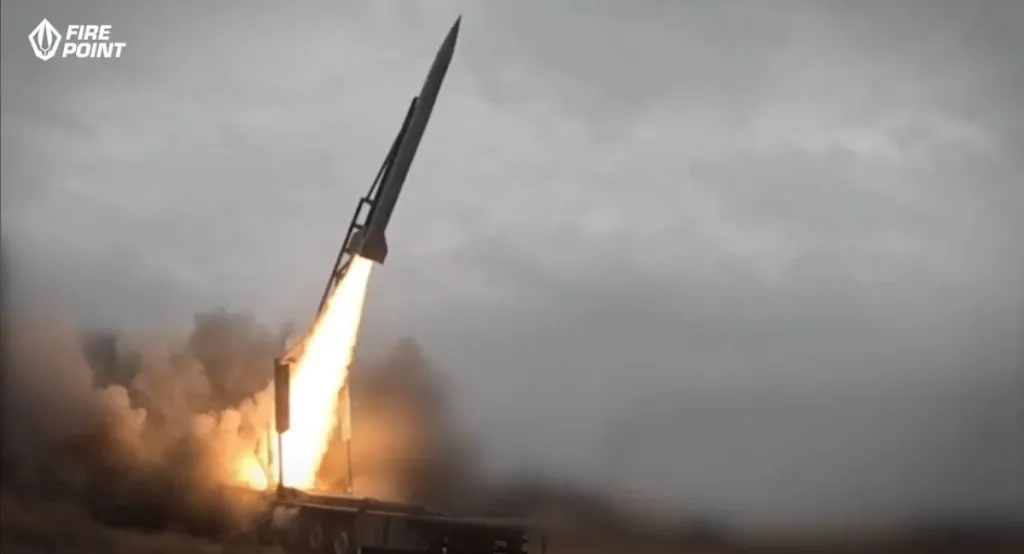
Ukraine has used its domestically developed FP-7 tactical ballistic missile in combat for the first time, President Volodymyr Zelensky announced on October 1, 2026, releasing video of a nighttime launch. “Ukrainian tactical ballistic missile. FP-7. First combat use. Thank you for the result. Next up: production,” Zelensky wrote. Kyiv has not disclosed the target, launch area, or number of missiles fired, and the claim has not been independently verified.
The announcement caps a 13-month sprint for Fire Point, maker of the FP-1 strike drone and FP-5 Flamingo cruise missile, which unveiled the FP-7 and larger FP-9 at the MSPO exhibition in Kielce, Poland, in September 2025. Footage of the first FP-7 test launches followed on February 27, 2026. For a military that has relied on finite stocks of U.S.-supplied Army Tactical Missile System (ATACMS) rounds, an indigenous ballistic weapon with no partner-imposed targeting restrictions narrows a long-standing gap with Russia’s Iskander-M arsenal.
Inside the FP-7 Ballistic Missile: 48N6 Roots and ATACMS Comparison
Fire Point describes the FP-7 as a ground-launched, solid-propellant ballistic missile with a composite airframe intended to cut weight and extend range. The company’s published figures give a maximum range of up to 200 kilometers (124 miles), a 150-kilogram (331-pound) warhead, a top speed of 1,500 meters per second, or roughly Mach 4.4, an apogee of 65 kilometers, and a maximum flight time of 250 seconds. Some reporting has cited a range closer to 250 kilometers; neither figure has been independently established.
Guidance relies on an inertial navigation system, and Fire Point claims a circular error probable (CEP) of 14 meters, a demanding figure for a purely inertial solution at 200 kilometers. The company has not said whether satellite navigation aiding or a terminal seeker supplements the inertial package, a material question given dense Russian electronic warfare.
Aerodynamically, the FP-7 draws on the Soviet-era 48N6 interceptor of the S-300 and S-400 systems; Fire Point says it replicates the 48N6 layout and control principles with different guidance and flight-control hardware. Publicly available specifications for the 48N6 family indicate a round about 7.5 meters long with a launch mass near 1.8 metric tons. Fire Point has not confirmed the FP-7’s dimensions, mass, or launcher configuration.
Against the U.S. M57 unitary ATACMS, which publicly available specifications credit with roughly 300 kilometers of range and a warhead near 225 kilograms, the FP-7 trades reach and payload for domestic supply. Russia’s 9M723 Iskander-M, rated at up to 500 kilometers with a warhead of about 480 kilograms, outclasses it on both counts. The FP-7 is instead sized for air defense sites, drone launch areas, command posts, and logistics nodes in Russia’s operational rear.
From FP-7 to FP-9: Fire Point’s Production Push and Interceptor Spinoff
Zelensky’s statement names production as the next step, but Ukraine has disclosed no FP-7 inventory, production rate, or delivery schedule. Fire Point chief executive Iryna Terekh said in September 2026 that the missile had entered codification, Ukraine’s formal process for clearing a weapon for military use, after roughly two years of development costing about $200 million for research and initial production setup. At MSPO 2026, she said service entry was weeks away.
Fire Point says it grew from 18 employees in 2023 to about 2,200 by September 2025, spread across dispersed production sites inside Ukraine. It has also announced solid propellant production plans in Denmark, near Skrydstrup Air Base, and Diehl Defence has confirmed plans to build the Flamingo in Germany. Solid motor capacity is the binding constraint on any ballistic program, and the larger FP-9 has pushed Fire Point to develop new capability for large solid-rocket motors.
The FP-9 is the deep-strike follow-on. Company figures list a range of up to 855 kilometers, a speed of 2,200 meters per second, an 800-kilogram warhead, an apogee of 70 kilometers, and 20-meter accuracy, with development targeted for completion by late 2026. Those numbers would place it in the Iskander-M’s class and bring Moscow within reach of launch sites in Ukraine, but they remain company claims.
Fire Point is also adapting the FP-7 airframe into the FP-7.X, a surface-to-air ballistic missile interceptor developed under Freyja, a European initiative to field a lower-cost ballistic missile defense round in larger numbers. The initial version is planned with a blast-fragmentation warhead, with hit-to-kill variants to follow. A first Freyja system test is reportedly planned for the first half of 2027. Fire Point’s stated ambition of thousands of interceptors per year has not been demonstrated.
Analysis: The FP-7’s operational value lies less in its specifications than in sovereign control over its use. A 150-kilogram warhead delivered at speeds up to Mach 4.4, with a flight time of about four minutes, gives Kyiv a faster, harder-to-intercept option than one-way attack drones against time-sensitive targets such as S-400 batteries, drone launch sites, and ammunition depots. Because Ukraine controls the supply chain, no partner can veto targets inside Russia. Its effect will scale with volume, however: sustained salvos, not occasional launches, would force Moscow to thin long-range air defense coverage over rear-area industry.
The next indicators are a disclosed FP-7 production rate, formal confirmation of service entry, and any Russian claims of intercepts or debris recovery that could test Fire Point’s range and accuracy figures. FP-9 progress and the 2027 Freyja interceptor test will show whether Fire Point’s ballistic line becomes a family of systems or remains a single short-range round.