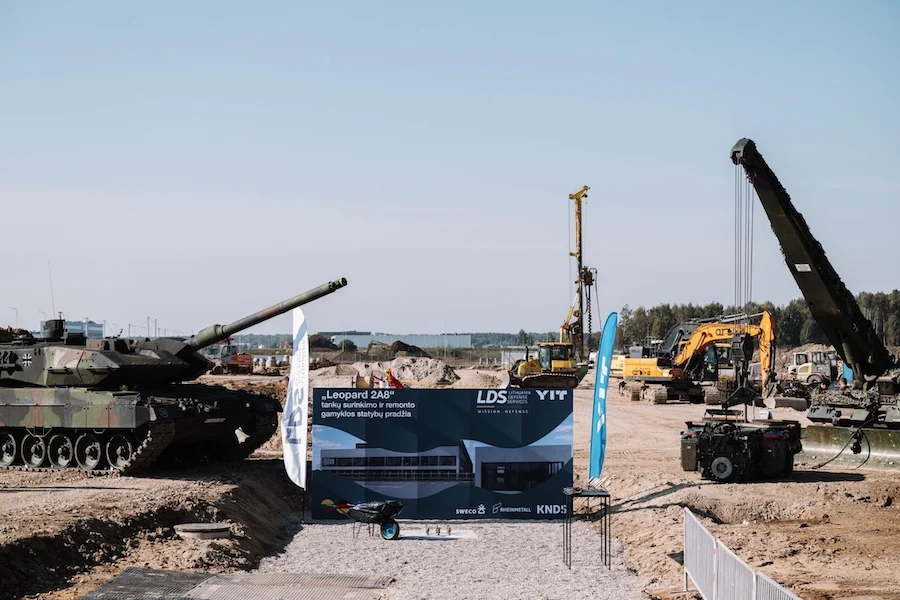
Lithuania marked the start of construction on a Leopard 2A8 main battle tank (MBT) assembly and repair plant in the Kaunas Free Economic Zone (FEZ) on October 1, 2026, laying a time capsule at the site in a ceremony attended by President Gitanas Nausėda. Lithuania Defence Services (LDS), a joint venture of KNDS Deutschland and Rheinmetall Landsysteme, is building the facility, which carries an earmarked investment of around €50 million and is expected to create about 80 jobs.
The plant anchors the industrial track of Lithuania’s largest armor acquisition. Vilnius ordered 44 Leopard 2A8s from KNDS Deutschland in December 2024 under the German-led Leopard 2 Cooperative Procurement Agreement, in a contract reported at about €950 million, to form a tank battalion within the Iron Wolf Mechanized Infantry Brigade, the core of a national 1st Division that Lithuania aims to bring to full capability by 2030. A December 11, 2025, agreement between the Ministry of National Defence and KNDS set local assembly at up to 41 of the 44 tanks, and the government approved the project in March 2026 under special investment conditions.
Inside the Leopard 2A8 Tank Plant: Scope, Schedule, and Ownership
YIT Lietuva, the Lithuanian arm of Finnish construction group YIT, signed a design-build contract worth about €29 million with LDS on July 30, 2026. It covers a 13,000-square-meter complex on a site of almost 10 hectares, with completion scheduled for November 2027. The facility will also maintain other heavy equipment of the Lithuanian Armed Forces.
Timelines diverge slightly on first output. LDS board chairman Markus Schmidt has pointed to the first Lithuanian-assembled tank at the beginning of 2028, while the contractor’s schedule places rollout in late 2028. Both align on completing the order by the end of 2030. A parallel availability agreement covers personnel training and five years of logistics support from first delivery.
LDS is not new to armor sustainment. Krauss-Maffei Wegmann, now KNDS Deutschland, and Rheinmetall founded it in 2022 as a 50-50 joint venture, with rail-connected workshops in Jonava near the Rukla garrison. Since October 2023, those workshops have returned battle-damaged Ukrainian Leopard 2A5 and 2A6 tanks to service. Ownership is now set to change: state-owned EPSO-G Invest is slated to acquire a 25.1% stake, although completion of the transfer has not been publicly confirmed.
What the Leopard 2A8 Brings to the Iron Wolf Brigade
The Leopard 2A8 is a new-build variant derived from the Leopard 2A7HU and 2A7A1 configurations rather than a rebuild of older hulls. Its main armament is the Rheinmetall 120 mm L55A1 smoothbore gun, fully stabilized, with 360-degree traverse and elevation from -7.4 to +17.4 degrees, firing NATO-standard 120 x 570 mm ammunition. KNDS cites an engagement range beyond 5,000 meters.
Protection drove the upgrade. Publicly available specifications describe new multi-layered armor, reinforced belly protection against mines, and strengthened hatches and turret roof, reflecting top-attack threats seen in Ukraine. The baseline also integrates the Trophy active protection system (APS) developed by Rafael Advanced Defense Systems, which detects and intercepts incoming anti-tank guided missiles and rockets. Lithuania has not publicly detailed its national configuration, including whether every tank will carry Trophy.
That protection costs mass. Combat weight reaches just under 69.5 tonnes depending on configuration, while the powerpack remains the MTU MB 873 Ka-501 12-cylinder diesel rated at 1,500 hp (1,100 kW), paired with a Renk HSWL 354 transmission. The result is roughly 21.6 hp per tonne at maximum weight, while the mass itself complicates bridge crossings and rail movement in the Baltics. The four-person crew layout, with a human loader, mirrors Bundeswehr tank units and simplifies combined training with German forces.
Then-Chief of Defence Valdemaras Rupšys argued in February 2024 that tanks would let Iron Wolf counterattack rather than only hold static positions, while acknowledging the army had no experience operating them.
How Kaunas Fits KNDS’s Distributed Leopard 2A8 Production
Kaunas follows Levanger, Norway, where KNDS and partner RITEK opened a Leopard 2A8 NO line in April 2026 after 18 months of construction. Levanger will build 37 of Norway’s 54 tanks, has capacity for up to 36 per year and begins production in autumn 2026. Kaunas differs in emphasis, pairing a short assembly run with long-term depot-level repair.
Demand explains the dispersal. Germany has ordered 123 Leopard 2A8s across two contracts, and Norway, the Netherlands, the Czech Republic, Sweden and Croatia have ordered or approved purchases of the type, an order book that pushes KNDS to spread final assembly beyond Munich.
The plant also sits within a growing German footprint. Panzerbrigade 45 “Litauen” absorbed Panzerbataillon 203 and Panzergrenadierbataillon 122 in January 2026 and the Multinational Battle Group Lithuania on February 4, 2026, and targets full operational readiness in 2027, with Leopard 2A8s earmarked for the brigade. Minister of National Defence Robertas Kaunas framed the project in sustainment terms, noting that heavy equipment serves for decades and that it is important “not only to assemble it, but also to maintain it.”
Analysis: Kaunas matters less as a production line than as a sustainment node on NATO’s northeastern flank. A run of up to 41 tanks will not rival Munich or Levanger. Its value lies in keeping depot-level repair inside Lithuania, avoiding rail moves of damaged armor to German plants under the very conditions that would contest that transit. If LDS extends the site’s remit to Panzerbrigade 45, as its existing mandate for allied forces in the Baltics suggests it could, Kaunas would anchor sustainment for both Leopard fleets in the country.
The next milestones are fixed: building completion in November 2027, the first Lithuanian-assembled Leopard 2A8 in 2028, and delivery of all 44 tanks by the end of 2030. Open questions remain on the EPSO-G share transfer, whether LDS will service German tanks at Kaunas, and how quickly the Lithuanian Land Force can generate crews and maintainers for a capability it has never fielded.