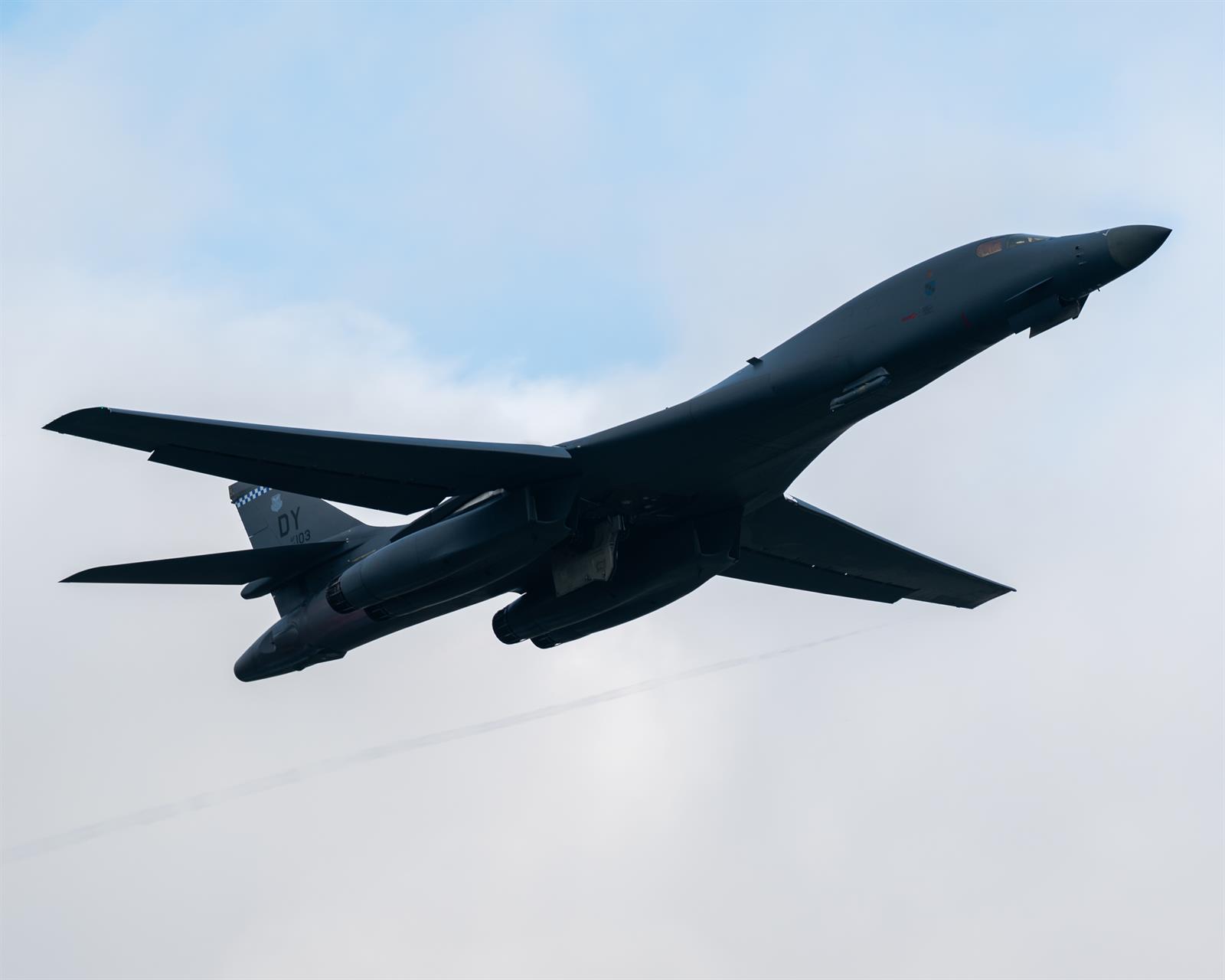
A US Air Force B-1B Lancer flew in a NATO air defense training mission over Lithuania and Latvia on September 29, 2026, the first US bomber to fly under the alliance’s new air defense framework. NATO Allied Air Command (AIRCOM) ran the sortie as a Flexible Deterrent Option (FDO) to rehearse Integrated Air and Missile Defense (IAMD) alongside German, Italian, Spanish and Turkish fighters.
On September 10, 2026, AIRCOM announced that the alliance’s air and missile defense efforts now operate under common rules, guidelines and command-and-control procedures regardless of the threat, from crewed aircraft and drones to cruise and ballistic missiles. During 2026, NATO upgraded its Air Policing mission, in place since 1961, into a comprehensive air defense posture. In May 2026, the presidents of Estonia, Latvia and Lithuania had asked NATO to convert Baltic Air Policing into an air defense mission and reinforce counter-drone capabilities. On September 15, two Italian Eurofighters on alert at Šiauliai Air Base shot down a drone near Pratkūnai, the first drone downed over Lithuanian territory.
How the Baltic Drill Tested the NATO Air Defense Framework
The September 29 scenario pitted red and blue forces against each other over Lithuania and Latvia. German and Italian Eurofighter Typhoons, Spanish F/A-18 Hornets and Turkish F-16 Fighting Falcons flew alongside the B-1B, and some of those fighters already serve in NATO detachments assigned to Baltic air defense. Airbus A330 Multi Role Tanker Transport aircraft from the Multinational MRTT Unit and an Italian Air Force KC-767A provided air-to-air refueling, extending time on station for fighters and bomber alike.
Spanish and Latvian ground-based assets fed the simulated multi-domain air defense picture. AIRCOM has not identified which surface systems took part. A Spanish National Advanced Surface-to-Air Missile System (NASAMS) unit joined a May 27, 2026 counter-drone serial over the Baltics; its role on September 29 is unconfirmed.
The command arrangement carried as much weight as the aircraft. AIRCOM assigned Joint Force Air Component responsibilities to the French Air and Space Force, with a French commander directing the mission. NATO periodically transfers operational command and control to certified national air command structures, keeping those headquarters practiced in running multinational air operations under alliance procedures.
“Each FDO brings us closer to realizing the full potential of NATO’s new defence design,” said US Air Force Lt. Gen. Jason T. Hinds, AIRCOM commander. “By training together and sharing knowledge, tactics and resolve, participating nations enhance the readiness of the entire Alliance from the High North to the Black Sea.” The Baltic event followed an AIRCOM-led FDO over Romania on September 9, 2026, involving fighters and tankers from France, Greece, Romania, Spain and Türkiye.
What the B-1B Lancer Brings to Baltic Air Defense Training
AIRCOM has not disclosed the bomber’s parent unit, its departure base, or whether it flew as a protected asset within the blue force or as a simulated threat track. Either role exploits the bomber’s speed, endurance and payload.
The Rockwell-built B-1B is powered by four General Electric F101-GE-102 afterburning turbofans, each rated at more than 30,000 pounds of thrust with afterburner, according to the Air Force fact sheet. The variable-sweep bomber exceeds 900 mph, or Mach 1.2 at sea level, carries 265,274 pounds of fuel and has a maximum takeoff weight of 477,000 pounds. Its three internal weapons bays hold a 75,000-pound payload, the largest conventional load of guided and unguided weapons in the Air Force inventory. Publicly available specifications indicate it can carry up to 24 AGM-158 Joint Air-to-Surface Standoff Missiles (JASSM) or 24 GBU-31 Joint Direct Attack Munitions, and it also fields the AGM-158C Long Range Anti-Ship Missile (LRASM). A synthetic aperture radar, a targeting pod and a Link 16-compatible data link let its four-person crew retask strikes in flight.
The B-1B has flown a conventional-only mission since its nuclear role was removed under the New START treaty. The Air Force operates roughly 45 airframes from Dyess Air Force Base, Texas, and Ellsworth Air Force Base, South Dakota, pending replacement by the B-21 Raider.
For air defenders, those figures make the Lancer a demanding training object. A large, fast aircraft refueling from allied tankers and crossing two national airspaces forces fighter controllers, ground-based sensors and tanker planners to deconflict and share a single track picture under one set of procedures, the test the new framework sets for itself.
Analysis: Folding a US strategic bomber into a framework built to counter drones and missiles shows that NATO intends its new air defense design to manage the full range of Allied air activity, not only fighters on quick reaction alert. The command chain matters more: an American bomber operated inside a French-led Joint Force Air Component, under procedures written by AIRCOM. As Washington presses European allies to carry more of the conventional burden, national headquarters that can absorb and direct US high-value assets on short notice reduce the framework’s dependence on any single nation’s command infrastructure and strengthen deterrence on the eastern flank.
AIRCOM has not published the date of its next FDO, though the 2026 cadence points to further rehearsals on both the Baltic and Black Sea flanks. Open questions include which ground-based systems will be assigned to the Baltic air defense posture on a lasting basis, and how the alliance will sustain the cost of engaging low-cost drones with crewed fighters as incursions continue.