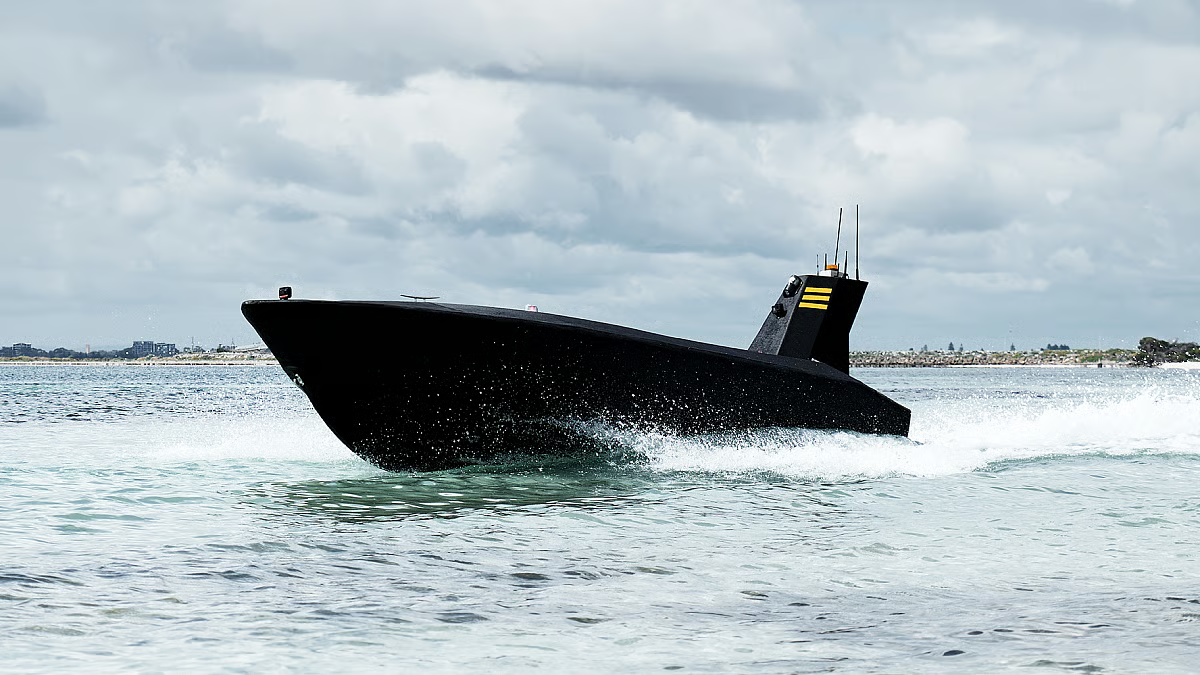
Australian manufacturer Hyperion Systems has completed the initial sea trial of its ASTRA 460, a 3D-printed unmanned surface vehicle (USV), with the craft reaching a top speed of 40 knots, the company said. The remotely operated test was the first time the printed hull and its fitted marine systems ran together at sea.
Hyperion, based in Henderson, Western Australia, unveiled the ASTRA 460 at the Indian Ocean Defence and Security (IODS) conference in Perth, held May 26 to 28, 2026, and said at the time that sea trials would begin by mid-year. The company has not disclosed when or where the initial trial took place. The result arrives as Canberra scales up its investment in uncrewed maritime systems: in September 2025, the Department of Defence signed a five-year, A$1.7 billion contract with Anduril Australia for the Ghost Shark extra-large autonomous underwater vehicle (XL-AUV). The ASTRA 460 sits at the opposite end: a small surface craft optimised for speed of production.
ASTRA 460 USV Specifications: Hull, Propulsion, and Performance
The ASTRA 460 is 4.6 metres long, with a beam of 1.67 metres and a draught of 0.3 metres. Its hull is printed from high-density polyethylene (HDPE) derived from recycled polymer waste, a thermoplastic Hyperion describes as tough and impact-resistant. The shallow draught matters most operationally: it opens reef, estuarine and near-shore waters that larger crewed patrol craft cannot safely enter.
The design accepts either an internally mounted waterjet or an outboard engine. Hyperion has not released engine type, power output, fuel capacity or the configuration used in the trial. The choice matters in service: a waterjet favours shallow-water work and close manoeuvring, while an outboard simplifies maintenance and field replacement.
Only the 40-knot top speed has been demonstrated so far. Follow-on trials will test the remaining targets: a cruising speed of 20 to 30 knots, a payload capacity of more than 200 kg and a range of up to 200 kilometres, roughly 108 nautical miles. The company markets the craft for intelligence, surveillance and reconnaissance (ISR), border protection, maritime security and the covert movement of small teams, with modular payloads. It has not identified a sensor suite, datalink or any armed configuration.
Publicly available specifications for Ukraine’s Magura V5, the most extensively combat-tested small USV in service, indicate a 5.5-metre hull, a top speed of about 42 knots, a payload of roughly 300 to 320 kg and a range of about 450 nautical miles. On its stated targets, the ASTRA 460 matches the Magura’s speed class but offers less than a quarter of its range, positioning it as a coastal asset rather than a long-range strike craft.
How Large Format Additive Manufacturing Cuts USV Hull Production Time
Hyperion prints the hull at Henderson using large format additive manufacturing (LFAM), a polymer extrusion process that deposits material layer by layer. The company says a hull takes about 40 hours to print, against four to six weeks with conventional boatbuilding methods. Printing and fitting out a complete vessel takes approximately seven days, per company figures released at IODS.
Production is not tied to Henderson. Hyperion’s TitanCell, a deployable printing cell with a minimal infrastructure footprint, is designed for on-site manufacture in remote or austere locations. A single TitanCell machine can produce two ASTRA 460 hulls per week, the company said. Hyperion also states that its printing process does not depend on foreign supply chains, though it has not detailed the sourcing of engines, electronics or sensors.
The operational logic is reconstitution. If hulls can be printed near the point of employment, losses can be replaced without waiting for a shipyard slot, and hull geometry can be altered between print runs to suit a specific payload. The bottleneck then shifts from the hull to propulsion units, autonomy hardware and mission payloads, which still must be stockpiled or shipped forward. Still undisclosed: the fatigue life of a printed HDPE hull at sustained high speed, its weathering in tropical conditions, its behaviour in higher sea states, and unit cost.
ASTRA Development Roadmap: 8-Metre Variant and ADF Demonstrations
The craft pairs a hull designed by Western Australian naval architecture firm Versatile Marine with autonomy from Greenroom Robotics, whose GAMA platform is slated to provide navigation and control. Because the initial trial was remotely operated, fully autonomous operation, a core element of the original pitch, has not yet been publicly demonstrated.
Hyperion describes the ASTRA 460 as the first of a family of USVs to be produced in multiple sizes and capability configurations. A larger 8-metre initial prototype is planned for delivery to a European navy for use in a major naval exercise later in 2026; neither the navy nor the exercise has been named. Hyperion said in May that it intended to demonstrate the ASTRA 460 to the Australian Defence Force (ADF) in the following months. No ADF contract, program of record or acquisition pathway has been announced.
Analysis: The ASTRA 460 is not yet a military capability, and its performance figures remain company-reported. Its relevance lies in the production model. On September 29, 2026, the US Navy announced production agreements for 30 medium unmanned surface vessels (MUSV) at an average cost of $40 million each, a larger class built for a different mission. Ukraine’s Black Sea campaign showed what cheap, numerous small craft can do against a conventional fleet. A hull printed in 40 hours and a vessel completed in a week pushes Australian industry toward that attritable model, in which the binding constraint becomes the supply of autonomy kits and payloads rather than shipyard capacity. Whether Defence wants that model for its northern approaches, and will fund it, is the open question.
Hyperion’s next milestones are validation of cruising speed, payload and range; the first trials under Greenroom’s autonomy stack; and delivery of the 8-metre prototype to the European navy before the end of 2026. Unit price, propulsion details and any ADF commitment will determine whether the ASTRA 460 moves beyond a demonstrator.