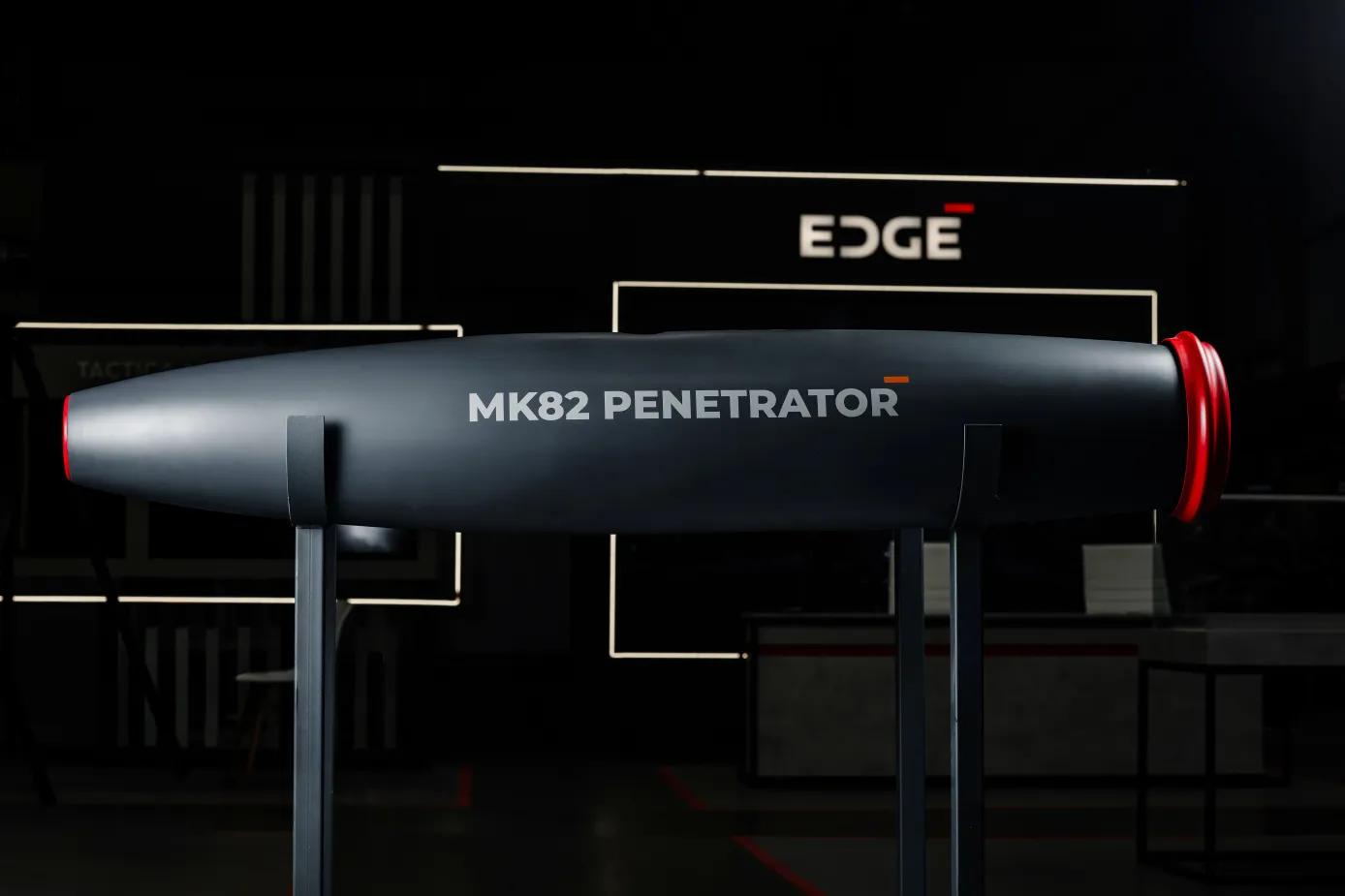
EDGE Group has completed development of the MK 82 Penetrator, a hardened-target bomb built to the MK 82 form factor and designed and manufactured in the United Arab Emirates by its munitions subsidiary LAHAB, the Abu Dhabi-based group announced on October 2, 2026. In qualification trials, the weapon defeated more than one meter of reinforced concrete without the trajectory deviation known as the “J” effect. EDGE said a heavier MK 83 Penetrator is already at an advanced stage of development.
The announcement adds a penetrating warhead to an Emirati bomb line built around general-purpose bodies. LAHAB won an AED 4.1 billion ($1.1 billion) Ministry of Defence contract at the November 2023 Dubai Airshow to produce MK 81, MK 82, MK 83 and MK 84 general-purpose bombs under the national “Make it in the Emirates” industrial drive. Penetrators are a harder engineering problem, demanding high-strength steel cases, shock-tolerant fills and fuzes that survive deceleration through concrete, and Gulf air forces have traditionally imported them.
MK 82 Penetrator Test Campaign Against Reinforced Concrete Targets
EDGE said the program closed with a combined performance and qualification campaign. Penetration was assessed against several hardened target types, and the weapon completed a sequence of environmental qualification tests. The headline result is defeat of reinforced concrete in excess of one meter. Equally important is the absence of a “J” effect: the bomb held its trajectory through the target instead of curving on impact, a failure mode that turns the casing sideways and detonates it short of the intended compartment.
EDGE has not published the parameters behind that figure. Concrete compressive strength, impact velocity and angle, weapon mass, explosive fill and fuze all remain undisclosed, and all determine how a penetration number translates to a real target. Publicly available specifications indicate a standard MK 82 weighs roughly 241 kg, has a 273 mm body diameter and carries about 87 kg of Tritonal or H-6. Penetrators trade much of that fill for a thicker, harder case. Türkiye’s SERT-82, which matches the MK 82’s external geometry and mass properties, carries 20 kg of aluminized plastic-bonded explosive, according to developer TÜBİTAK SAGE.
The one-meter result places the MK 82 Penetrator level with Israel’s MPR 500, which Elbit Systems credits with penetrating 1 meter of reinforced concrete, also without a “J” effect. Publicly available figures credit the 2,000-lb BLU-109 with up to roughly 1.8 meters. The case for a 500-lb-class penetrator is loadout density: a multirole fighter can carry several MK 82-size weapons in place of one 2,000-lb store, letting a single sortie service multiple hardened aim points such as command posts or munitions bunkers, at the cost of shallower penetration per weapon.
How AL TARIQ and THUNDER Kits Guide the MK 82 Penetrator
The design priority is compatibility. EDGE states the MK 82 Penetrator can be released from any aircraft already cleared for the MK 82 general-purpose bomb and accepts MK 82 guidance kits, including its own AL TARIQ and THUNDER families, adding a hardened-target option to guided weapons already in inventory without a separate guidance chain. LAHAB CEO Mohammed Arbabi said the weapon “expands the end-user’s capabilities while maintaining familiarity and ease of use.”
AL TARIQ, derived from Denel Dynamics’ Umbani kit, pairs GNSS/INS navigation with imaging infrared seekers featuring automatic target recognition, or semi-active laser seekers. EDGE lists standoff ranges of up to 45 km for the AL TARIQ-S and 120 km for the wing-equipped AL TARIQ-LR, ordered by the UAE Armed Forces under an AED 1 billion ($272 million) contract in February 2023. The short-range THUNDER P32 is advertised at more than 20 km from 30,000 feet. The AL TARIQ-LR standoff keeps launch aircraft beyond most short- and medium-range air defenses around a buried site, while terminal seekers and advertised attack angles up to 90 degrees support the steep impacts that maximize penetration.
The stated aircraft list exceeds the UAE’s own fleet. EDGE cites NATO-configuration fourth and 4.5-generation fighters, variable-geometry strike aircraft, advanced jet trainers, light attack aircraft and fifth-generation fighters. The UAE Air Force flies F-16E/F Block 60 and Mirage 2000-9 fighters and ordered 80 Rafale F4s in December 2021, but operates neither swing-wing strike jets nor fifth-generation fighters, which reads as an export pitch. EDGE has not confirmed whether the penetrator matches the MK 82’s mass and center of gravity exactly, the condition for inheriting existing release clearances, or whether it descends from the penetration warhead AL TARIQ displayed at IDEX 2021.
Analysis: The MK 82 Penetrator matters less for its penetration figure, which matches rather than exceeds the MPR 500, than for where it is built. A domestically qualified penetrator, paired with Emirati guidance kits and produced on a domestic bomb line, gives Abu Dhabi a hardened-target strike chain whose stockpile depth and resupply do not hinge on US Foreign Military Sales approval or congressional notification. For Gulf air forces planning against dispersed, buried missile and drone infrastructure, that autonomy is the real capability. It also puts EDGE into a 500-lb-class penetrator export market already contested by Elbit and TÜBİTAK SAGE.
The next milestone is the MK 83 Penetrator, a 1,000-lb-class variant EDGE describes as at an advanced stage of development. Unknowns remain: whether the UAE Ministry of Defence has placed a production order, LAHAB’s planned output rate, which aircraft have completed integration trials, and whether EDGE will release mass, fill and test-condition data to export customers.