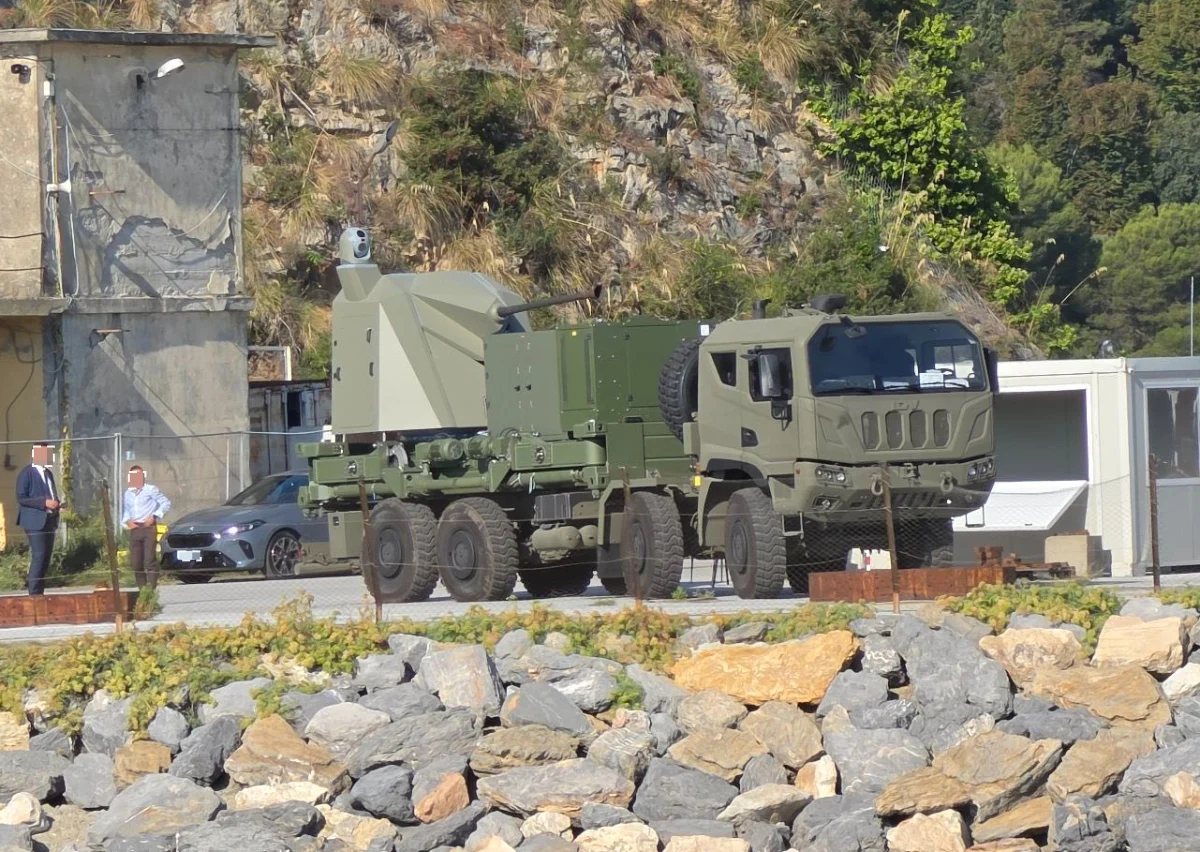
Leonardo’s Hystrix 40 ADS, a land-based counter-drone gun system built around the company’s Marlin 40 naval turret, has been photographed undergoing testing for the first time. The image, which circulated on social media in early October 2026, shows the 40 mm turret in its Independent Line of Sight (ILOS) configuration mounted on a heavy military truck. Leonardo has not commented publicly, and neither the date nor the location of the photograph has been disclosed.
The sighting suggests Leonardo is on schedule. When it unveiled the Hystrix family on February 2, 2026, following a media presentation at its Brescia facility, the company showed the 40 mm system only in renderings and committed to a prototype before the end of 2026. Hystrix provides the gun-based inner layer, dubbed the “Dead Zone,” of Michelangelo Dome, the multi-domain air and missile defense architecture Leonardo launched on November 27, 2025, with trials of that layer planned for the second half of 2026.
Hystrix 40 ADS Brings the Marlin 40 Naval Mount Ashore
The Hystrix 40 ADS adapts the Marlin 40, a single-barrel 40 mm L70 mount whose lineage traces back to the 40 mm naval systems Oto Melara developed from the 1950s onward. Leonardo states that more than 850 of its 40 mm naval systems serve with 30 navies. Of its two configurations, the RC (Remotely Controlled) variant is slaved to an external fire control system, while the ILOS variant carries its own electro-optical director.
According to Leonardo’s published data, the naval Marlin 40 trains through 360 degrees, elevates from minus 20 to plus 85 degrees, carries up to 80 ready rounds and reaches a maximum effective range of 4,500 m. Its servo drives deliver 120 degrees per second in training and 75 degrees per second in elevation, with accelerations of 200 degrees per second squared on both axes, figures that matter when tracking small, maneuvering drones at short range.
The land variant changes the operating logic. Leonardo quotes a dry mass of 2,100 kg, plus about 180 kg of ammunition. Ready capacity drops to 72 rounds, reloadable through a hatch at the rear of the turret roof in under five minutes. The gun fires only at its maximum rate of 300 rounds per minute, because defeating a small aerial target requires placing a dense cluster of rounds near it in the shortest possible time. At that rate, a full load empties in about 14 seconds, which makes reload speed and fire discipline central to the system’s sustainability.
Electro-Optical Director and Programmable 40 mm Ammunition Against Drones
In the ILOS configuration, the turret is a self-contained fire unit able to detect, track, compute a ballistic solution, engage and terminate an engagement autonomously. The current director, supplied by INSIS, now part of Fincantieri, combines a laser rangefinder reaching 6.5 km, a thermal imager with detection, recognition and identification ranges of 15 km, 6.8 km and 3.5 km, and a day camera rated at 20 km, 9 km and 4.5 km for the same tasks. The production configuration is expected to adopt Leonardo’s Janus D, a fully digital evolution of the Janus sight optimized for the counter-unmanned aircraft systems (C-UAS) role. Which director equips the photographed turret is unconfirmed.
Beyond practice rounds, the gun fires high-explosive incendiary tracer rounds, high-explosive pre-formed fragment rounds with programmed proximity fuzes (HE-PFF), and Multi-Purpose Ammunition (MPA) whose programmable fuze offers five modes: proximity, gated proximity, airburst, point detonating, and gated proximity combined with airburst. Leonardo claims a 40 mm round costs 35 to 50% as much as a 35 mm round, a figure not independently verified but central to the cost-exchange case for gun-based C-UAS.
To extend reach beyond gun range, Leonardo is working with MBDA Italia to integrate the Fulgur very short-range air defense (VSHORAD) missile, still in development, potentially making the Hystrix 40 ADS a stand-alone fire unit.
Truck-Mounted Configuration and the Marlin 40 Export Track Record
The photograph shows the turret on the flatbed of a multi-axle military truck, with what appears to be an equipment module between the mount and the cab. That matches the relocatable layout Leonardo described in February: a flatbed with hydraulic jacks for autonomous unloading, a container for electronics, communications and power, and a carrier drawn from the Iveco Defence Vehicles (IDV) Astra 8×8 trucks already used by the SAMP/T and SAMP/T NG long-range air defense systems. Reusing that chassis would cut training and logistics burdens for SAMP/T operators.
The concept already has a customer. Leonardo has supplied trailer-mounted Marlin 40 ILOS turrets in large numbers to an unnamed Far East country for its air force, with local industry now assembling Leonardo-supplied core components. The company is bidding for a comparable order from the same country’s army. Within the Hystrix family, the 40 mm system sits between the Hystrix 76 ADS, based on the 76/62 naval gun and weighing about 7,000 kg in its heavier form, and a 30 mm variant built around Leonardo’s X-Gun.
Analysis: The Hystrix 40 ADS reflects a broader European shift toward guns as the volume layer of C-UAS defense, where interceptors are too scarce and costly to expend on mass-produced drones. Leonardo’s advantage is maturity: the turret, its 40 mm L70 ballistics and its programmable ammunition are already fielded at sea, which narrows development risk to integration, mobility and fire control. Endurance and reach remain the open questions: a 72-round load and an effective range in the 4.5 km class define a point-defense effector that depends on networked cueing and fast resupply, so Michelangelo Dome integration and the Fulgur pairing will decide whether it becomes a true air defense layer or remains a site-protection gun.
Leonardo intends to integrate the 40 mm and 76 mm prototypes with Michelangelo Dome command and control elements, and live-fire results against drone targets will be the next real indicator of progress. Italian Army procurement plans, the final sensor fit and the Fulgur timeline remain unknown. The Dead Zone trials scheduled for the second half of 2026 are the nearest milestone.