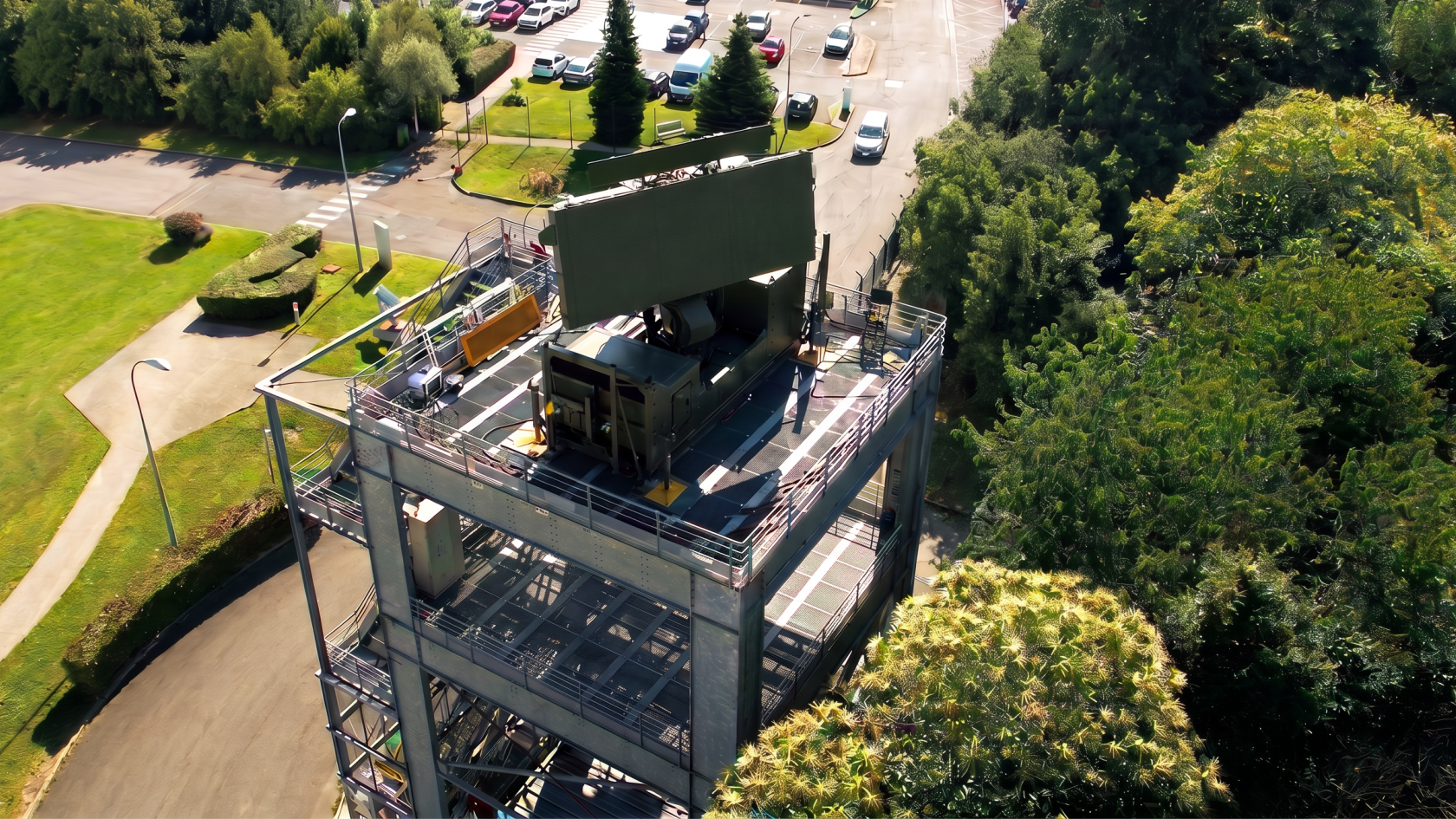
Ireland will field four Thales Ground Master 400 Alpha (GM400α) long-range air surveillance radars and one Ground Master 200 Multi-Mission All-in-one (GM200 MM/A) medium-range radar under a contract between the Irish Department of Defence and France’s Direction Générale de l’Armement (DGA), Thales announced on October 2, 2026. First deliveries are scheduled for 2027, and the Department of Defence expects full capability by the end of 2028, giving the Defence Forces their first military primary radar coverage of Irish airspace.
The order anchors Ireland’s Military Radar Programme, which the Commission on the Defence Forces identified as an immediate priority in its 2022 report. Ireland has never operated a military primary radar. Beyond the terminal areas of its main airports, its air picture rests on civil surveillance that depends on aircraft transponders, leaving non-cooperative aircraft and drones largely invisible. For interception, Dublin relies on a long-standing bilateral arrangement, never published in full, under which Royal Air Force (RAF) quick reaction alert fighters can respond to threats in Irish-controlled airspace.
The gap turned political on December 1, 2025, when Irish media reported that four or five unidentified drones flew near the approach path of Ukrainian President Volodymyr Zelensky’s aircraft into Dublin Airport, then loitered over the patrol vessel LÉ William Butler Yeats. The Defence Forces declined to comment on specifics. Weeks later, the government approved a preliminary business case and opened talks with France.
Ireland Military Radar Backbone: GM400 Alpha Range and Clutter Performance
The GM400 Alpha, launched at the Dubai Airshow in November 2021, is an S-band 3D long-range surveillance radar derived from the GM400, which Thales introduced in 2007. The upgrade combines gallium nitride (GaN) transmit technology with digital stacked-beam processing and five times the computing power of its predecessor. Instrumented range rises to 515 km (278 nm), roughly 10% beyond the GM400 and more than 20% more coverage area, with no increase in transmitter or receiver power. Publicly available specifications indicate a ceiling of 100,000 ft and 40 degrees of elevation coverage.
Thales quotes a six-second update rate and says the radar’s processing chain holds tracks in dense clutter. That addresses the target set Ireland currently cannot see: low-flying tactical drones close to the radar, which the company says the GM400 Alpha can track while simultaneously following fighter-sized targets at maximum range. Each system fits a 20-foot ISO container with an integrated lifting system, so the four units can be relocated rather than tied to fixed sites.
Four long-range heads could, at altitude, cover the island and a large share of its Atlantic approaches, where Russian long-range aviation has repeatedly flown through Irish-controlled airspace with transponders switched off over the past decade. Low-altitude coverage will remain bounded by the radar horizon and terrain. The Department of Defence has not disclosed planned radar sites. Serbia and Malaysia are among existing GM400 Alpha operators.
GM200 MM/A Adds Rapid-Deployment Cueing for Ground-Based Air Defense
The single GM200 MM/A brings a different mission set. It uses Thales’ 4D active electronically scanned array (AESA) technology, with electronic beam steering in both azimuth and elevation, 950 receivers, and more than 30 independent beams. Thales rates its instrumented range at up to 350 km and claims a 40% performance gain over the original GM200.
Radar, mast, and power generator share a single 20-foot shelter. The system moves by truck and goes from transit to operation in 15 minutes, a feature Thales presents as key to asset survivability. Beyond air surveillance, the GM200 MM/A provides weapon coordination for very short-range through medium-range air defense (VSHORAD to MRAD) systems, plus threat warning for deployed forces.
That role points to the programme’s second pillar: ground-based air defense, including a counter-drone component. Irish media have reported, citing unnamed sources, that MBDA will supply the effectors; the Department of Defence has not confirmed a supplier or system. The third element, ship-borne radar for the Naval Service, remains unannounced.
Government-to-Government Route Puts DGA at Center of Irish Procurement
Dublin did not run an open competition. In December 2025, Minister for Defence Helen McEntee described a government-to-government deal with France as the only viable route to the required capability, and the DGA has coordinated the French offer since. The final business case, completed in July 2026, set a cost envelope of €300 million to €500 million for the entire programme. The Department of Defence signed an acquisition order with the DGA on September 18, 2026. Neither Dublin nor Thales has disclosed the value of the radar contract itself.
Thales attributes the 2027 delivery start to its industrial ramp-up and short production lead times, and reports more than 300 Ground Master radars sold in over 40 countries. Eric Huber, Thales vice president for surface radars, said the systems reflect the company’s focus on modular, interoperable, rapidly deployable air defense solutions, and that the agreement highlights Europe’s will to bolster sovereignty and resilience. Martin Soegaard, Thales country director for Denmark, Ireland, Iceland and the Baltics, said the radars will be instrumental in providing the nation’s first fully recognized air picture.
Analysis: Radar coverage solves only the detection half of Ireland’s problem. The Irish Air Corps operates no combat jets, so a GM400 Alpha track on a non-cooperative aircraft will still end with the RAF flying the intercept. The recognized air picture Thales promises will also depend on a control and reporting function, data links, and trained crews that neither government has described. The procurement path carries a longer-term consequence: by contracting through the DGA, a militarily neutral, non-NATO state has placed its entire sensor layer, and possibly its effectors, inside a single French industrial ecosystem. That accelerates delivery and simplifies integration, but it also sets the technical baseline for Irish air defense for a generation.
The next milestones are delivery of the first radars in 2027, the selection of sites and command-and-control architecture, and contracts for the air defense and maritime radar elements, with the land-based capability due by the end of 2028. Ireland’s EU Council presidency ends on December 31, 2026, before any of the new radars arrive. Until then, Irish airspace remains monitored largely through civil systems and partner information.