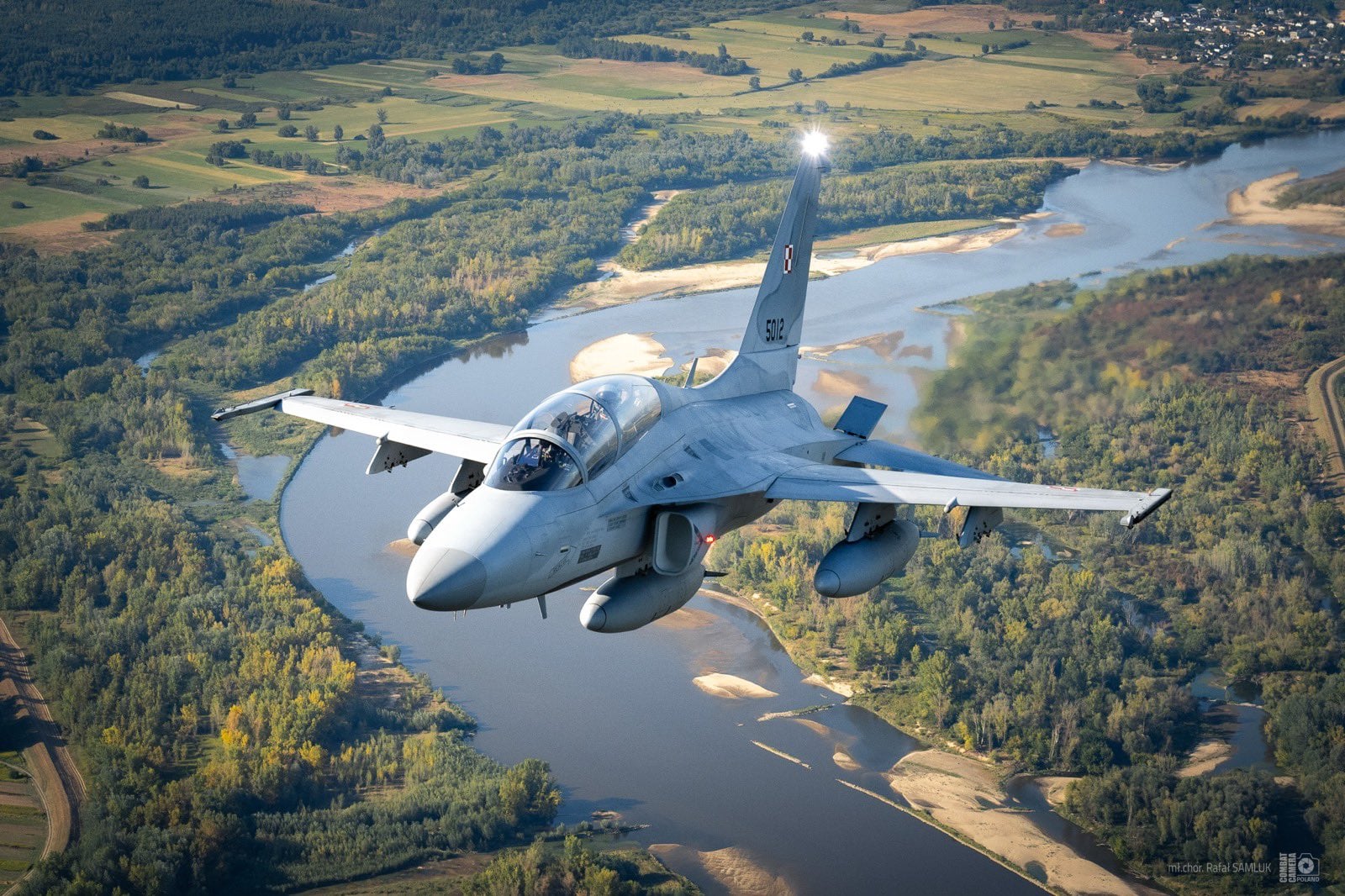
Poland’s 12 FA-50GF Fighting Eagle light fighters have entered combat duty, Deputy Prime Minister and Minister of National Defence Władysław Kosiniak-Kamysz announced on October 2, 2026, adding the South Korean-built jets to the alert system guarding the eastern border. Military officials said the duty began on October 1 at the 23rd Tactical Air Base in Mińsk Mazowiecki, east of Warsaw. “Light FA-50GF aircraft have just entered combat duty. This means another reinforcement of our eastern border,” the minister wrote.
The announcement closes a three-year gap between delivery and operational use. Korea Aerospace Industries (KAI) handed over the jets in 2023 under a September 16, 2022, contract for 48 FA-50s worth about $3 billion, signed as Warsaw moved to replace Soviet-era MiG-29s. The first 12 aircraft, diverted from Republic of Korea Air Force production, arrived without a combat weapons package. Demand for armed alert fighters has grown since Russian drones entered Polish airspace in September 2025, an incursion that led NATO to launch Operation Eastern Sentry.
FA-50GF Combat Duty: Sidewinders, Cannon, and a Block 10 Sensor Suite
As the minister acknowledged, arming the fleet required Warsaw to source weapons after delivery. Poland first leased older AIM-9P infrared-guided Sidewinders, then ordered AIM-9L/I-1 rounds and 20mm ammunition for the internal three-barrel cannon derived from the M197. The GF cannot employ the AIM-9X Block II carried by Polish F-16C/D and F-35A fighters, leaving it with legacy seekers that lack the AIM-9X’s high off-boresight and lock-on-after-launch capability.
Maj. Gen. Ireneusz Nowak, Operational Commander of the Polish Armed Forces, said the jets will be used primarily against jet-powered combat drones, naming Russia’s Geran-4 and Geran-5. He noted that alert MiG-29s have intercepted Russian Il-20 reconnaissance aircraft and Su-30SM fighters several times this year. Polish officers describe the GF’s share of alert tasks as limited, with the broader threat set reserved for the future FA-50PL.
Publicly available specifications indicate the FA-50 Block 10 is powered by a single General Electric F404-GE-102 afterburning turbofan producing about 17,700 lbf (79 kN) of thrust, for a top speed near Mach 1.5. The tandem two-seat jet carries the Elta EL/M-2032, a mechanically scanned X-band fire-control radar with air-to-air, air-to-ground, and mapping modes, credited in Polish assessments with detecting up to 64 targets. A radar warning receiver and chaff and flare dispensers form the self-protection suite. Maximum external load is put at about 4.5 metric tons, against roughly 7.7 tons for the F-16.
For the drone mission, that package is coherent. An infrared missile and a gun suit short-range identification and engagement of a fast, low-signature jet drone, and the light fighter costs less per flight hour than an F-16 or F-35. The limits are clear: without an active electronically scanned array (AESA) radar or a medium-range missile, the GF cannot engage manned aircraft beyond visual range.
FA-50PL Delays Push Full Light Fighter Capability to 2029
The GF was conceived as a bridge to 36 FA-50PL Block 20 aircraft built to Polish requirements. On January 9, 2026, the Armament Agency and KAI signed a contract annex moving the first FA-50PL delivery to mid-2027 and completion to early 2029, from an original 2025 to 2028 window. Supply chain constraints, integration of US avionics and weapons, and the geopolitical situation were cited. At that point, the FA-50PL prototype had not flown, after a first flight planned for November 2025. South Korean reporting has tied the slippage largely to PhantomStrike radar integration, which in turn gates AIM-9X employment.
The PL configuration adds the Raytheon PhantomStrike, a lightweight, fully air-cooled AESA radar, plus probe-and-drogue aerial refueling, the AN/AAQ-33 Sniper Advanced Targeting Pod, a helmet-mounted display, expanded external fuel, and GBU-12 laser-guided bombs. Poland signed an agreement with Washington on January 13, 2026, to support AIM-9X integration, and US approval to integrate AIM-120C-5, C-7, and C-8 AMRAAM variants was subsequently reported, citing Gen. Nowak. Link 16 and NATO-standard identification friend or foe systems are planned across the Polish FA-50 fleet.
The Polish Air Force has dropped plans to retrofit the GF jets to the PL standard, judging the conversion cost-ineffective, in part because the GF radar is relatively new. Poland will therefore operate two FA-50 sub-fleets, with the GF also carrying advanced training to shorten pilot transition to the F-16 and F-35A. Of the contract value, about $700 million covered the 12 GF jets and $2.3 billion the 36 PL aircraft, according to Polish defense reporting.
What FA-50GF Combat Duty Means for Eastern Flank Air Defense
Analysis: The FA-50GF’s arrival on the alert roster matters less as added interceptor capacity than as a step toward cost-tiered air defense on NATO’s eastern flank. During the September 2025 incursion, allied fighters, including fifth-generation jets, fired expensive missiles at cheap drones. A light fighter with legacy Sidewinders and a gun lets Warsaw reserve F-35A and F-16 sorties, and AIM-9X and AIM-120 stocks, for higher-end threats. The program also shows the price of speed: a 2022 purchase optimized for delivery time left 12 jets unable to defend airspace for nearly three years, and the stopgap now covers a PL slip of almost two years.
The next markers are a confirmed FA-50PL first flight, PhantomStrike and AIM-9X integration testing, and the first PL delivery in mid-2027. Polish authorities have not disclosed how many GF jets stand alert per shift, the size of the Sidewinder stock, or fleet availability rates. Meanwhile, Poland’s ninth F-35A, the first assembled in Italy, arrived at Łask on October 1, 2026, one of 32 on order.