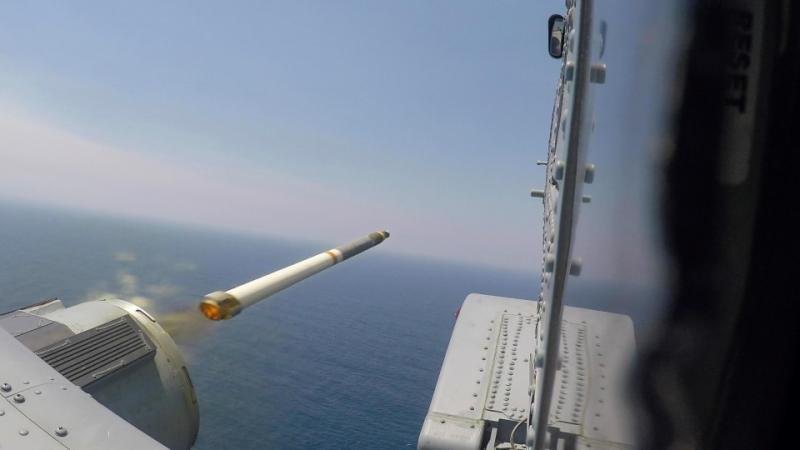
The US State Department on October 2, 2026, approved a possible Foreign Military Sale to the United Arab Emirates of up to 10,000 Advanced Precision Kill Weapon System II (APKWS II) guidance sections, combining air-to-air and air-to-ground configurations, at an estimated cost of $1.041 billion. BAE Systems, Inc., of Nashua, New Hampshire, is the principal contractor under Transmittal 26-100.
The notification is Abu Dhabi’s second APKWS II case in five months. On May 1, 2026, Washington cleared 1,500 air-to-air guidance sections for $147.6 million, with Secretary of State Marco Rubio invoking emergency authority to bypass congressional review as the 2026 war with Iran drained Gulf stocks of US-made munitions. The UAE, which Washington designated a Major Defense Partner in September 2024, first sought the weapon in 2019, when the State Department approved a $900 million emergency case for 20,004 all-up rounds.
What the $1.041 Billion UAE APKWS Sale Covers
The State Department describes the request as up to 10,000 guidance sections split between air-to-air and air-to-ground configurations, without disclosing the ratio. Non-major defense equipment includes Mk-152 high-explosive warheads, MK66 rocket motors, proximity fuzes, WTU-1/B practice warheads, inert MK66 motors, support equipment, technical publications, transportation, and US Government and contractor engineering, technical, training, and logistics support.
One omission stands out. The May case listed LAU-131 launchers; the October notification does not. That suggests the UAE plans to fire the new rounds from launchers already in inventory or ordered under earlier cases, making this buy about magazine depth rather than new launch capacity.
Dividing the ceiling by quantity yields a nominal $104,100 per guidance section, consistent with the region’s other 2026 cases: roughly $98,400 for the UAE’s May buy, $99,240 per all-up round for the parallel Israeli and Qatari packages, and $98,000 for the 20,000-section Saudi case approved on July 15, 2026. Notification values are ceilings that bundle warheads, motors, fuzes, training, and support. Open-source estimates put the guidance kit itself at roughly $20,000 to $25,000.
According to the State Department, implementation will not require additional US Government or contractor personnel to be assigned to the UAE, though temporary visits will be needed, and the sale will not alter the basic military balance in the region.
WGU-59/B Guidance Section: Seeker, Range, and Counter-Drone Role
APKWS II turns the unguided 2.75-inch (70 mm) Hydra 70 rocket into a semi-active laser-guided munition by inserting the WGU-59/B mid-body guidance unit between the Mk66 Mod 4 rocket motor and the warhead and fuze. Publicly available specifications indicate the section adds about 47 cm and 4.1 kg, producing a complete round of roughly 1.87 m and 15 kg. Distributed Aperture Semi-Active Laser Seeker (DASALS) optics sit on four wings that deploy about half a second after launch, allowing lock-on after launch against a laser spot designated by the firing aircraft, a second platform, or ground troops.
Open-source figures place the engagement envelope at roughly 1.1 to 5 km from helicopters and up to about 11 km from fast-moving fixed-wing aircraft. Because the kit fits between existing components, operators keep their motor and warhead stocks, and earlier US notifications state that the guidance section requires no depot maintenance.
The air-to-air configuration pairs the guidance section with a proximity fuze, which explains why fuzes appear in both UAE packages. US fighters have used guided 70 mm rockets operationally against one-way attack drones in the Middle East, according to publicly available reporting, reserving AIM-9X and AIM-120 missiles for harder targets. The air-to-ground configuration covers vehicles, launch teams, and small boats with lower collateral risk than heavier munitions.
Magazine depth is the payoff. An AH-64 Apache with four 19-tube pods can carry up to 76 rockets, against 16 Hellfire missiles on four rails. The 2019 UAE notification framed APKWS as a lower-collateral complement to Hellfire II across Emirati helicopter fleets. Which platforms will carry the new rounds has not been disclosed.
Gulf APKWS Demand Tests BAE Systems Production Capacity
The UAE case lifts 2026 APKWS II notifications for Israel, Qatar, Saudi Arabia, and the UAE to 51,500 guidance sections or all-up rounds. The UAE alone now accounts for 11,500 sections worth up to $1.19 billion across two cases. These figures are ceilings, not signed contracts, but they converge on a single production base that also supplies the US Navy, Marine Corps, Army, and Air Force.
When its dedicated US plant opened in 2016, BAE Systems cited capacity of up to 20,000 units per year. Even at twice that rate, the 2026 regional notifications alone would absorb more than a year of output before US requirements are counted. Delivery sequencing, rather than export approval, is likely to be the binding constraint for Gulf customers. The US Navy served as implementing department for the May UAE case, and contract actions with BAE will determine when Emirati rounds enter the production queue.
Analysis: The jump from 1,500 emergency air-to-air sections in May to up to 10,000 mixed-configuration sections in October marks a shift from stopgap to standing capability. Abu Dhabi is building a cost-tiered defense in which Patriot and THAAD interceptors are reserved for ballistic and cruise missiles, while guided rockets absorb drones and fleeting surface targets at a fraction of the cost. That logic now runs across the Gulf, and it rewards whichever supplier can deliver volume. For Washington, the sale deepens interoperability with a Major Defense Partner but adds pressure on a guided rocket line that US forces also depend on.
The notification does not mean a contract has been signed. Next steps include negotiation of a Letter of Offer and Acceptance and BAE contract actions that will set delivery dates. Key unknowns remain the air-to-air versus air-to-ground split, the Emirati launch platforms involved, any offset arrangement, and how deliveries will be sequenced against the Saudi, Qatari, and Israeli cases already in the queue.