Leonardo DRS has established DRS UK, a British subsidiary, and launched local production of its tactical radars at a purpose-built site in the United Kingdom, the company announced on October 5, 2026. The Arlington, Virginia-based firm said the site includes full manufacturing and will anchor its tactical radar business across the UK and Europe, targeting counter-unmanned aircraft systems (C-UAS), air defense and active protection system (APS) requirements.
The radars descend from RADA Electronic Industries, the Israeli tactical radar maker that merged with Leonardo DRS in November 2022 and now operates as DRS RADA Technologies, with existing operations in Israel and a production facility in Germantown, Maryland, established in 2019. The company says more than 10,000 of its radar panels are in service with the US Armed Forces, NATO allies and other international customers. Because a full 360-degree installation typically combines four panels, that figure counts antennas rather than complete systems. Leonardo DRS has not disclosed the UK site’s location, the value of the investment, expected headcount, production start date or which radar variants will be built there.
Leonardo DRS Tactical Radar Family: Range, Coverage and Variants
The product line is built around the Multi-Mission Hemispheric Radar (MHR) family: pulse-Doppler, software-defined S-band radars using active electronically scanned array (AESA) antennas and gallium nitride (GaN) amplifiers. Each fixed panel covers 90 degrees in azimuth and 90 degrees in elevation, so four panels deliver hemispheric coverage with no moving parts, an architecture that allows search and track on the move. The company says the radars detect, track and classify drones and rockets, artillery and mortars (RAM), managing hundreds of simultaneous tracks in track-while-search mode.
Manufacturer data for the Improved and Enhanced MHR (ieMHR) list a 79 cm panel weighing 58 kg and drawing 790 W on average from a standard 28 V vehicle bus, with passive cooling. Published maximum detection ranges reach 10 km against nano UAVs, 45 km against medium-size UAVs, 14 km against direct-attack rockets and missiles and 35 km against low-observable fighters. The larger Enhanced and Extended MHR (exMHR) trades weight for reach: 150 kg and 2,500 W per panel, with listed ranges of 18 km against nano UAVs and 80 km against medium-size UAVs.
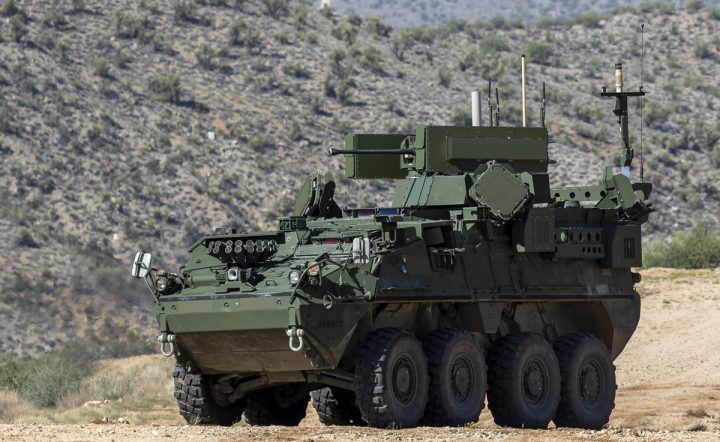
That power and weight profile explains the family’s foothold in mobile short-range air defense. Four MHR-family panels equip each mission equipment package on the US Army’s Stryker-based Mobile Short-Range Air Defense (M-SHORAD) Increment 1, now fielded as the SGT Stout, and DRS radars also feature on the US Marine Corps’ Marine Air Defense Integrated System (MADIS). The smaller Advanced Compact Hemispheric Radar (aCHR) covers APS, the third market named in the announcement, detecting rocket-propelled grenades, antitank guided missiles and tank rounds. The family’s ASTERIX output, the European air surveillance standard, eases integration into allied command-and-control networks.
DRS UK and the European Counter-UAS Radar Competition
The radars are not new to British service. In August 2018, the British Army became launch customer for the Drone Dome counter-drone system from Israel’s Rafael Advanced Defense Systems under an urgent capability requirement, with RADA’s MHR as primary sensor, then rated to detect drones at 3 to 5 km, protecting sites where British forces deploy. The system paired the radar with electro-optical sensors and RF jamming. That UK Ministry of Defence tender was won ahead of Israel Aerospace Industries’ Elta and Italy’s Leonardo, the group that now controls the radar’s maker.
The European market DRS UK targets is crowded. Saab’s Giraffe 1X, Hensoldt’s Spexer family, Thales’ Ground Master 200 and UK-based Blighter Surveillance Systems all compete for drone-detection and very short-range air defense (VSHORAD) requirements across NATO’s European members. All four already manufacture in Europe, so local production removes a handicap for DRS rather than creating an edge. Max Cohen, senior vice president and general manager of the tactical radar portfolio, said the local capacity positions DRS UK “to support future export growth and deliver greater value to customers across the UK and Europe.”
British manufacturing does not, however, clear the European Union’s content rules. The EU’s €150 billion Security Action for Europe (SAFE) loan instrument requires at least 65% of component value to originate in the EU, the European Economic Area or Ukraine. Talks on UK participation collapsed on November 28, 2025, leaving British suppliers to compete on third-country terms within the remaining 35%. Under SAFE, a radar built in Britain carries no advantage over one built in Maryland.
Analysis: DRS UK reads first as a bid for British programs of record and only second as a European export platform. London has made domestic content and supply-chain resilience central to its defense industrial policy, and a production line on British soil lets DRS bid for British requirements as a UK supplier rather than an importer. For EU buyers spending SAFE money the calculus is unchanged, so continental growth will likely hinge on teaming with EU-based integrators able to absorb DRS content within the third-country allowance. A third production node also diversifies supply for a radar family underpinning US short-range air defense.
The open questions are practical: the site’s location, annual panel output, when the first UK-built units ship and whether production covers the ieMHR, the larger exMHR or newer variants such as the C-band cxMHR. The decisive milestone will be a first contract placed through DRS UK by the Ministry of Defence or a British integrator. Leonardo DRS’s next quarterly earnings report may add detail.