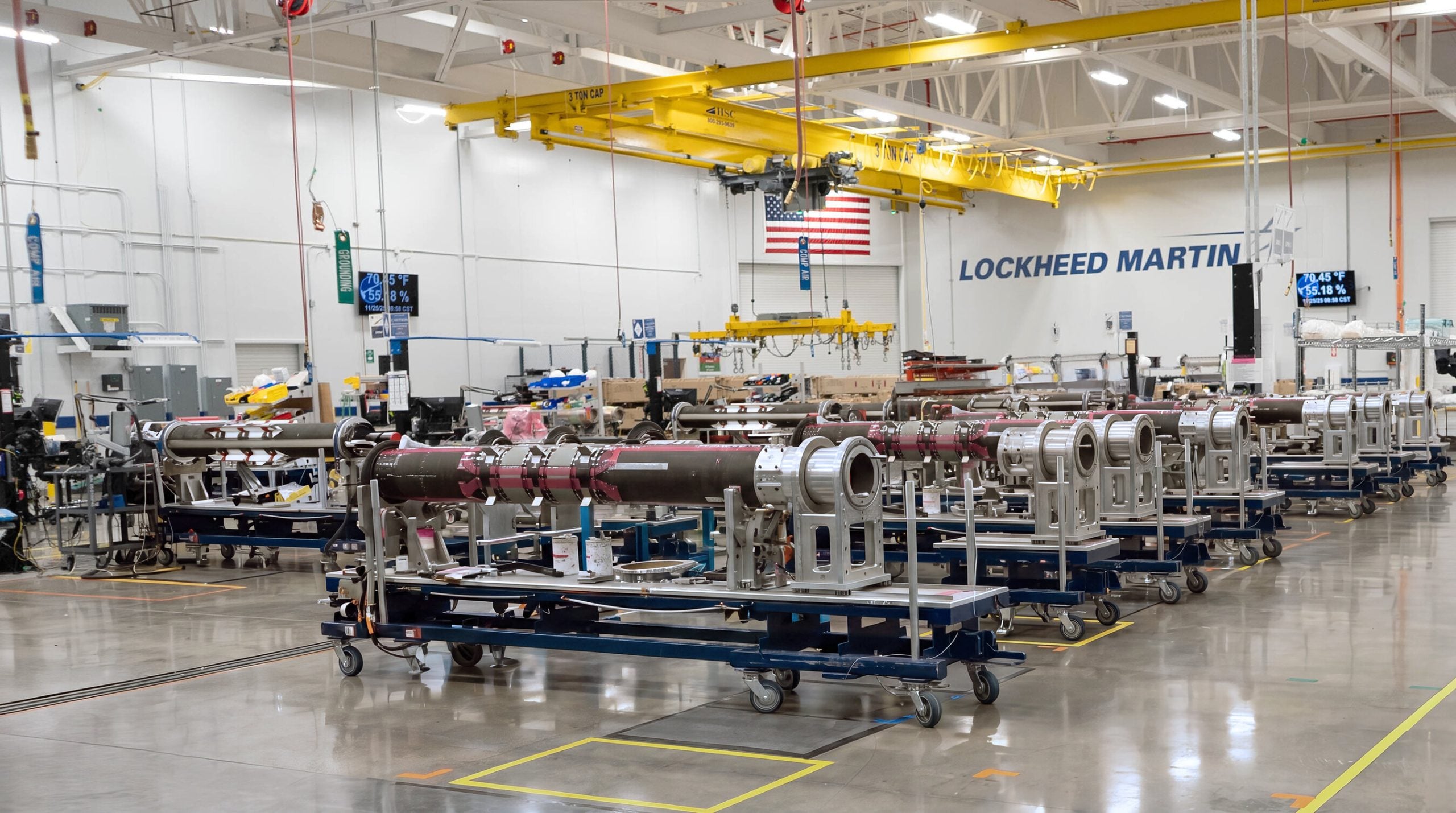
Boeing has received an undefinitized contract action (UCA) valued at approximately $14.7 billion from Lockheed Martin to scale production of seekers for the Patriot Advanced Capability-3 Missile Segment Enhancement (PAC-3 MSE) interceptor, the company announced on October 5, 2026. The award allows Boeing to triple seeker output in Huntsville, Alabama, under a seven-year framework agreement with the U.S. Department of War (DoW).
The contract is the latest subtier award in a production surge the DoW launched on January 6, 2026, when it signed a framework with Lockheed Martin to raise PAC-3 MSE capacity from roughly 600 to 2,000 interceptors a year by the end of 2030. Boeing signed its own seeker framework on April 1. The Army followed with a $4.76 billion UCA for year one in April and a modification of up to $53.86 billion on July 29, bringing the multiyear prime contract to $58.62 billion. On September 8, L3Harris received a $4.7 billion, seven-year subcontract from Lockheed Martin for the missile’s propulsion.
How the PAC-3 MSE Seeker Drives Hit-to-Kill Intercepts
The Boeing seeker governs the interceptor’s endgame. Lockheed Martin describes it as a high-power, all-weather active Ka-band radar that feeds range, range rate, and angle data to the missile’s homing guidance. In midcourse flight, the MSE relies on inertial navigation and command updates uplinked from the Patriot fire control system through a Multi-band Radio Frequency Data Link (MRFDL). Shortly before intercept, the seeker acquires the target, selects an aim point, and initiates autonomous terminal homing.
That precision is what makes hit-to-kill work. Rather than a blast-fragmentation warhead, the PAC-3 family destroys targets through direct impact, using a forebody ring of 180 small solid-propellant attitude control motors for rapid divert and a lethality enhancer to increase lethal radius. The MSE adds an 11.4-inch dual-pulse solid rocket motor, larger fins, and upgraded actuators and thermal batteries; the second pulse is reserved for long-range or high-altitude engagements. Publicly available specifications indicate a length of about 5.2 meters and a launch weight near 370 kilograms. Open-source range estimates vary widely, and Lockheed Martin does not publish an official figure. A Patriot M903 launcher carries 12 MSE rounds, or six MSE alongside eight PAC-3 Cost Reduction Initiative (CRI) missiles.
Boeing says its seekers allow the interceptor to engage hostile aircraft as well as ballistic, cruise, and hypersonic missiles. The Army validated updated seeker algorithms against air-breathing threats in a June 26, 2025, flight test at White Sands Missile Range, New Mexico. Because every MSE round carries one seeker, Boeing’s line effectively caps how many interceptors Lockheed Martin can deliver, regardless of how much airframe or motor capacity comes online.
How Boeing and Lockheed Martin Are Scaling PAC-3 Seeker Production
Boeing has delivered more than 6,000 PAC-3 seekers from Huntsville since 2000 as a Lockheed Martin subcontractor. The company has invested more than $200 million in the site since 2024, including a 35,000-square-foot facility expansion, and says deliveries rose by more than 30% in 2025. In October 2025, Boeing received multiyear contracts worth about $2.7 billion for more than 3,000 seekers at rates of up to 750 units a year through 2030. The new UCA is more than five times that value.
Neither company has disclosed the quantities, unit price, or delivery schedule tied to the $14.7 billion award, and its terms remain subject to negotiation. Tripling Boeing’s 2025 output, which the company targeted at 650 to 700 seekers, would put annual production near 2,000 units, in line with Lockheed Martin’s interceptor goal. Boeing has not confirmed that figure, nor said whether the new action absorbs or adds to the October 2025 awards.
Production ramp-up and hiring began after the April framework announcement, and Boeing expects the contract to create hundreds of direct and indirect jobs in the Huntsville area. The company says it has also restructured supplier relationships for a more resilient and scalable supply chain, installed new production technology, and tightened process controls to raise first-time quality. Steve Parker, president and CEO of Boeing’s defense, space and security business, credited early investment and a focus on execution for positioning the company to deliver seekers at record levels in the near term. The PAC-3 award follows the seven-year framework agreements Boeing signed on August 14 with the DoW and Raytheon to increase Standard Missile-3 hardware production.
Analysis: With the propulsion and seeker subcontracts now in place, the DoW framework model has pushed long-term demand certainty down to two of the most critical PAC-3 MSE subtier suppliers. The seeker award alone equals roughly a quarter of the prime contract’s face value, though scopes and periods may not map one to one. That ratio shows where cost and industrial risk sit in a hit-to-kill interceptor: in radio-frequency hardware and precision electronics, not the airframe. Reaching 2,000 rounds a year by 2030 now depends less on contracting than on Boeing’s supplier base, Huntsville workforce growth, and the annual appropriations the multiyear structure still requires.
Next milestones include definitization of both Boeing’s UCA and Lockheed Martin’s prime contract, which will fix pricing, quantities, and delivery schedules, along with fiscal 2027 appropriations for PAC-3 procurement. Boeing reports third-quarter results on October 27, 2026, which may offer further detail on the seeker ramp.