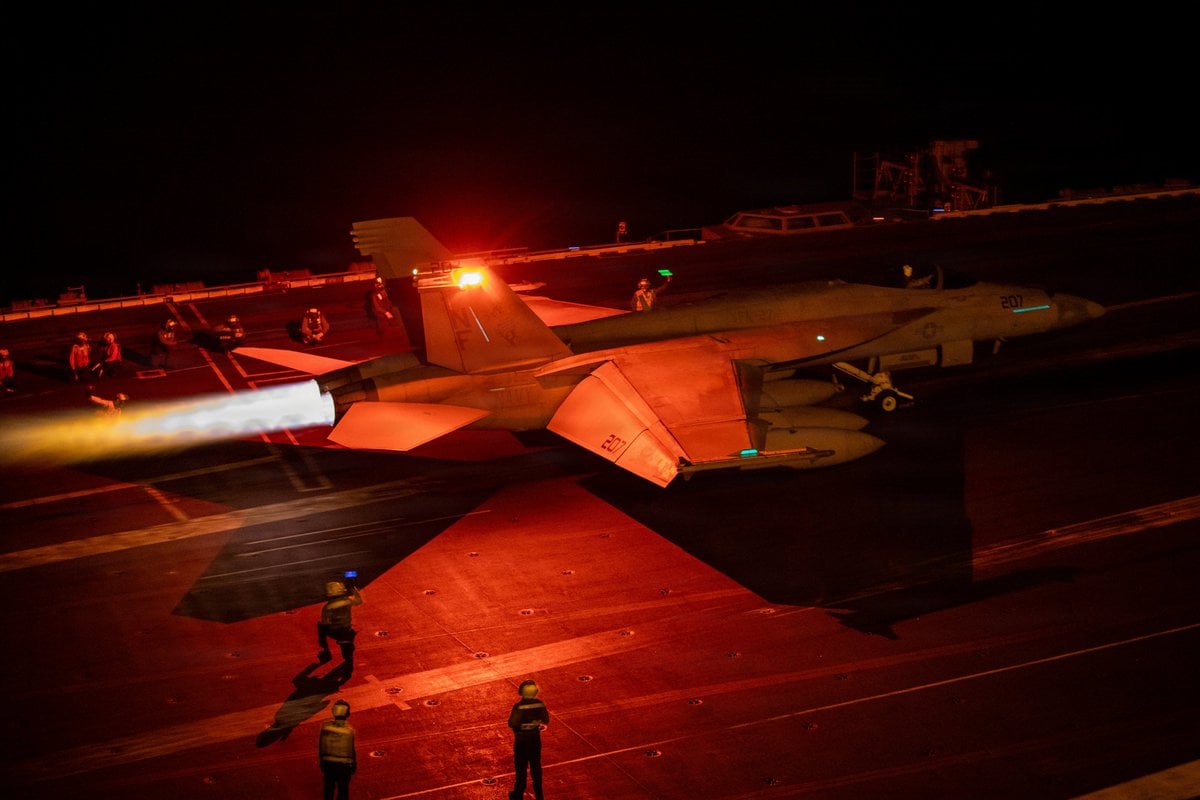
U.S. Central Command released imagery on September 26, 2026, of an F/A-18 Super Hornet launching from the USS George Washington (CVN-73) as the Nimitz-class carrier conducted flight operations in the Middle East. The release confirms the carrier remains fully operational three weeks after an Iranian ballistic missile attack targeted the strike group near the Strait of Hormuz, and continues generating sorties from the Arabian Sea.
George Washington, the Navy’s only forward-deployed carrier, left its homeport at Yokosuka, Japan, on May 23, 2026, on what began as a routine Indo-Pacific patrol with Carrier Air Wing 5 embarked. In mid-August, the ship was redirected through the Strait of Malacca to relieve the USS Abraham Lincoln (CVN-72), which had by then logged more than 260 consecutive days underway, sustaining U.S. operations against Iran since the war began on February 28, 2026. George Washington reached the Arabian Sea on August 19. Iranian state media claimed the Islamic Revolutionary Guard Corps struck the carrier with ballistic missiles on September 5; the Pentagon has not confirmed any damage or casualties. The September 26 imagery follows Iran’s latest ceasefire offer, a seven-day plan to reopen the strait, which the Trump administration rejected the same day.
USS George Washington: Nimitz-Class Design Meets Super Hornet Air Power
George Washington is the sixth of ten Nimitz-class carriers, roughly 333 meters long and displacing approximately 97,000 tons at full load, powered by two nuclear reactors driving four shafts to speeds in excess of 30 knots. The ship embarks Carrier Air Wing 5, the Navy’s only forward-deployed wing, with roughly nine squadrons and 5,000 personnel, including F/A-18E/F Super Hornet and F-35C Lightning II strike fighters, E-2D Hawkeye early-warning aircraft, and MH-60R/S Seahawk helicopters. Escorting the carrier in the Arabian Sea are the Ticonderoga-class cruiser USS Robert Smalls (CG-62) and the Arleigh Burke-class destroyer USS Shoup (DDG-86), the latter reportedly coordinating integrated air and missile defense for the strike group.
The Super Hornet pictured launching from the carrier’s deck measures 18.5 meters long with a 13.7-meter wingspan, publicly available Navy specifications indicate, and is powered by two General Electric F414-GE-400 turbofans producing roughly 22,000 pounds of afterburning thrust each. Maximum takeoff weight runs to 29,900 kilograms, with combat radius of approximately 720 kilometers on an interdiction profile. The jet carries an internal 20mm M61A2 cannon and mounts ordnance across eleven hardpoints, including AIM-9X and AIM-120 air-to-air missiles, Joint Direct Attack Munitions, and Harpoon anti-ship weapons, cued by an AN/APG-79 active electronically scanned array radar on Block II airframes. Sustained strike and escort sorties over the strait require the air wing to generate enough cycles for continuous combat air patrols while the carrier maneuvers under the same missile threat, reportedly including a Qasem Basir variant Iran claims, without independent confirmation, to have fired on September 5.
Carrier Rotation Strain Deepens as Ceasefire Talks Collapse
The carrier’s arrival gave the Navy dual-carrier coverage in the Middle East alongside the USS George H.W. Bush (CVN-77), sustaining the naval blockade of Iran while Lincoln’s crew rotated home after its marathon deployment. Adm. Brad Cooper, the CENTCOM commander, said on September 19 that his forces had escorted more than one billion barrels of crude oil through the Strait of Hormuz and protected more than 2,000 commercial transits since the blockade took hold, while Iranian exports through the strait remained at zero. That posture carries a cost elsewhere: with George Washington committed to the Middle East, the Western Pacific has gone without a persistently forward-based U.S. carrier, a gap the Navy expects to close only once USS Theodore Roosevelt (CVN-71) deploys from San Diego following a maintenance availability.
Iran has tried repeatedly to convert battlefield pressure into a diplomatic exit. At the United Nations on September 24, Iranian officials proposed a 60-day regional ceasefire and phased reopening of the strait, then narrowed the offer on September 26 to seven days in exchange for ending the blockade. People familiar with the discussions said the Trump administration rejected the proposal and that the president told aides he expects to resume bombing Iran after November’s midterm elections. Brent crude traded above $103 a barrel in the aftermath, a reminder that the standoff over Hormuz continues to weigh on global energy markets even as Central Command’s photograph depicts routine flight deck operations.
Analysis: The imagery’s significance lies less in what it shows than in what it confirms: a carrier struck by Iranian ballistic missiles three weeks earlier is still generating sorties at a normal operational tempo, and the Trump administration has chosen to keep pressing the blockade rather than accept an offramp Tehran has floated twice in three days. That choice extends a carrier rotation the Navy had hoped to shorten, delays the return of persistent U.S. carrier presence to the Western Pacific, and signals that U.S. officials are betting continued attrition of Iran’s tanker fleet, not a negotiated reopening, will force Tehran’s hand before the next anti-ship missile attempt succeeds.
George Washington has no announced relief date, and the Navy has not said when Theodore Roosevelt will sail or how long George H.W. Bush remains in theater. Iran’s own ceasefire deadline, tied to its September 24 roadmap, lapses within days, and officials have signaled renewed strikes could follow the November midterms if talks stay frozen. Whether Central Command’s blockade figures hold, whether Iran attempts another anti-ship ballistic missile launch, and how the parallel Houthi threat to the Bab el-Mandeb Strait affects escort assignments will shape the strike group’s next weeks in the Arabian Sea.