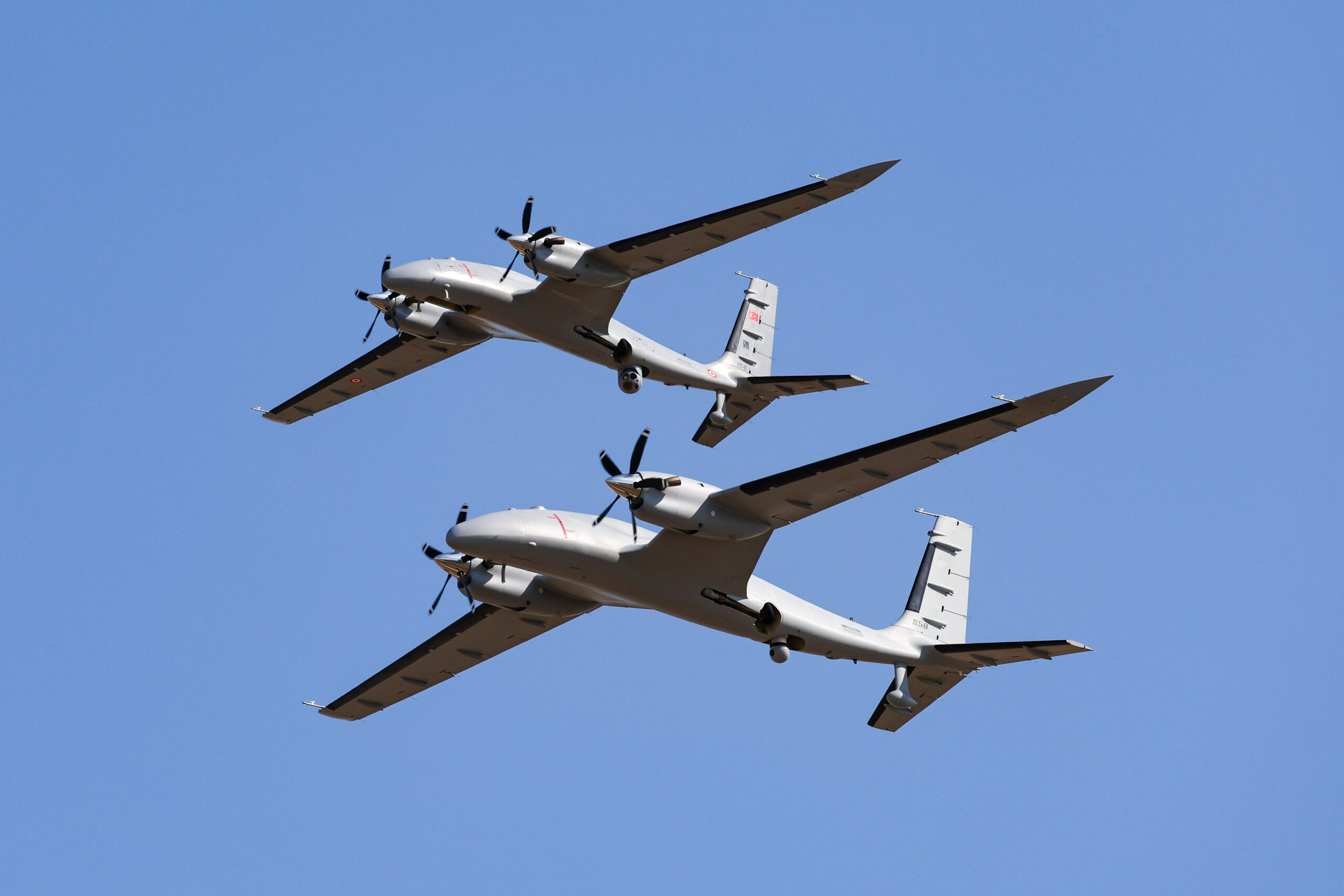
Royal Saudi Naval Forces personnel have completed training on Türkiye’s Bayraktar AKINCI unmanned combat aerial vehicle (UCAV), Baykar announced on September 25, 2026, marking the first graduating class trained specifically for naval operation of the high-endurance strike drone. The Turkish manufacturer said 15 pilots and 15 mechanical and electronic technicians completed the course at its Çorlu Flight Training and Test Center in Tekirdağ province, northwestern Türkiye.
The graduation follows the AKINCI export and cooperation agreement Baykar and Saudi Arabia’s Ministry of Defense signed on July 18, 2023, in Jeddah, during Turkish President Recep Tayyip Erdoğan’s visit and in the presence of Saudi Crown Prince Mohammed bin Salman. Baykar General Manager Haluk Bayraktar characterized it as the largest defense and aerospace export contract in the Turkish Republic’s history, covering aircraft, training, technical support, and logistics for both the Royal Saudi Air Force (RSAF) and the Royal Saudi Naval Forces (RSNF). Weeks later, Saudi Arabian Military Industries signed a separate agreement with Baykar to localize AKINCI production inside the Kingdom, part of the wider Saudi Vision 2030 defense-localization drive. Media reports have placed the aircraft contract’s value near $3 billion, though neither government has confirmed price, quantity, or delivery schedule. An earlier graduation on October 13, 2025, trained 76 enlisted personnel and 36 officers from the RSAF on the same airframe; this month’s class is the first composed entirely of naval crews.
AKINCI UCAV Brings Persistent Maritime Watch to the Saudi Navy
Baykar markets AKINCI as a twin-engine, medium-altitude, long-endurance UCAV, a heavier and more capable design than the single-engine Bayraktar TB2 that built the company’s export business. Saudi Arabia is the only AKINCI customer that had not already fielded the smaller TB2 before ordering the larger aircraft. Baykar’s published specifications for the type include:
- Variants: AKINCI-A (twin 450-horsepower engines), AKINCI-B (twin 750-horsepower turboprops), and AKINCI-C (twin 850-horsepower engines, 1,700 horsepower combined)
- Maximum takeoff weight of approximately 6 tons
- Payload capacity of up to 1,500 kilograms across internal and external stations
- Endurance beyond 24 hours at an operational altitude of 30,000 feet
- A sensor and datalink suite built around an ASELSAN ASELFLIR-500 electro-optical and infrared turret, synthetic aperture radar, and dual satellite communication links
For a navy, endurance matters as much as any weapon. An aircraft that can loiter for more than a day while scanning the sea with radar and infrared sensors can build a continuous surface picture across a wide patrol box and relay contacts to ships or shore commanders without needing to fire a shot. In size and mission scope, AKINCI sits in the same broad class as the United States’ MQ-9 Reaper, though Baykar has pursued a faster, lower-cost export model that has already placed the smaller TB2 across dozens of air arms.
Stand-Off Missiles Extend AKINCI’s Reach Against Ships
AKINCI’s payload also opens the door to heavier munitions than typical tactical drones carry. Roketsan has fire-tested its UAV-230 and UAV-300 supersonic ballistic missiles from the airframe, and in a September 2026 test over the Black Sea, a UAV-300 launched from an AKINCI struck a maritime target more than 250 kilometers away, a demonstrated test distance rather than a published maximum range. That standoff distance exceeds the effective engagement range of the air-defense systems fitted to most surface combatants worldwide. Roketsan’s SOM cruise missile has also been listed among the aircraft’s compatible weapons, and Baykar has separately demonstrated an air-to-air intercept of a high-speed target drone, a self-escort capability distinct from the naval strike role but relevant to long overwater patrols. Smaller engagements can be handled with Roketsan’s laser- and infrared-guided MAM-series precision munitions. Baykar has not said which weapons, if any, will accompany the aircraft delivered to the RSNF, nor whether Saudi crews have begun weapons qualification alongside the flight and maintenance training announced this week.
Analysis: The graduation puts an armed, persistent-surveillance UCAV within reach of a Gulf and Red Sea navy for the first time, at a moment when both waterways have seen recurring attacks on merchant and naval shipping. A drone that can loiter above shipping lanes for more than a day, cued by satellite links rather than a manned aircraft’s fuel and crew limits, offers the RSNF a cheaper way to extend maritime domain awareness across its Red Sea and Persian Gulf approaches than adding frigates or manned patrol aircraft. The deal also deepens Ankara’s position as a defense supplier to Riyadh independent of Washington or European capitals, extending a bilateral relationship that already spans air, land, and now naval unmanned systems, and gives other Gulf navies a working example of what an AKINCI-based maritime posture looks like in practice.
Baykar has not disclosed when the newly trained Saudi crews will take delivery of operational aircraft, what missions the RSNF plans to fly, or whether the naval fleet will carry the same weapons already tested on Turkish and export airframes. The total number of aircraft under contract, the pace of the SAMI localization work, and the program’s final cost remain undisclosed by both governments. The next milestone to watch is whether Baykar or Riyadh confirms an operational employment date or a first at-sea deployment, which would mark the transition from training to a fielded naval capability.