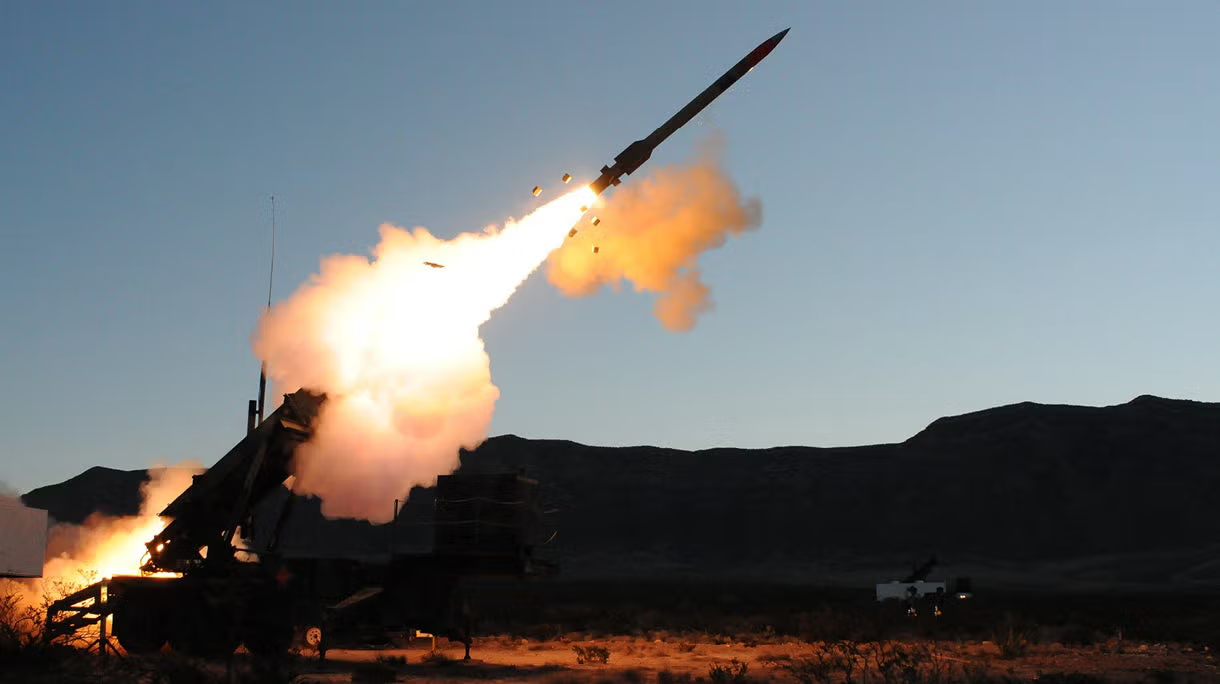
L3Harris Technologies argued in a sponsored commentary published September 24, 2026, that the United States needs both low-cost munitions and high-end interceptors, and that its Missile Solutions business can supply either at scale. Scott Alexander, president of propulsion systems at the unit, rests the case on company-reported figures. Publicly available budget data support the pairing logic, but they place the binding constraint on interceptor production in rocket motors and sub-tier suppliers rather than in doctrine.
The argument follows Operation Epic Fury, the U.S. and Israeli campaign against Iran that began on February 28, 2026, and ran 39 days of air and missile operations before a ceasefire. Iran fired more than 2,000 drones and 500 ballistic missiles in the first four days, according to Pentagon briefings cited in independent analyses. Those analyses, built on Pentagon budget documents, estimate that U.S. forces may have expended more than half of prewar inventory for four of seven critical munitions. Pentagon procurement data also show a gap in new Terminal High Altitude Area Defense (THAAD) interceptor deliveries to the United States that runs from 2023 to April 2027.
Interceptor Production and the Cost Gap Exposed by the Iran War
The commentary divides the problem into two tiers. Low-cost interceptors, it argues, suit cases where a defender must engage ten threats in ten seconds or cannot justify firing a multimillion-dollar round at a drone built in a garage. Exquisite systems suit maneuvering targets at altitudes where cheaper rounds cannot reach. The Iran campaign put numbers on that gap. Raytheon’s Coyote and Anduril’s Roadrunner interceptor drones already occupy the low-cost tier, so L3Harris competes there as one supplier among several.
A Shahed-type attack drone costs roughly $35,000 by public estimates. A Patriot Advanced Capability-3 Missile Segment Enhancement (PAC-3 MSE) interceptor costs about $4 million, according to Army budget documents, the price of more than 110 such drones. The Advanced Precision Kill Weapon System (APKWS), a laser-guided 70 mm rocket that L3Harris equips with a proximity fuze for its VAMPIRE counter-drone launcher, costs an estimated $20,000 to $30,000 per round. Lockheed Martin unveiled the PAC-3 Adapted Capability Effector on July 20, 2026, with a target price below half that of the MSE, but has not published a figure.
Independent analyses found that U.S. forces largely held Patriot and Standard Missile-6 (SM-6) rounds back from cheap drones, yet lacked enough low-cost interceptors, so U.S. and Gulf crews relied on gun-armed helicopters and fixed-wing aircraft and on air-to-air missiles, some costing about $1 million each. The same analyses conclude that no cheaper substitute exists for Patriot, THAAD or Standard Missile against ballistic threats. That record supports the layered argument. It also shows the shortfall appeared in both tiers, a production problem before a doctrinal one.
Solid Rocket Motor Capacity: What L3Harris Has Documented So Far
The commentary cites production of more than 115,000 solid rocket motors, about 60 facilities under construction, more than 1 million square feet of added space and a capital buildout above $3 billion. It does not say the 115,000 figure is annual; company site materials tie it to yearly output at Camden, Arkansas, across motors from hand-sized to truck-sized. The mix matters because each PAC-3 MSE or THAAD round consumes one primary motor. Lockheed Martin plans to raise PAC-3 MSE output from about 600 to 2,000 a year by 2030 and THAAD output from 96 to 400.
The Department of War announced two seven-year framework agreements with L3Harris and Lockheed Martin on July 27, 2026. L3Harris says they will nearly triple PAC-3 MSE propulsion output and quadruple THAAD booster and divert system output. Lockheed’s PAC-3 target implies about 3.3 times current output; L3Harris has not published the baseline for its own multiple. On September 8, 2026, L3Harris disclosed a $4.7 billion undefinitized contract award from Lockheed for PAC-3 MSE propulsion over seven years, and it cautioned that continued funding up to the full value is a risk.
Supply-side limits sit below the motor makers. L3Harris and Northrop Grumman remain the only two domestic suppliers of large solid rocket motors, while Anduril, Ursa Major and X-Bow are still ramping or qualifying products. Industry analyses identify a single U.S. producer of ammonium perchlorate, shared sub-tier suppliers and nozzle lead times of seven to 10 months as chokepoints for both incumbents. The Pentagon closed a $1 billion convertible preferred investment in Missile Solutions on April 23, 2026, though L3Harris has since postponed the unit’s public offering to mid-2027 at the earliest.
Ramjet Propulsion and Manufacturing Gains Behind the Affordability Claim
The commentary says L3Harris’s liquid- and solid-fueled ramjets can lower the cost of interceptors and strike munitions while extending range, and that internal investment in the technology rose more than sixfold over two years, without giving a baseline. The public test record is narrower. On June 3, 2026, L3Harris reported a successful transition from solid booster to ramjet in a ground test of a potential propulsion solution for the Army’s Precision Strike Missile (PrSM) Increment 4, a strike weapon fired from High Mobility Artillery Rocket System (HIMARS) and M270 launchers. On August 25, 2026, the company said a full-scale solid-fueled ramjet campaign at its Orange County, Virginia, site produced results in line with expectations, with more ground tests planned later this year.
L3Harris lists a long-range, maneuverable interceptor among the applications, but it has disclosed no unit cost, program of record or flight-test date for one. The commentary also credits artificial intelligence-assisted nondestructive testing, advanced propellant mixing, robotics and additive manufacturing with shortening motor production cycles, without quantifying the reductions. The one concrete example in company materials is automated digital X-ray inspection at Camden, which L3Harris says has lowered inspection and cycle times. The portfolio also includes platform-agnostic seekers, electronic safe-and-arm devices compatible with existing inventory and longer-range counter-drone options, none with a published price.
The affordability evidence already in the field is more modest still: the proximity fuze that adapts the APKWS rocket to counter-drone use, which reached Ukraine in 2023 aboard VAMPIRE and is the only fielded example the commentary names.
Analysis: The both-and thesis is sound, and L3Harris sits on both sides of it: it supplies motors for PAC-3, THAAD and Standard Missile, and fuzes for low-cost counter-drone rounds. But the argument relocates the constraint rather than removing it. Cost per round matters less than qualified motors, energetics, nozzles and seekers, and low-cost interceptors will draw on many of the same sub-tier suppliers as high-end ones. Framework agreements and undefinitized awards signal demand; they do not deliver rounds, and first-delivery lead times for critical munitions now run 36 months or more. The metric that will settle the debate is delivered interceptors per year, not announced capacity.
L3Harris expects its PAC-3 and THAAD contracts to be finalized later this year, and its two new Camden facilities for PAC-3 motors, which broke ground in June 2026, are due to be operational in 2027, when THAAD interceptor deliveries are scheduled to resume. More ramjet ground tests are planned for late 2026. Unknowns include the unit price of ramjet-powered munitions, how many low-cost interceptors the Pentagon will fund, and whether fiscal 2027 appropriations match the framework volumes.