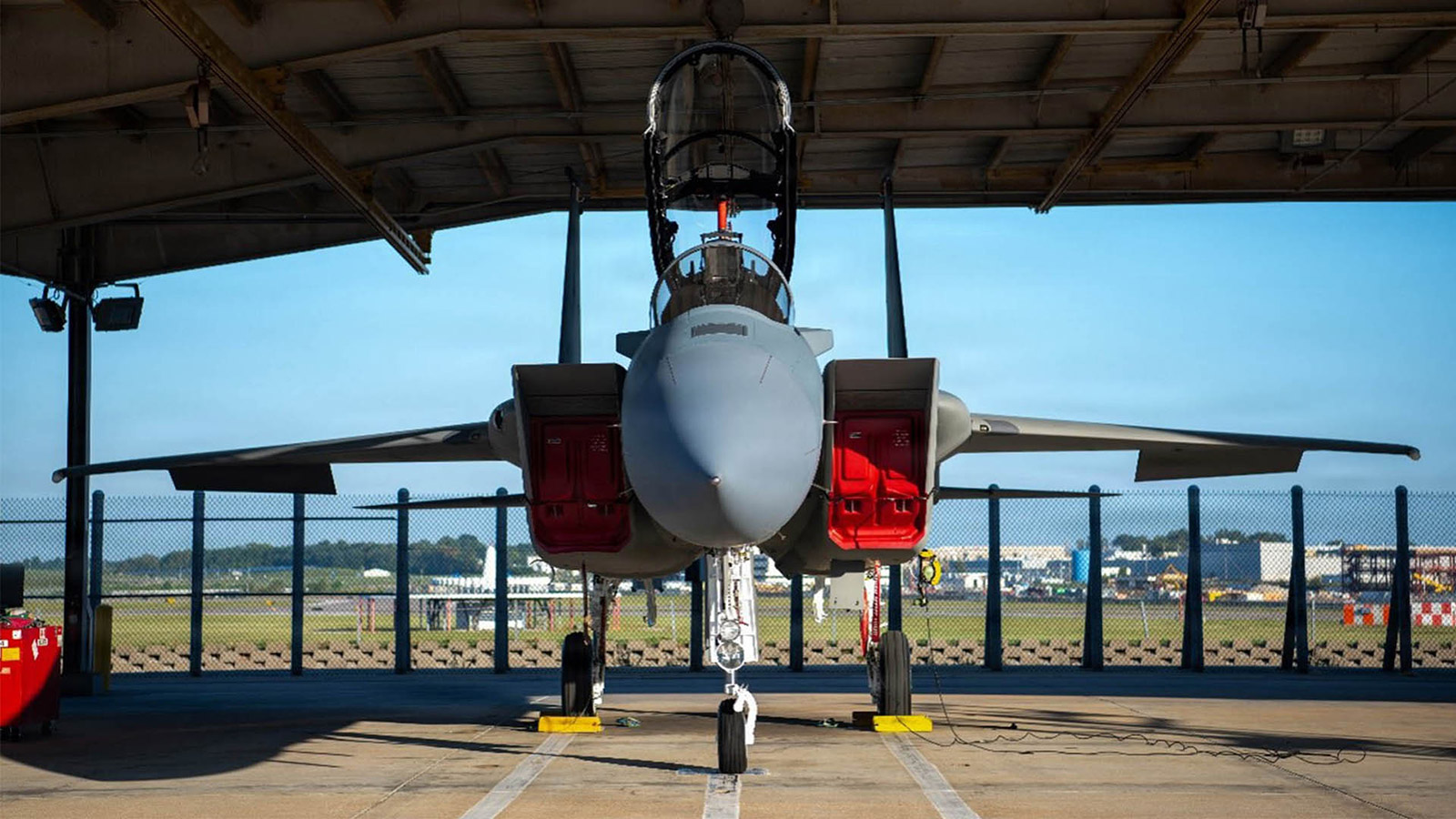
The U.S. Air Force awarded Boeing a $2.38 billion contract on September 29, 2026, for 22 F-15EX Eagle II fighters under production Lot 7, bringing the number of F-15EX aircraft under contract to 120 across Lots 1 through 7. The service closed the deal one day before the end of fiscal 2026, locking in reconciliation funding that would otherwise have been reduced after October 1.
The award follows the Air Force’s April 2026 decision to more than double its planned F-15EX fleet, from 129 to 267 aircraft. That objective caps six years of revisions: the service projected up to 144 jets when it placed the first order in 2020, cut the plan to 80 in 2022, restored it to 104 in 2023 and raised it to 129 in 2025. According to the Air Force, the expanded buy completes existing F-15EX units, then begins recapitalizing the 216-aircraft F-15E Strike Eagle fleet.
F-15EX Contract Terms: Lot 7 Funding, Unit Cost and Production Rate
Lot 7 draws on two funding streams: $115 million from the fiscal 2026 appropriation and $2.8 billion from the reconciliation package signed into law in July 2025, known as the One Big Beautiful Bill Act. The reconciliation money carried a condition: funds not obligated by October 1, 2026, faced an 8.3 percent reduction. That clause set the negotiating clock.
At $2.38 billion for 22 airframes, the average cost works out to roughly $108 million per aircraft. That figure excludes the General Electric F110-GE-129 engines, which the Air Force procures separately.
The quantity shifted during negotiations. Earlier Air Force budget documents projected a Lot 7 buy of 21 aircraft; the final award covers 22, and neither party has publicly explained the additional airframe. According to the Air Force, negotiators kept all 22 jets within available reconciliation funding despite industry-wide inflation and a labor strike at Boeing’s St. Louis facility that halted the F-15EX line from August 4 to November 17, 2025.
The strike still shapes the delivery schedule. Boeing delivered F-15EX-22, the first Lot 3 aircraft, in August 2026 and will continue Lot 3 deliveries through the end of the year. With roughly two dozen aircraft delivered since the first two jets reached Eglin Air Force Base, Florida, in 2021, close to 100 contracted F-15EXs remain in the pipeline. Boeing is working with the Air Force and the Department of War to raise output to two aircraft per month.
“Boeing is committed to delivering this critically important aircraft to the U.S. Air Force, which will strengthen the nation’s ability to project power and stay ahead of emerging threats around the world,” said Christina Upah, Boeing F-15 program vice president.
Eagle II Capabilities: APG-82 Radar, EPAWSS and 29,500-Pound Payload
The F-15EX is a two-seat multirole fighter derived from Boeing’s Advanced Eagle design, the baseline behind Qatar’s F-15QA. Publicly available specifications indicate a maximum takeoff weight of 81,000 pounds, a maximum payload of 29,500 pounds and two General Electric F110-GE-129 afterburning turbofans rated at approximately 29,500 pounds of thrust each. Top speed is listed at Mach 2.5 at altitude.
Mission systems separate the aircraft from legacy Eagles. The Raytheon AN/APG-82(V)1 active electronically scanned array (AESA) radar is the primary sensor, complemented by the Lockheed Martin Legion Pod carrying the AN/ASG-34(V)1 IRST21 infrared search and track sensor for passive detection. Self-protection relies on the BAE Systems AN/ALQ-250 Eagle Passive/Active Warning and Survivability System (EPAWSS), which integrates radar warning, threat geolocation and countermeasures dispensing. Digital fly-by-wire controls, a large area display touchscreen cockpit and an Open Mission Systems architecture allow new software and weapons to be integrated without major hardware redesign.
Weapons capacity drives the Air Force’s case. The F-15EX can carry up to 12 air-to-air missiles, including the AIM-120 AMRAAM and AIM-9X Sidewinder, and its centerline station can accommodate outsized standoff weapons of up to approximately 7,000 pounds, a capability the service has linked to future hypersonic munitions. In April 2026 budget briefings, Air Force officials cited the jet’s carriage capacity, its number of weapons rails and its role in the Pacific theater as the reasons it complements, rather than competes with, the F-35A.
That role is taking shape. The 142nd Wing at Portland Air National Guard Base, Oregon, received the first operational F-15EX in June 2024, and the Air Force has begun receiving aircraft designated for Kadena Air Base, Japan, where the type replaces F-15C/Ds withdrawn from permanent basing.
Analysis: Lot 7 confirms that contracting is no longer the binding constraint on the F-15EX; production is. With 120 aircraft on order against a 267-aircraft objective, the Air Force still needs to contract 147 more jets. At the targeted rate of two per month, or 24 a year, delivering the remaining backlog plus that balance would keep the St. Louis line running well into the 2030s. Boeing now also carries the Air Force’s F-47 and, following the Navy’s September 29 selection announcement, the F/A-XX, placing competing demands on its fighter enterprise just as the Eagle II line must accelerate.
Boeing will complete Lot 3 deliveries through December 2026 while ramping toward two aircraft per month. The fiscal 2027 request for 24 F-15EXs now depends on Congress, and a continuing resolution, which typically bars production rate increases, could delay that step. The broader test is whether the 267-aircraft objective survives future budget cycles; since 2020, F-15EX fleet targets have moved in both directions.