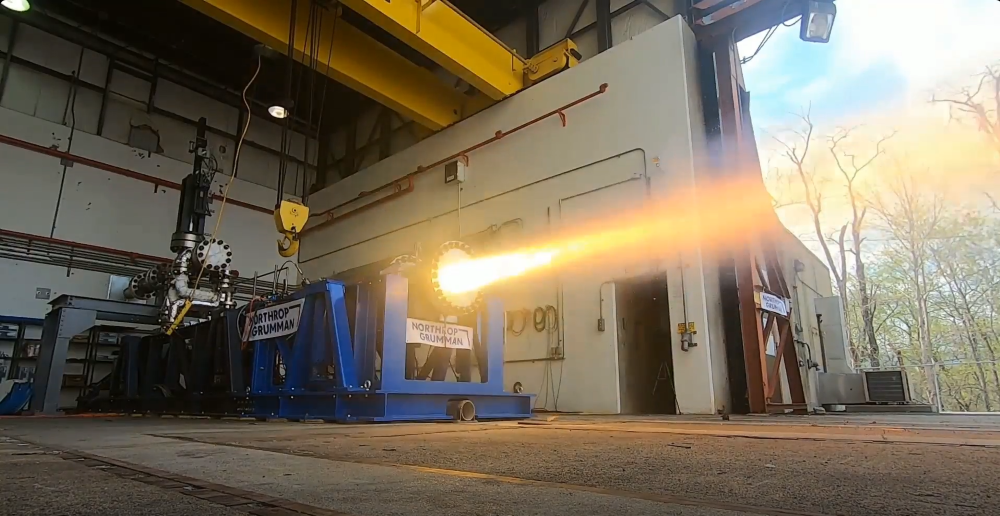
Northrop Grumman will develop solid fuel ramjet propulsion for missile prototypes under the US Army’s eXtended Range Counter-Unmanned Aircraft System (XRC) effort, backed by an $18.8 million contract with the Army Combat Capabilities Development Command Aviation & Missile Center (DEVCOM AvMC). The company announced the award on September 29, 2026, and will perform the work at Allegany Ballistics Laboratory in Rocket Center, West Virginia.
XRC is a science and technology (S&T) program, not a program of record. It aims to mature an interceptor for the Stinger Vehicle Universal Launcher (SVUL) that outranges the FIM-92 Stinger against Group 2 and Group 3 small unmanned aircraft systems (sUAS). Group 3 drones can weigh up to 1,320 pounds and fly as high as 18,000 feet under Pentagon classification. Army planning calls for an all-up-round (AUR) prototype demonstration before fiscal 2030.
How Solid Fuel Ramjet Propulsion Extends the XRC Interceptor’s Reach
The contract covers development of a solid fuel ramjet (SFRJ) and its integration into XRC missile prototypes, followed by a ground and flight test campaign to validate both the design and the production processes. Northrop Grumman says the resulting design will support scalable, cost-effective manufacturing.
A solid rocket motor carries an oxidizer blended into its propellant grain, which consumes internal volume. A solid fuel ramjet carries only fuel, typically cast as a grain lining the combustor, and burns it with atmospheric oxygen captured through an inlet during flight. According to Northrop Grumman, the volume saved goes to additional fuel, yielding greater range and energy and allowing engagements against highly maneuverable targets at safer distances from protected forces. Publicly available engineering literature points to a second benefit: a ramjet sustains thrust across much of the flyout instead of burning out early and coasting, so the missile retains more energy for terminal maneuvering.
The approach carries engineering penalties. Ramjets produce no static thrust and need a booster to accelerate them to operating speed, typically supersonic. Inlet efficiency and combustion stability become harder to manage as diameter shrinks, and the SVUL was designed around the Stinger, whose airframe measures 70 millimeters in diameter according to publicly available specifications. Northrop Grumman has not disclosed whether its design uses an integral booster, which airframe dimensions it targets, or the range and speed goals set by the Army. Publicly available figures place the Stinger’s effective range at roughly 4.8 kilometers, the baseline XRC must beat.
Erik Buice, Northrop Grumman’s vice president for missile products, said the effort will deliver “capability that engages targets farther away, protects mobile forces and strengthens layered defense against emerging aerial threats.”
XRC and NGCM: Two Paths to Longer-Range Army Drone Intercepts
Range is only one of XRC’s stated objectives. DEVCOM AvMC also wants shorter reaction time, higher lethality, better reliability and faster reloads across fixed-site and mobile configurations. The missile must work with the Forward Area Air Defense Command and Control (FAAD C2) network and, as an objective, remain lethal against traditional Maneuver Short Range Air Defense (M-SHORAD) targets, including fixed-wing and rotary-wing aircraft. SVUL compatibility would put XRC on the four-round launcher carried by the Stryker-based Sgt Stout M-SHORAD vehicle and the Avenger system, the same launcher family the Army plans to use for its Next-Generation Short Range Interceptor (NGSRI), the Stinger’s planned successor.
Northrop Grumman already serves as prime contractor for FAAD C2, the Army’s short-range air defense command-and-control program of record, giving the company a position at both the network and propulsion layers of the kill chain. Its counter-drone portfolio also includes the AiON command system for managing multiple sensors against drone swarms.
XRC runs alongside a nearer-term acquisition effort. On August 4, 2026, the Army’s Counter-Unmanned Aircraft System (C-UAS) Product Office issued a sources-sought notice for a Next Generation C-sUAS Missile (NGCM) compatible with Raytheon’s Coyote launcher. The NGCM threshold calls for defeating Group 2 and Group 3 drones beyond 16 kilometers at 6 kilometers altitude, with an objective of 25 kilometers at 8 kilometers. The Army wants a unit cost below $150,000 across a buy of at least 5,000 missiles and 50 rounds ready for operational assessment in the first quarter of fiscal 2028. XRC, by contrast, targets the SVUL, remains an S&T effort and has no publicly released range threshold.
Analysis: The award shows the Army treating propulsion, not only seekers and warheads, as a binding constraint on kinetic counter-drone defense for maneuver units. Stinger was sized to kill helicopters and low-flying jets at short range, while the Army’s own XRC planning describes Group 3 drones operating at higher altitudes and greater standoff ranges. An SVUL-compatible air-breathing round would let Sgt Stout and Avenger crews reach those targets without adding a new launcher. Cost is the open question: air-breathing hardware adds complexity, and whether a ramjet interceptor can approach the sub-$150,000 price the Army set for NGCM is unproven. The likely result is a tiered magazine: low-cost effectors for volume, air-breathing rounds for the higher and more distant threats.
Northrop Grumman has not released a test schedule, the number of prototypes involved or the contract’s period of performance. The next visible milestones are ground tests at Allegany Ballistics Laboratory, flight tests of integrated prototypes and the AUR demonstration the Army expects before fiscal 2030. Whether XRC transitions to a program of record or remains a technology feeder will depend on those results and on Army air defense funding.