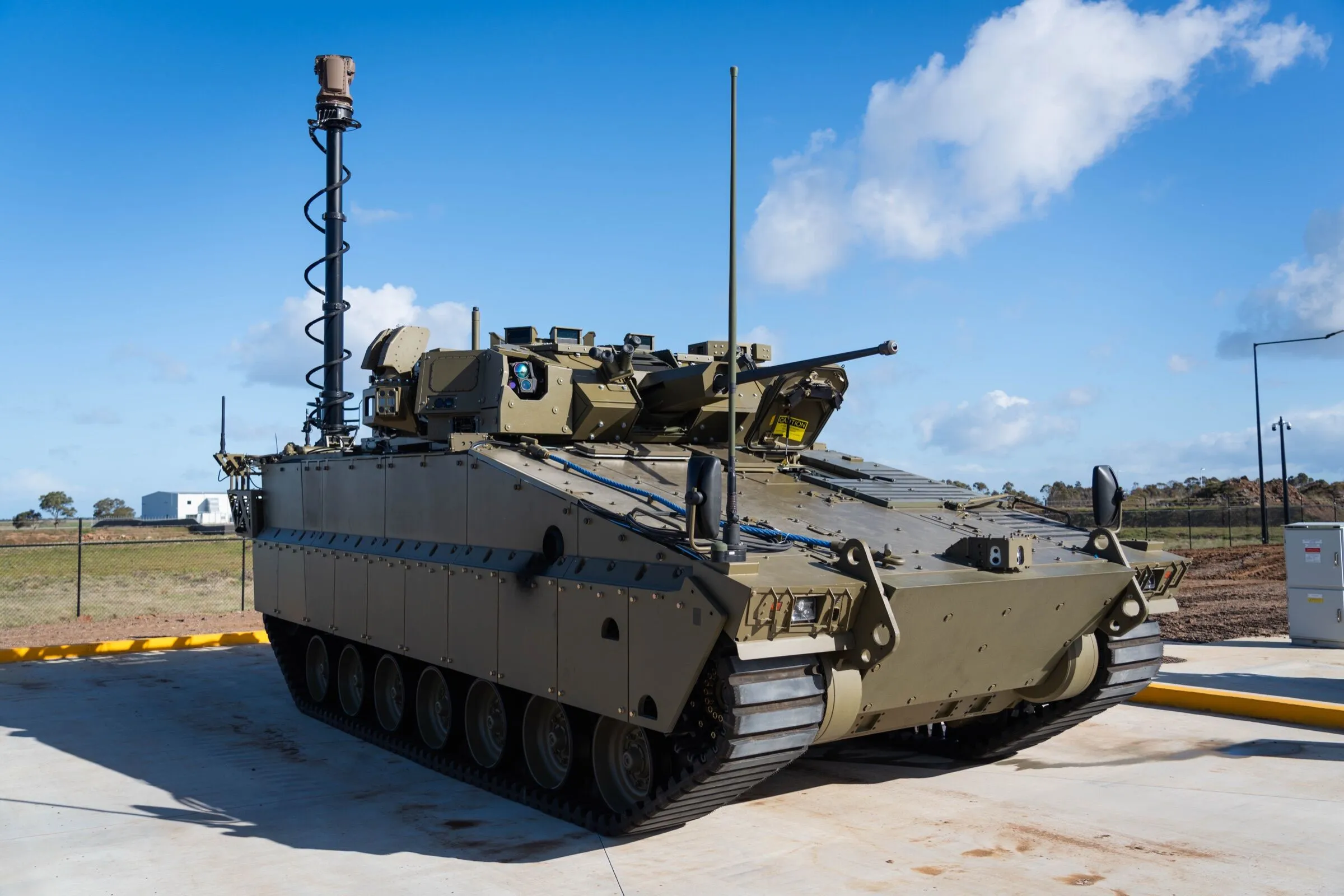
Australian sensing firm Visionary Machines and Hanwha Defence Australia (HDA) have opened a new phase of joint development to assess counter-drone sensing on the AS21 Redback Infantry Fighting Vehicle (IFV), using Visionary Machines’ Pandion Sentinel passive detection and tracking system, the companies announced on September 30, 2026. The work focuses on force protection and situational awareness for armored vehicles operating under persistent uncrewed aerial system (UAS) threat.
The activity builds on a Memorandum of Understanding (MOU) signed by Visionary Machines, HDA and Hanwha Systems at the Avalon International Airshow in March 2025. It comes as the Australian Army prepares to field 129 Redbacks under LAND 400 Phase 3 to replace its M113AS4 armored personnel carriers, and as the Australian Defence Force (ADF) builds a dedicated counter-small UAS capability under the A$1.3 billion LAND 156 project. Neither company has disclosed a contract value, a Commonwealth sponsor, or any formal link to either program.
How Pandion Sentinel Would Add Passive Drone Detection to the Redback IFV
Pandion Sentinel is a passive optical sensor array that detects, tracks and classifies drones without emitting a signal. According to the manufacturer, it covers radio-frequency (RF) controlled drones, autonomous drones and so-called “dark drones” that fly without an RF link. Company specifications list coverage of Group 1 through Group 3 UAS across air, land and maritime domains, critical-range protection beyond 1 kilometer against Group 1 targets, power draw under 250 watts, day, night and all-weather multi-spectral operation, and a vehicle-mounted configuration designed to military environmental standards. None of these figures has been independently verified, and detection ranges against larger Group 2 and 3 platforms have not been published.
The operational case rests on emissions control. Radar-based counter-UAS sensors expose the vehicle carrying them to adversary electronic support measures, while RF detectors cannot see drones that do not transmit. Fiber-optic first-person-view (FPV) drones, now common on the Ukrainian front, defeat both RF detection and jamming. An electronically silent optical sensor producing three-dimensional track data, which Visionary Machines describes as measured rather than inferred, addresses that gap without adding to the vehicle’s electromagnetic signature.
The system is hardware agnostic and designed to feed third-party command-and-control (C2) networks and counter-drone effectors. That matters on the Redback, whose publicly reported armament includes a Northrop Grumman Mk44S Bushmaster II 30mm cannon firing 30x173mm programmable airburst ammunition and an EOS R400 remote weapon station. Neither company has said whether Pandion tracks would cue those weapons through the vehicle’s fire-control system, or where the sensor heads would sit on the hull or turret.
Redback Growth Margin and the LAND 400 Phase 3 Delivery Timeline
Publicly available specifications describe the Redback as a tracked IFV of roughly 42 tonnes, powered by a 1,000-horsepower MTU eight-cylinder diesel, with a road speed above 65 km/h, a range of about 520 kilometers, and seating for a crew of three and eight dismounts. Its turret, derived from Elbit Systems’ MT30, carries the Mk44S cannon, a coaxial 7.62mm MAG 58 machine gun and a retractable twin launcher for Rafael Spike LR2 anti-tank guided missiles. Protection includes Elbit’s Iron Fist active protection system, while the Iron Vision helmet-mounted display gives crews an external view fed by turret-mounted cameras.
HDA pitches that architecture as a growth platform. “The Redback has been designed with growth and adaptability in mind, enabling the integration of emerging technologies as operational requirements evolve,” said Glenn Halupka, HDA’s head of research and development. The practical constraint is space, weight, power and cooling on a turret already crowded with sights, active protection sensors and missile launchers. Pandion’s sub-250-watt draw is modest by armored vehicle standards, but mounting and data architecture remain undisclosed.
HDA signed the LAND 400 Phase 3 acquisition and initial support contracts at the end of 2023, a package the company values at approximately A$4.5 billion. Vehicles are to be built at the Hanwha Armoured Vehicle Centre of Excellence (H-ACE) in Greater Geelong, Victoria, which opened in August 2024. Timelines announced in July 2023 called for first deliveries in early 2027 and the final vehicle by late 2028. The 129-vehicle buy reflects the 2023 Defence Strategic Review’s cut from the 450 IFVs originally planned.
Analysis: The assessment reflects a shift in how armies treat the IFV: less as a passenger under a separate air defense umbrella, more as a node responsible for its own close-in drone defense. Passive sensing suits the Australian Army’s pivot toward dispersed littoral maneuver, where emissions discipline shapes survivability. The harder question is programmatic. Without a disclosed Army sponsor or a link to LAND 156, whose systems integration partner Leidos Australia was appointed in September 2025 to deliver Group 1 and 2 counter-drone capability, Pandion on the Redback remains an industry-led demonstration. Turning it into fleet capability would require a funded requirement, fire-control integration and qualification on a fleet whose production deliveries are scheduled to begin in 2027.
Both companies will exhibit at the Land Forces International Land Defence Exposition at the Perth Convention and Exhibition Centre from October 6 to 8, 2026, the first likely venue for integration details. Key unknowns include the assessment’s duration and test venue, sensor placement, performance data against Group 2 and 3 targets, and whether the capability targets LAND 400 Phase 3 production, a later upgrade block, or Redback export campaigns run from H-ACE.