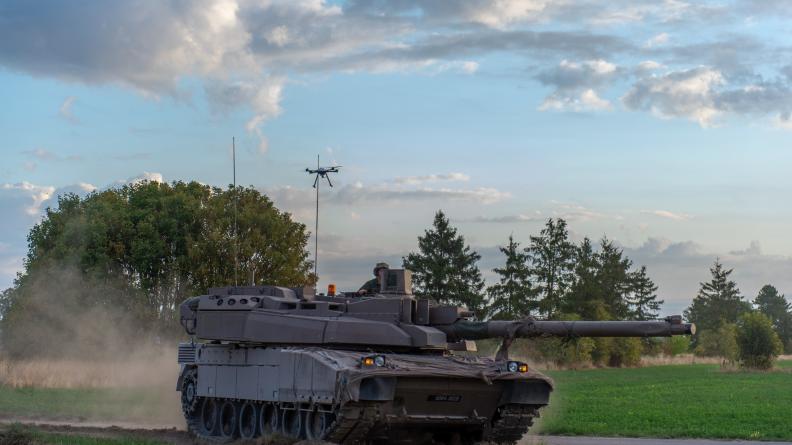
The French Army’s 501st Combat Tank Regiment (501e régiment de chars de combat, 501e RCC) has field-tested a drone teamed with its Leclerc main battle tanks during Saint-Chamond 26, a regimental exercise held September 14 to 18, 2026, on open civilian terrain near Reims. Developed under a project called Odin, the system gives the tank commander an aerial view of the vehicle’s immediate surroundings. The Army describes the first trial as conclusive.
The test lands at a pressure point for French armor. The Leclerc, in service since the early 1990s, must carry the force until a successor arrives, while the Franco-German Main Ground Combat System (MGCS) slips into the 2040s and the war in Ukraine has shown how quickly tanks without organic overwatch are found and struck. Saint-Chamond 26, named after one of France’s first tanks of 1917, mobilized 500 personnel, eight Leclercs and about 100 vehicles. After a year dominated by deployments, the regiment used it to rehearse high-intensity combat and test new capabilities.
Odin Project: Inside the Leclerc Tank Drone Link Tested Near Reims
Odin was developed in-house by the 501e RCC with support from a private company the Army has not named. According to the Army, the drone is autonomously linked to the Leclerc and gives the vehicle commander a view of the terrain around the tank from above. The project moved from launch to its first field trial in eight months.
Key parameters remain undisclosed: the airframe, sensor payload, endurance, datalink, and whether the drone is tethered or free-flying. The Army has also not said whether the imagery runs through the tank’s fire control system or the SCORPION combat information system (SICS), or whether the tanks involved were legacy Leclercs or upgraded Leclerc XLRs.
The operational logic is clearer. Publicly available specifications indicate the Leclerc commander relies on the stabilized HL-70 panoramic sight and the gunner on the HL-60 day and thermal sight, both bound by line of sight from a turret about 2.5 meters high. A drone lifts that viewpoint over crests, tree lines and villages, letting a crew observe a reverse slope or a likely ambush position while the hull stays masked.
That matters on the ground the regiment chose. The 80-kilometer advance from Mourmelon-le-Grand north to the Sissonne camp, against an opposing force played by the regiment’s 4th Squadron, crossed wide, open farmland that forced crews to favor concealment over speed. Colonel Gille, the regiment’s commander, framed the intent: “We try to reveal the tank at the last moment to create shock in the enemy. It is the only one that can absorb the blows and then break through with its firepower.” The more a commander sees from the air, the longer the tank can stay hidden.
From Leclerc XLR to CAPINT: Where Tank-Drone Teaming Goes Next
Odin was one strand of a wider package. The 501e RCC also tested reduced-footprint command posts, robotization, and a new company pairing drone operators with commandos, all in what the Army called a realistic environment. Smaller command posts answer a lesson from Ukraine, where large, emitting headquarters are detected and struck quickly, while the drone-commando company tests how light dismounted teams can scout and screen ahead of an armored battlegroup.
The host platform is a third-generation design. Publicly available specifications indicate the Leclerc weighs about 57 tonnes, mounts a 120 mm smoothbore gun with an autoloader that allows a three-person crew, and uses a 1,500-horsepower V8X Hyperbar diesel for a road speed near 70 km/h and a range of about 550 km. The XLR upgrade, first delivered to the 501e RCC in November 2023, adds SICS, a remotely operated weapon station and extra protection, tying the tank into the SCORPION network shared with the Griffon, Jaguar and Serval. If Odin imagery can be pushed through SICS, one tank’s aerial picture becomes the whole platoon’s.
The industrial horizon points the same way. At Eurosatory on June 15, 2026, KNDS unveiled CAPINT (Capacité Intermédiaire), an interim tank pairing a German hull with the uncrewed French ASCALON turret and an autoloaded 120 mm gun. KNDS presents it as the core of a multiplatform system that includes tethered drones and robotic wingmen. General Philippe de Montenon, commander of French land forces, said in June that the Leclerc fleet will reach the end of its life around 2035.
Analysis: Odin is a regiment-level answer to a gap the French Army cannot leave to the next tank. With CAPINT years from service and MGCS later still, the Leclerc will carry French armor well into the 2030s, and a tank that cannot see past the next hedgerow is increasingly a target. Building drone overwatch inside a line regiment means crews will reach the CAPINT era already trained to fight with a drone overhead. The unresolved issue is survivability: a drone above a tank is also an emitter and a visual marker, and the Army has not said whether the opposing force used electronic warfare or counter-drone measures.
No follow-on milestones have been announced. The open questions are whether Odin moves to wider evaluation by the 2nd Armored Brigade, the Army’s Future Combat Command (Commandement du Combat Futur, CCF) or the Direction générale de l’armement (DGA), whether its feed is integrated into SICS, and whether the industrial partner is named. A second trial under electronic warfare conditions would be the real test of the concept.