Northrop Grumman has introduced a collaborative robot, or cobot, and quality inspection tools driven by artificial intelligence (AI) on the line that builds communications, navigation and identification (CNI) avionics modules for the F-35 Lightning II, the company said on September 30, 2026. According to Northrop Grumman, the cobot fastens the front housing of each CNI module and has cut a bolting task that previously took hours to a few minutes.
The change arrives as F-35 production and delivery performance face renewed scrutiny. Lockheed Martin handed over a program record 191 jets in 2025, but the Defense Contract Management Agency said 93 of those were overdue from previous years. Deliveries then dropped to 51 aircraft in the first half of 2026, compared with 97 a year earlier, including 19 in the second quarter. As of June 28, 2026, Lockheed Martin had delivered 1,344 production F-35s and carried a backlog of 317 aircraft. The Lots 18 and 19 agreement, finalized in September 2025, covers up to 296 jets for about $24 billion, and supplier throughput at every tier now feeds directly into that schedule.
How AI Inspection and Cobots Reshape F-35 Production of CNI Modules
The CNI suite, designated AN/ASQ-242, is among the most densely integrated mission systems on the aircraft. Northrop Grumman’s published descriptions state that its software-defined radio architecture delivers the equivalent of more than 27 avionics functions, consolidating roles that legacy fighters distributed across separate federated boxes. Those functions include Identification Friend or Foe (IFF), tactical air navigation (TACAN), radar altimetry, UHF and VHF voice, Link 16, and the Multifunction Advanced Data Link (MADL), the directional, high-data-rate waveform that lets F-35s share sensor data with a low probability of detection. The design cuts size, weight and power demands, but it also concentrates many mission-critical functions in a small number of hardware modules, which raises the cost of every manufacturing defect.
Lavell Catlin, manufacturing manager for the CNI production line, said the cobot works alongside technicians to install the front-housing bolts with high precision, and that the time saved allowed the team to reassign a couple of employees to other priority efforts. In parallel, Northrop Grumman has expanded AI-driven quality control that analyzes completed modules in fine detail and flags potential issues before a unit leaves the factory. The company says both tools are being rolled out to other stations on the CNI line.
Several data points remain undisclosed. Northrop Grumman has not published monthly CNI module output, defect escape rates before and after the AI deployment, the inspection technique involved, the software supplier, or the investment cost. It has also not said whether the F-35 Joint Program Office (JPO) funded the effort. For now, the verified gain applies to a single assembly step.
Palmdale Integrated Assembly Line Builds a Center Fuselage Every 30 Hours
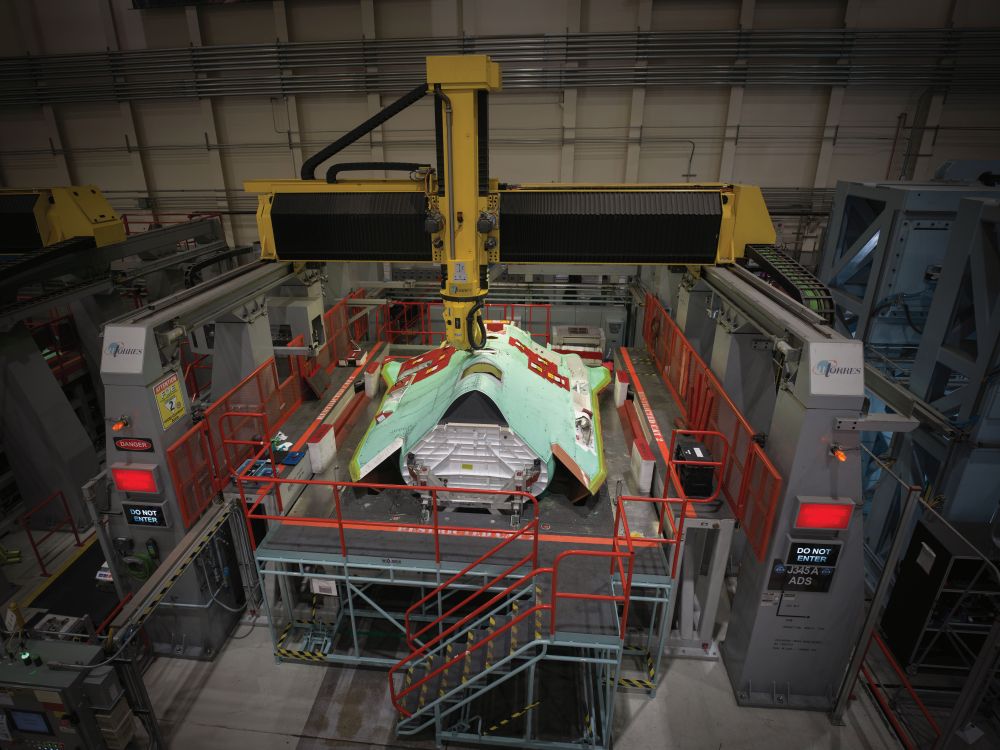
The CNI upgrade extends an automation model that is most mature in Palmdale, California. Northrop Grumman’s Integrated Assembly Line there builds center fuselages for the F-35A conventional takeoff and landing, F-35B short takeoff and vertical landing, and F-35C carrier variants on a single line, at a rate of one unit every 30 hours. The center fuselage is the aircraft’s largest stealth-critical structural assembly, where tolerances bear directly on low-observable performance. The company delivered its 1,500th unit in January 2026 and credits augmented and virtual reality tools with a 35 percent cut in assembly time and a 20 percent reduction in technician learning curve. It also produces wing skins and nacelles for all variants through automated composite manufacturing machinery and tooling the company developed itself.
Northrop Grumman’s other major F-35 product line shows the limits of that model. The company builds the AN/APG-81 active electronically scanned array (AESA) radar and is developing its gallium nitride based successor, the AN/APG-85, for Block 4 aircraft. At a Senate Armed Services Committee hearing in June 2026, Lt. Gen. Gregory Masiello, head of the JPO, confirmed that the Marine Corps had accepted six F-35s without radars because APG-85 units were not available. Budget documents place the first production APG-85 deliveries no earlier than April 2028, and the new radar’s mounting hardware is not backward compatible with the APG-81, which rules out an interim fit on those airframes. The JPO describes this as a deliberate concurrency decision, taken so that production jets would not require extensive Block 4 retrofits later.
Analysis: Northrop Grumman’s automation gains are concrete but sit on mature, rate-stable lines, while the program’s binding constraints lie in Block 4 hardware maturity, power and thermal margin, and sustainment. The Government Accountability Office reported that the fleet’s full mission capable rate fell from 38 percent to 25 percent between fiscal years 2020 and 2025, figures the JPO contests on methodology, and the JPO itself acknowledges spare parts shortages. If AI inspection measurably reduces CNI defect escapes and frees capacity for spares, its main payoff will show up in fleet readiness rather than new-build delivery speed. It does nothing for the APG-85, which is a development problem, not a throughput problem.
The next checkpoint is Lockheed Martin’s third-quarter 2026 earnings, which will show whether F-35 deliveries recovered from the second-quarter low of 19 aircraft. For Northrop Grumman, the open questions are whether it will publish quantified CNI yield or throughput data, whether the cobot and AI inspection approach migrates to radar production, and whether the APG-85 holds its April 2028 production delivery target.