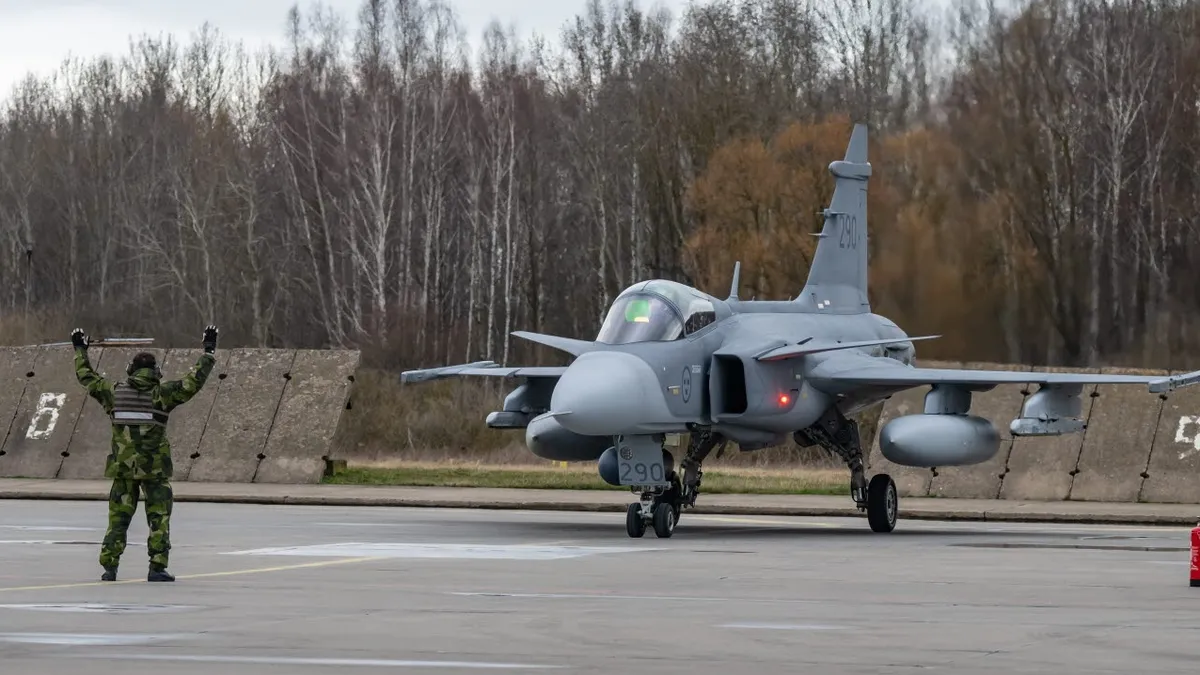
Swedish Gripen fighters will return to Poland from October 2026 to support NATO’s integrated air and missile defense (IAMD) on the Alliance’s eastern flank, the government in Stockholm announced on September 30, 2026. The Saab JAS 39 Gripen jets will protect the logistics hub in southeastern Poland that channels military and civilian aid to Ukraine, flying mainly from bases in Sweden with a smaller forward operating base on Polish soil.
The mission is Sweden’s second fighter contribution to the hub’s defense since it joined NATO in March 2024, and it follows a string of incidents that have kept Polish air defenses on alert. On July 30, 2026, an object Polish authorities assessed as a Russian Kh-101 cruise missile came down in a field near Tarnawa-Kolonia, in Lublin province, during a mass strike on Ukraine. On September 23, 2026, a Russian Mi-8 helicopter from Kaliningrad crossed roughly 300 meters into Polish airspace near Braniewo for 42 seconds. Defense Minister Pål Jonson cited repeated violations of NATO airspace as the reason the eastern flank requires high readiness.
Swedish Gripen Fighters Shift to Home-Based Operations
Basing is the clearest change from 2025. That year, Sweden sent six Gripens from the Norrbotten Wing (F 21) to Malbork Air Base in northern Poland for NATO’s enhanced Air Policing from late March, the first time Swedish combat aircraft operated from an ally’s territory. A second detachment of six JAS 39Cs from the Blekinge Wing (F 17), with roughly 120 personnel, reached Malbork in late May to cover the logistics hub under NATO command. The Riksdag had authorized up to eight aircraft for that mission between May 1 and August 31, 2025.
This rotation will fly mostly from home. Ronneby, the Blekinge Wing’s base, lies approximately 820 km from Rzeszów-Jasionka, against about 480 km from Malbork. Publicly available specifications credit the Gripen C with a combat radius of roughly 800 km, depending on fuel and weapons load. Persistent combat air patrols over southeastern Poland will therefore rely on air-to-air refueling, turnarounds at the forward operating base, or both. Swedish Air Force officials said in September 2025 that preparing for this mission had required crews to train in night aerial refueling and in engaging drones and cruise missiles of the types Russia fires at Ukraine.
The government has not disclosed the number of aircraft, the size or location of the forward detachment, or the mission’s duration.
JAS 39C Sensors and Weapons Against the Cruise Missile Threat
The announcement does not specify the variant, but Sweden’s operational fleet consists of single-seat JAS 39C and two-seat JAS 39D aircraft, and open-source reporting on the deployment identifies the jets as C models.
Publicly available specifications indicate the Gripen C measures 14.1 m in length with an 8.4 m wingspan and a maximum takeoff weight of 14,000 kg. A single Volvo Aero RM12, a license-built derivative of the General Electric F404, delivers about 54 kN dry and 80.5 kN with afterburner, for a top speed near Mach 2 at altitude. The Saab PS-05/A pulse-Doppler radar provides search and fire control, and the single-seater carries a 27 mm Mauser BK-27 cannon. Air-to-air weapons include the Diehl IRIS-T (Rb 98), the AIM-120 AMRAAM (Rb 99) and the MBDA Meteor ramjet-powered beyond-visual-range missile. Imagery from the 2025 Malbork rotation showed jets carrying live Meteor and IRIS-T rounds. Link 16 ties the aircraft into the NATO air picture.
That loadout fits the IAMD task. The Kh-101 is an air-launched, low-observable cruise missile with a range publicly estimated at more than 2,500 km, built to fly below ground-based radar coverage. A fighter with a look-down radar and an imaging infrared missile such as IRIS-T can push the engagement zone beyond the radar horizon of surface-based batteries. Against slower one-way attack drones of the Shahed type, the cannon offers a cheaper kill than a missile, at the cost of closing to visual range.
Protecting the Rzeszów-Jasionka Logistics Hub Under NATO Command
The defended asset centers on Rzeszów-Jasionka airport, less than 100 km from the Ukrainian border, through which much of the Western equipment bound for Ukraine passes. Since 2025, NATO Security Assistance and Training for Ukraine (NSATU), headquartered in Wiesbaden, Germany, has coordinated that flow after U.S. Army units withdrew from Jasionka. The hub has been defended by a rotating mix of allied assets, including Norwegian National Advanced Surface-to-Air Missile System (NASAMS) batteries deployed from December 2024.
Swedish aircraft have already flown live missions in this sector. During the 2025 rotation, Gripens based at Malbork scrambled alongside Polish fighters and a NATO tanker in response to Russian strikes on Ukraine. Foreign Minister Maria Malmer Stenergard described Poland as “a crucial link in the chain for channelling support to Ukraine.”
Analysis: The home-basing model trades responsiveness for sustainability. Keeping most aircraft, maintainers and munitions in Sweden protects national quick reaction alert and dispersed-basing readiness while still committing combat power to the Alliance, but it places close to an hour of transit at typical cruise speeds between Swedish runways and the defended area. Against a low-flying cruise missile detected minutes before it crosses the border, only aircraft already airborne on patrol or on alert at the forward base can intercept. The defensive value of this contribution therefore rests on two numbers Stockholm has not published: the size of the forward detachment and the tanker support allocated to it.
Sweden needed Riksdag consent for the 2025 mission, which capped the force at eight aircraft, and the September 30 announcement does not say whether a new bill will follow. It is also unclear how NATO-commanded Swedish jets will align with Poland’s tighter posture: on September 17, 2026, Deputy Defense Minister Cezary Tomczyk said the Polish operational commander had issued pre-authorized orders allowing pilots to shoot down drones or missiles crossing the border without further approval, while stressing that visual identification remains necessary in peacetime. Force size, rotation length and the forward base location are the next details to watch.