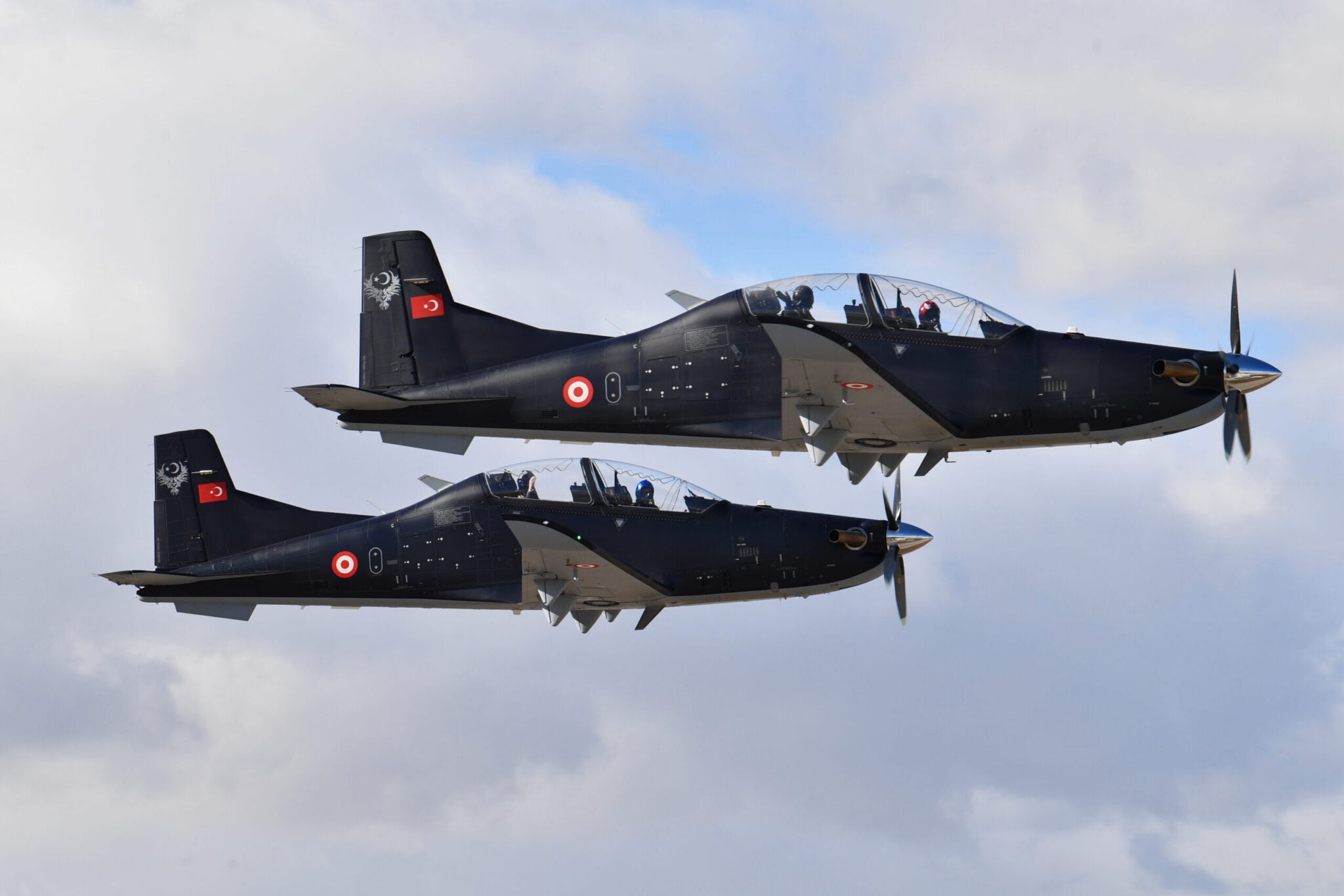
Azerbaijan signed defense procurement contracts with Turkish manufacturers worth more than $500 million on September 30, 2026, on the opening day of the sixth Azerbaijan International Defence Exhibition (ADEX 2026) in Baku. The package covers 14 HÜRKUŞ-II trainers from Turkish Aerospace Industries (TAI), Baykar’s MIZRAK loitering munition and ANTIDOT electronic warfare (EW) systems, and Roketsan’s BARBAROS coastal defense system, plus a memorandum of understanding (MoU) for ASELSAN’s ALP-100 radar.
Haluk Görgün, head of Türkiye’s Presidency of Defense Industries (SSB), announced the aggregate value but no contract-level figures, and it is unclear whether the radar MoU counts toward the total. The round extends a relationship formalized by the mutual assistance clause of the 2021 Shusha Declaration and expanded at ADEX 2024, when ASELSAN announced Azerbaijani orders for the TOLUN glide bomb and ASELFLIR-500 targeting system for Bayraktar AKINCI unmanned combat aerial vehicles (UCAVs).
HÜRKUŞ-II and MIZRAK Anchor the Azerbaijan Defense Deals
The HÜRKUŞ-II order is the first export contract for TAI’s new-generation trainer, and Görgün said deliveries will begin in 2026. The aircraft first flew on December 30, 2024; the first two production examples entered Turkish Air Force service on September 28, 2026, under a 55-aircraft program due for completion in 2028. A 1,600 shp Pratt & Whitney Canada PT6A-68T turboprop powers a composite airframe fitted with Martin-Baker Mk T16N zero-zero ejection seats, and TAI lists a 30,000 ft ceiling and a 320 kt top speed. Görgün said the cockpit and avionics architecture share commonality with the HÜRJET jet trainer and KAAN fighter. For Baku, the type modernizes a pilot pipeline still built around Aero L-39 Albatros jet trainers as the air force inducts 40 JF-17C Block III fighters ordered from Pakistan.
MIZRAK, which Baykar debuted at SAHA 2026 in Istanbul in May, is the long-reach element. Baykar lists an operational range above 1,000 km, endurance beyond seven hours, a 200 kg maximum takeoff weight and a 100-knot top speed. Configurations include twin warheads totaling 40 kg or a single 20 kg warhead paired with a radio-frequency (RF) seeker. Rocket-assisted takeoff allows launch from unprepared sites, while AI-assisted electro-optical or infrared sensors, anti-jamming protection and visual positioning support autonomous flight without satellite navigation. Baykar’s datalink ties it to TB2, TB3 and AKINCI aircraft. Azerbaijan already fields Israeli-built long-range loitering munitions; MIZRAK adds a Turkish second source in the same class.
ANTIDOT, ALP-100 and BARBAROS Add Electronic Warfare and Coastal Strike
ANTIDOT is an ASELSAN-developed family of UAV-mounted EW pods, contracted here through Baykar. Its electronic support variants detect, identify and locate hostile radar emitters, while electronic attack variants jam them; both types have flown on AKINCI. The configurations Azerbaijan ordered have not been disclosed. Combined with MIZRAK’s RF-seeker variant, ANTIDOT gives Baku the components of an unmanned suppression of enemy air defenses (SEAD) chain: locate, jam, then strike.
The ALP-100 MoU covers the defensive layer. ASELSAN’s ALP 100-G is an S-band gallium nitride (GaN) active electronically scanned array (AESA) radar on an 8×8 truck, designed to track fighters, hovering helicopters, UAVs and cruise missiles at low altitude. Publicly available specifications indicate detection beyond 180 km. Accepted into Turkish service in 2025 as a primary search and gap-filler radar, it would sit beneath Azerbaijan’s mix of Russian- and Israeli-origin long-range air defenses.
BARBAROS is a mobile, battalion-structured system of launch, command-and-control and transport vehicles, with an optional coastal surveillance radar in the command vehicle. It fires Roketsan’s ATMACA, rated above 220 km, and the turbojet-powered ÇAKIR, listed above 150 km with a 70 kg warhead. Deployed on the Absheron Peninsula, that envelope would cover the approaches to the Shah Deniz and Azeri-Chirag-Gunashli offshore fields, in a sea where Russia’s Caspian Flotilla remains the dominant naval force.
Nakhchivan Factory Plan Shifts Cooperation Toward Local Production
The industrial agreements may outlast the hardware. ASELSAN and Azerbaijani firm NOVASIS signed a preliminary agreement to build a factory in Nakhchivan, the exclave bordering Armenia, Iran and Türkiye; its product line has not been disclosed. Boğaziçi Savunma signed an MoU with NOVASIS on a partnership to develop RF-based systems, and Kayı Savunma signed a separate cooperation MoU with the same company. Türkiye’s Mechanical and Chemical Industry Corporation (MKE) agreed a strategic cooperation and business development MoU with Azerbaijan’s MİRAS, which also signed a logistics support agreement with OTOKAR.
An academic MoU links Türkiye’s Council of Higher Education (YÖK) and the SSB with Azerbaijan’s ministries of Defense Industry and of Science and Education, and Türkiye’s Defense Industry Academy signed an R&D and university-industry agreement with an Azerbaijani counterpart. Görgün framed the goal as training Turkish and Azerbaijani engineers together and expanding joint production.
Analysis: Türkiye is selling Azerbaijan functions rather than platforms. Together, the contracts deliver a training pipeline, a low-altitude sensor layer, airborne EW, 1,000 km-class strike and coastal sea denial, with local manufacturing and engineering education layered on top. That deepens Baku’s reliance on Turkish datalinks, mission planning and sustainment even as it buys fighters from Pakistan and munitions from Israel. For Ankara, it secures an anchor customer and a forward production node on the periphery of Iran and Russia, pushing a NATO member’s defense-industrial footprint further into the South Caucasus as Baku and Yerevan pursue the peace framework initialed in Washington in August 2025.
The first test is HÜRKUŞ-II delivery tempo: Görgün put 2026 output at 12 to 14 aircraft, while TAI also plans 12 deliveries to the Turkish Air Force this year, leaving the number of Azerbaijani airframes before year-end unclear. Delivery schedules for MIZRAK, ANTIDOT and BARBAROS remain unpublished, the ALP-100 MoU has yet to become a contract, and the Nakhchivan plant’s scope is undefined. Whether the Canadian-built PT6A-68T engine raises export licensing questions for an Azerbaijani end user has not been addressed publicly.