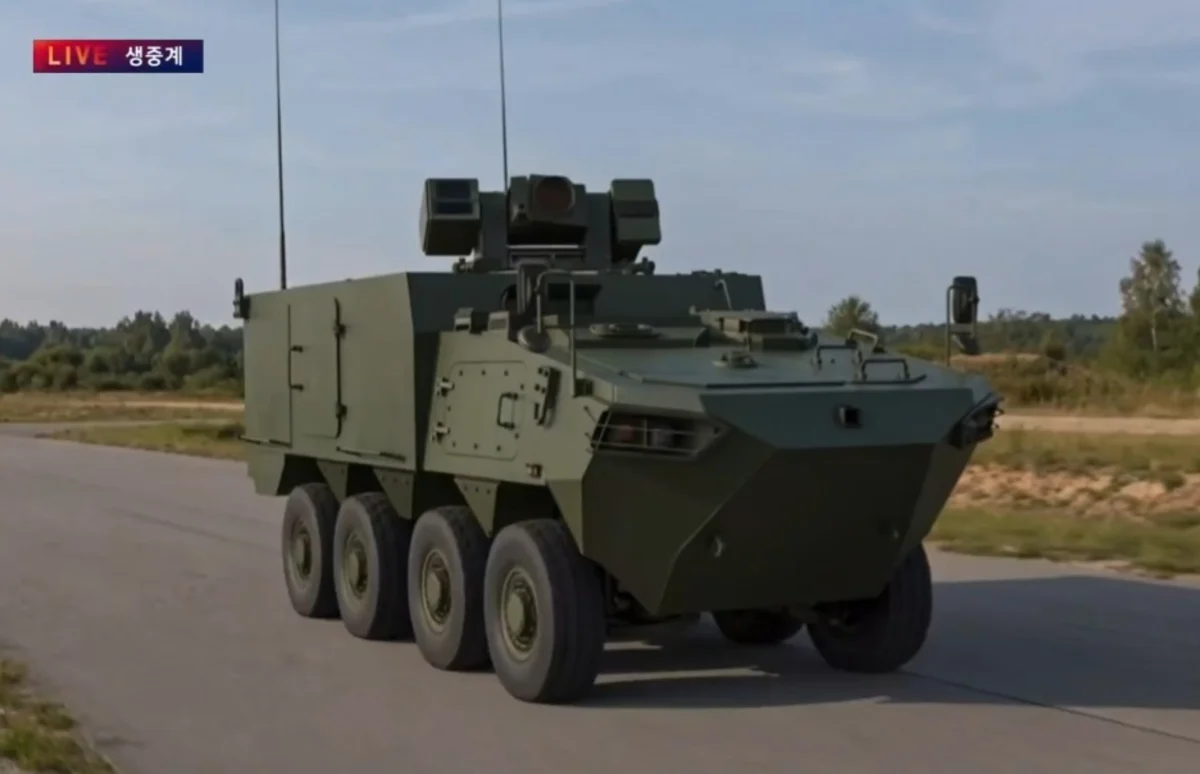
South Korea unveiled two new Cheongwang laser weapon prototypes on October 1, 2026, at its 78th Armed Forces Day ceremony at Gyeryongdae: a Block 2 variant integrated on an 8×8 wheeled armored vehicle and a 100-kW-class high-energy laser. A live-fire demonstration of the in-service Block 1, staged before President Lee Jae Myung, downed two of four target drones; the other two never reached the engagement zone.
The debut came 10 days after a mine blast in the Demilitarized Zone (DMZ), which Seoul attributes to North Korea, seriously wounded two soldiers of the Republic of Korea (ROK) Army’s 25th Division. Cheongwang, developed under the Agency for Defense Development (ADD), entered service in December 2024 as fixed-site point defense against small unmanned aircraft, a gap exposed in December 2022 when five North Korean drones penetrated South Korean airspace. At the ceremony, which featured about 70 systems of 46 types, Lee pledged to accelerate high-energy laser interceptors, artificial intelligence (AI)-based command and control, and high-yield missiles.
Cheongwang Laser Weapon Block 2 and 100-kW Prototype Make Debut
Block 2 moves Cheongwang from static site defense toward maneuver-force protection. Every fielded Block 1 operates from fixed positions; an 8×8 wheeled chassis lets the laser travel with ground units. Program planning has pegged Block 2 at the 30-kW class, with higher output and precision in a smaller, lighter package. The Ministry of National Defense (MND) has not disclosed the prototype’s chassis designation, power generation scheme, or test schedule.
The 100-kW-class system, shown in what appears to be a towed configuration, addresses a different threat tier. South Korean defense assessments place roughly 100 kW as the threshold for engaging small rockets, artillery and mortar rounds, and tactical guided missiles, the counter-rocket, artillery and mortar (C-RAM) mission most relevant to North Korea’s forward-deployed long-range artillery. Earlier roadmaps targeted a 100-kW-plus Block 3 around 2028. Seoul has not said whether this prototype is a Block 3 demonstrator.
Hanwha Systems, which took over the group’s laser business in April 2025 and serves as Cheongwang’s system integrator, showed a 50-kW laser on its Tigon 8×8 armored vehicle at MSPO 2026 in Poland in September, targeting serial production by the end of 2027. The company has said it is discussing Cheongwang exports with customers in Europe, Asia, and the Middle East. Whether the Block 2 shown at Gyeryongdae shares the Tigon architecture remains unconfirmed.
Inside Block 1: Output, Range, and a Domestic Laser Oscillator
Block 1 is a fiber laser that holds its beam on a target until heat defeats the airframe, propulsion, or electronics. The system combines a laser generator, target-positioning unit, beam director, and integrated cooling, with cueing from air defense radar and electro-optical and infrared tracking. MND rates Cheongwang in 20-kW and 30-kW classes with an engagement envelope of 500 m to 2 km.
In late May 2026, ADD and Hanwha Systems completed a domestic laser oscillator, the component that sets beam output, replacing a German-made unit. The Defense Acquisition Program Administration (DAPA) says the new oscillator improves output and other key metrics by more than 50 percent, cuts time-to-kill against first-person view (FPV) drones from 2 to 4 seconds to 1 to 2 seconds, and downs fixed-wing drones in a few seconds instead of more than 10. Domestic content rose from 76 percent to 90 percent. DAPA says only the United States, Israel, China, and Germany otherwise develop and mass-produce such oscillators, under tight export controls.
About five Block 1 units protect key state facilities, including the MND headquarters, with roughly 10 more planned for sites such as the National Assembly. Cost figures diverge: DAPA has cited about 2,000 won, roughly $1.33, per shot, while MND put the electricity cost of one interception at 10,000 to 20,000 won. Neither figure covers acquisition or sustainment.
What the Gyeryongdae Live-Fire Revealed About Counter-Drone Readiness
The demonstration used four target drones flown by fiber-optic cable rather than radio link. In the first sequence, one drone crashed on takeoff after strong gusts damaged its cable, according to the military, and Cheongwang burned down the second. The second sequence was meant to show two Cheongwang units engaging two targets simultaneously. One drone fell in flames; the other drifted outside the designated area in upper-air weather, and operators cut its power for safety, a defense ministry official said.
Scripted conditions further limit what the event proves. The military capped target speed and altitude inside confined airspace to protect spectators. Lasers degrade in rain, fog, and cloud and need dwell time on each target, so the demonstration says little about performance against a saturation raid. It follows drone crashes at a September 16 MND showcase and an August experiment aboard the amphibious assault ship ROKS Marado, where two loitering munitions fell into the sea.
The ceremony also previewed the layered architecture forming around the laser: a radar-cued ADD counter-drone interceptor UAV with a 200 km/h top speed and 15 minutes of endurance, built to engage targets beyond Cheongwang’s inner envelope.
Analysis: The Gyeryongdae stumbles are an execution problem, not a capability verdict; the strategic signal is the supply chain. Replacing the German oscillator removes the one foreign chokepoint that could cap Cheongwang production or block exports, giving Hanwha a sovereign directed-energy product as militaries seek cheap answers to drone saturation. Operationally, Block 1 remains point defense for a handful of fixed sites. Its value to ROK warfighting depends on Block 2 solving mobile power and thermal management on a wheeled chassis, and on the 100-kW class reaching C-RAM performance. Until then, lasers complement rather than replace kinetic interceptors such as the planned Low-Altitude Missile Defense (LAMD) system.
MND has published no fielding dates for either prototype. Near-term markers include roughly 10 additional Block 1 deliveries with the domestic oscillator, Block 2 test and evaluation, Hanwha Systems’ 50-kW production target at the end of 2027, and a first export contract. Two unknowns remain: whether the October 1 shooter carried the new oscillator, and whether Lee’s pledge becomes dedicated budget lines.