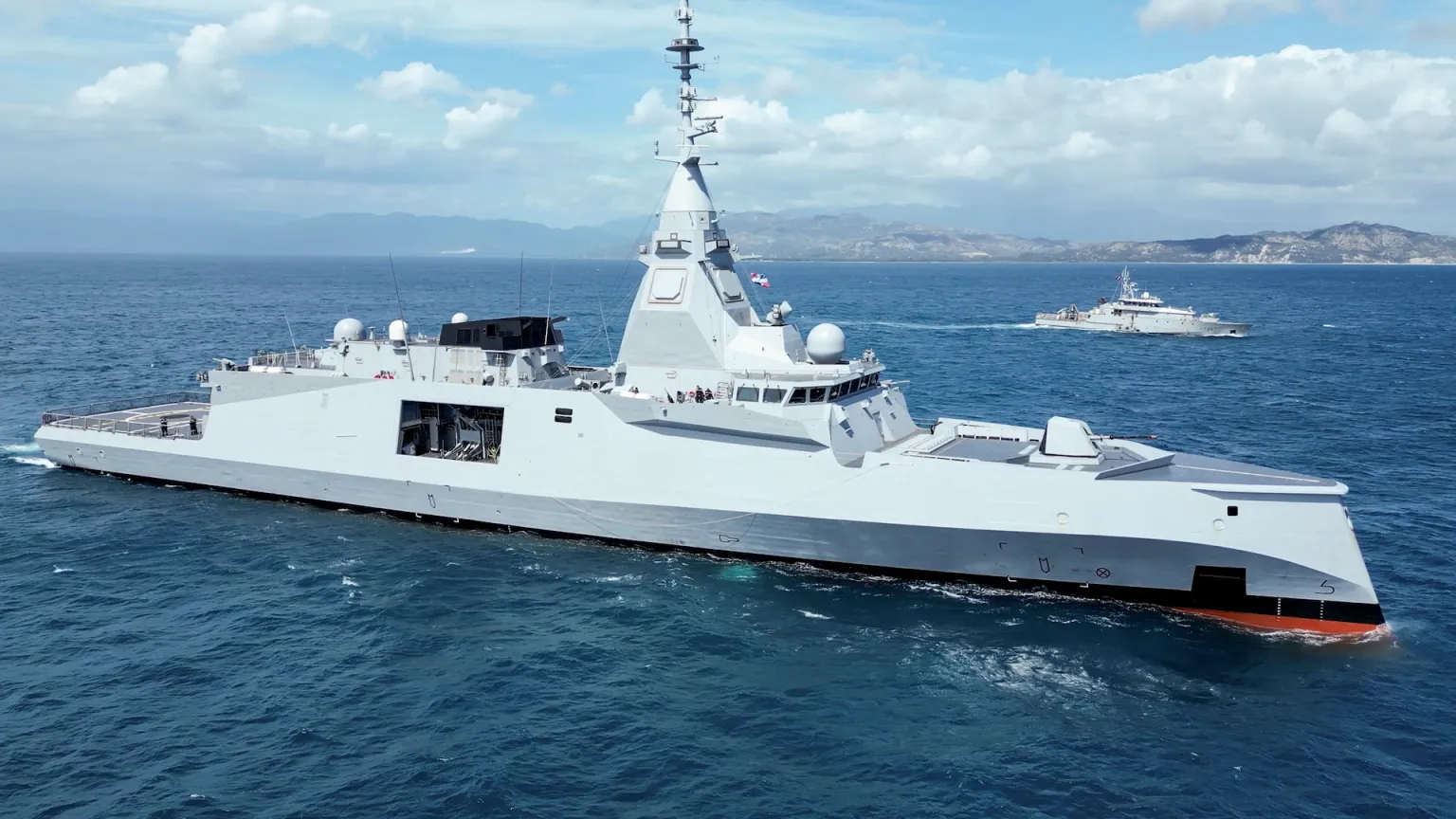
Naval Group cut the first steel for HSwMS Luleå, lead ship of the Royal Swedish Navy’s four-ship Luleå class, at its Lorient shipyard in Brittany on October 1, 2026, 31 days after Sweden signed the procurement contract. Rear Admiral Fredrik Lindén, Head of Naval Systems at the Swedish Defence Materiel Administration (FMV), led the ceremony in the presence of Caroline Vicini, Sweden’s ambassador to France.
FMV Director-General Mikael Granholm and Naval Group Chairman and CEO Pierre Éric Pommellet signed the contract in Stockholm on August 31, 2026, with French President Emmanuel Macron and Swedish Prime Minister Ulf Kristersson present. Valued at approximately SEK 47 billion (about $4.9 billion), it covers four Frégates de Défense et d’Intervention (FDI) plus training systems, spares and associated equipment. Stockholm selected the FDI on May 19, 2026, over Babcock’s Arrowhead 120, offered with Saab, and Navantia’s ALFA 4000, after requiring a mature design already in series production. Luleå is due in 2030, followed by Norrköping in 2032, Trelleborg in 2033 and Halmstad in 2034.
How Naval Group Is Scaling FDI Frigate Production in Lorient
Cutting steel one month after signature was possible because the Lorient line was already running. Two FDI hulls are in service, Amiral Ronarc’h with the French Navy and Kimon with the Hellenic Navy, and Naval Group launched France’s second ship, Amiral Louzeau, in May 2026. Sweden’s order brings the FDI backlog to 13 frigates for three NATO navies: five for France, four for Greece and four for Sweden.
Naval Group says the line is sized to deliver two frigates a year, with open slots still available in 2030, and that each hull absorbs roughly 1 million production hours and 1,200 employees. Sustaining that cadence while Swedish hulls overlap the remaining French and Greek work is the program’s central industrial risk. Naval Group says it relies on years of yard investment, local construction and partnerships with other European shipyards to absorb peaks, without naming which yards could take Swedish work.
Vincent Martinot-Lagarde, Naval Group’s Executive Vice President for Surface Ships, said the company is “proud to begin FDI Luleå’s industrial journey in Lorient.” The contract also commits Naval Group to a long-term partnership with Swedish industry, including transfer of know-how and technology to several Swedish partners.
Aster 30 and CAMM-ER: Inside the Luleå-Class Combat System
Publicly available specifications for the retained FDI hull indicate a length of 122 meters, an 18-meter beam, a displacement of about 4,500 tonnes, a top speed of 27 knots and an endurance of 5,000 nautical miles or 45 days, with accommodation for a crew of 125 plus 28 additional personnel, a hangar for an NH90-class helicopter and an unmanned aerial system. Naval Group says the inverted bow has been tested in sea state 7, with 6- to 9-meter waves, a margin relevant to High North deployments.
The mission fit departs sharply from French ships. FMV has confirmed Saab RBS15 anti-ship missiles, Torped 47 lightweight torpedoes, the Giraffe 1X radar and the Trackfire remote weapon station, along with a Bofors 57 mm main gun and a 40 mm secondary mount in place of the French 76 mm. Torped 47 is a 400 mm, roughly 340 kg weapon with pump-jet propulsion, designed for the shallow, acoustically complex Baltic and capable of wire-guided or autonomous runs.
Air defense is the defining change. The Swedish ships will carry MBDA Aster 30 in Sylver A50 vertical launchers alongside CAMM-ER in a Naval Group cold-launch system. A load of 16 Aster 30 and 48 CAMM-ER has been reported but not confirmed. Open sources credit Aster 30 with roughly 120 km of reach; MBDA quotes CAMM-ER at more than 40 km. The pairing reserves costly Aster rounds for aircraft and high-end missiles while CAMM-ER handles drones and subsonic cruise missiles at lower cost per shot. The contract excludes the MBDA Naval Cruise Missile, which requires deeper Sylver A70 cells; a later swap has been reported but not confirmed.
From Visby Corvettes to Blue-Water Frigates: Sweden’s Doctrinal Shift
At about 4,500 tonnes, each Luleå-class frigate will displace roughly seven times as much as the 640-tonne Visby-class corvettes, currently the Swedish Navy’s largest frontline surface combatants. The four ships are expected to roughly triple the navy’s air defense capacity and give Stockholm an area air defense escort able to protect allied shipping, not just its own coastline.
That shift follows Sweden’s accession to NATO on March 7, 2024. FMV names air defense and anti-submarine warfare as the class’s two core capabilities, and Naval Group says the frigates will support NATO naval operations across the Baltic Sea, the North Atlantic and the High North. On August 31, Swedish Defence Minister Pål Jonson and French Armed Forces Minister Catherine Vautrin also signed a framework agreement to deepen bilateral defense cooperation.
Analysis: Sweden traded its tradition of domestic warship construction for schedule certainty, and the Luleå steel cut is the first evidence the trade is paying off. A Swedish-built surface combatant would have competed for the same constrained capacity that has pushed the A26 Blekinge-class submarines years behind plan. With France, Greece and Sweden now operating or building the same hull, the FDI is becoming a common mid-size frigate standard across NATO’s northern and southern flanks, with shared Aster logistics. The risk has moved from design to integration: fusing Swedish sensors, guns and torpedoes with a mixed Aster and CAMM-ER architecture inside a four-year build window leaves little schedule margin.
Next milestones for Luleå are keel laying, launch and sea trials, none yet publicly dated, ahead of delivery in 2030. Open questions include the final Aster 30 and CAMM-ER cell count, whether Stockholm adds a cruise missile option, the size of the Swedish industrial workshare and whether Lorient can hold two deliveries a year as the French, Greek and Swedish programs overlap through 2034.