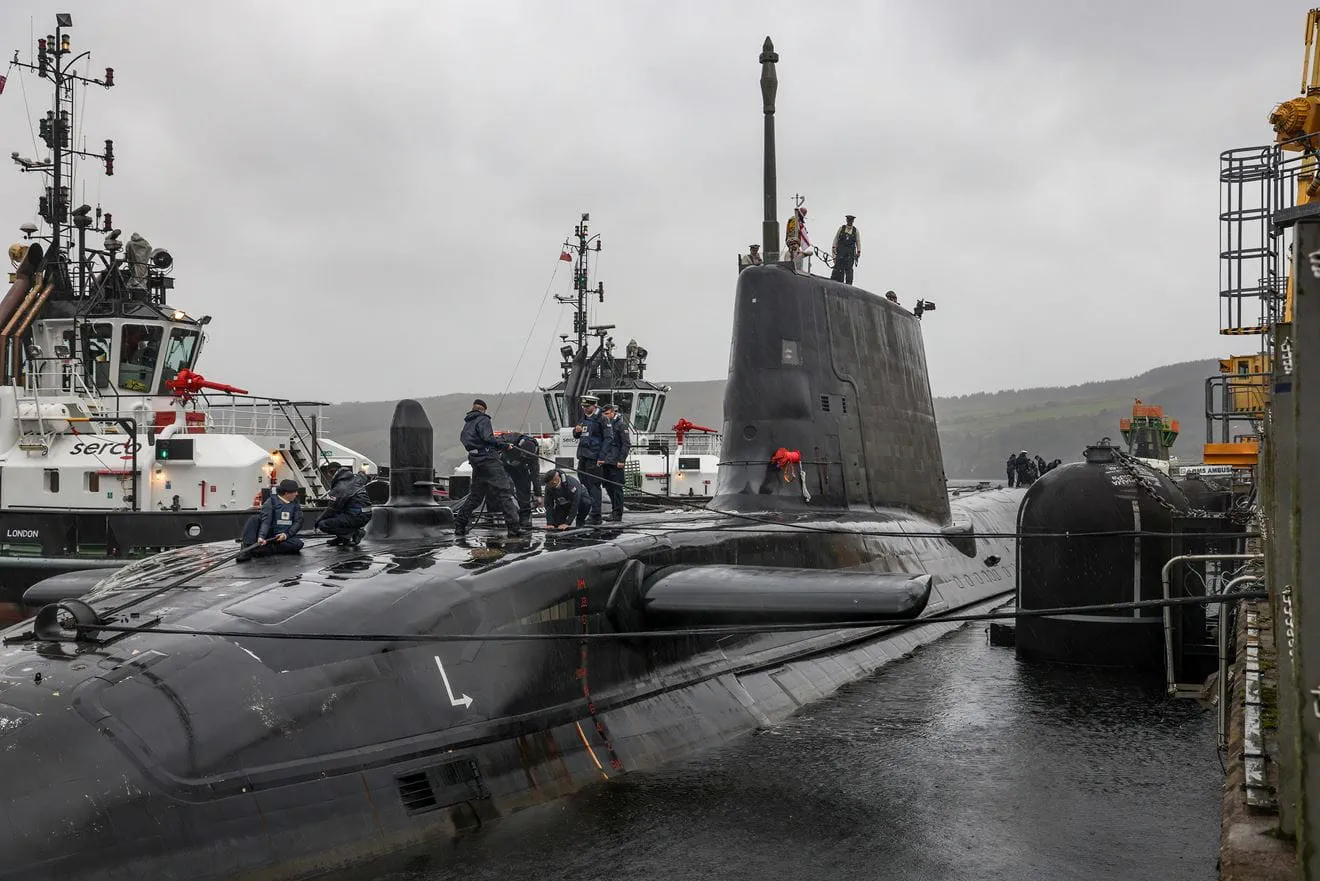
The Royal Navy’s sixth Astute-class nuclear-powered attack submarine (SSN), HMS Agamemnon (S124), arrived at her home port of His Majesty’s Naval Base (HMNB) Clyde at Faslane, Scotland, on October 2, 2026, a week after sailing from BAE Systems’ shipyard in Barrow-in-Furness. She is in the opening phase of sea trials that will run for months before she joins the operational fleet.
The arrival closes an unusually long build-to-sea interval and lands in a submarine force under acute strain. King Charles III commissioned Agamemnon on September 22, 2025, yet the boat spent another full year alongside at Barrow completing in-water commissioning. Her first berthing on the Clyde fell exactly 125 years after the launch of Holland 1, the Royal Navy’s first submarine, on October 2, 1901. For a service that has struggled through 2026 to keep any attack boat at sea, the date carries more operational weight than symbolism.
HMS Agamemnon’s Path From 2013 Keel Laying to First Dive
Agamemnon’s keel was laid in July 2013 and she was launched at Barrow in October 2024. Her first trim dive followed in October 2025 at the BAE Systems site, where she submerged to roughly 15 meters (49 feet) to confirm buoyancy and balance. In a written parliamentary answer earlier in 2026, Minister for Defence Readiness and Industry Luke Pollard said the Ministry of Defence (MoD) expected the boat to leave Barrow and begin sea trials by the end of the year. She sailed on September 25 after a multi-day transit through the yard’s basins and locks into the Walney Channel and the Irish Sea.
Her first dive at sea took place during the passage north, in the Inner Hebrides exercise areas, under the watch of a Royal Navy Merlin helicopter. Trials will now test performance, maneuverability, speed and general seaworthiness, according to the Royal Navy. The commanding officer, Commander John Gabb, leads a crew of around 100 submariners and described the boat as “incredibly quiet” with “a world-class Sonar.” The next phase, he said, will be harder: “Next time we will be pushing the crew and the submarine to its maximum potential to operate undetected.”
Sonar 2076, PWR2 and Tomahawk: Inside the Astute-Class Design
Publicly available specifications put the Astute class at 97 meters (318 feet) in length, with an 11.3-meter beam and a submerged displacement of about 7,400 tonnes. Propulsion comes from a Rolls-Royce PWR2 pressurized water reactor fitted with the Core H, driving a pump-jet propulsor. The core is designed to last the boat’s planned 25-year service life without refueling, and open-source figures cite a top submerged speed of about 30 knots. With onboard oxygen and freshwater generation, the boat can circumnavigate the globe submerged, leaving food stores and crew endurance as the practical limits.
The sensor suite centers on the Thales Sonar 2076, an integrated passive and active search and attack system with bow, intercept, flank and towed arrays. The Astute boats are the first Royal Navy submarines without optical periscopes; two Thales CM010 optronic masts that do not penetrate the pressure hull feed imagery to the control room. Combat management runs on the Common Combat System being standardized across the Astute, Vanguard and Dreadnought fleets.
Armament is delivered through six 533 mm (21-inch) torpedo tubes with stowage for up to 38 weapons: the Spearfish heavyweight torpedo, which the Royal Navy credits with reaching targets up to 30 miles away at low speed, and the Tomahawk Block IV land attack cruise missile, with a range of more than 1,000 miles according to the MoD. Because missiles and torpedoes share the same tubes and racks, every Tomahawk embarked displaces an anti-submarine or anti-ship weapon. The US Navy’s Virginia class, by contrast, carries its strike missiles in dedicated vertical launch tubes, a capability the Royal Navy will only gain with SSN-AUKUS.
Astute Fleet Availability and the Faslane Maintenance Bottleneck
Agamemnon joins HMS Astute, Ambush, Artful, Audacious and Anson at Faslane. Hull count is not the binding constraint; availability is. Open-source fleet tracking in June 2026 found all five in-service boats alongside at the same time, with HMS Ambush reported in very low readiness and partially stripped for spares. The underlying problem is docking capacity: the ageing shiplift at Faslane and the dry docks at HMNB Devonport are the only facilities able to handle major SSN maintenance.
The First Sea Lord launched a Submarine Maintenance Recovery Plan in January 2026, alongside a Devonport dock rebuild and a plan to acquire floating docks for Faslane. The stakes are concrete: an attack submarine is normally needed to escort Vanguard-class ballistic missile submarines (SSBNs) in and out of the Clyde, and to track Russian submarine activity in the North Atlantic.
Analysis: Agamemnon’s operational value lies less in raising the fleet to six hulls than in what a brand-new boat brings to a force throttled by maintenance. She carries no accumulated maintenance backlog and, with a life-of-boat reactor core, faces no refueling outage. Once worked up, she is likely to deliver a disproportionate share of available sea days while older sisters queue for docks, making her central to the deterrent escort mission and to North Atlantic Treaty Organization (NATO) anti-submarine commitments. She does not fix the structural problem. Every new Astute adds demand on the same constrained docks, engineers and crews, and until the recovery plan delivers, Royal Navy SSN availability will be set by support infrastructure rather than by Barrow’s output.
The MoD declines to disclose a full operational capability date, citing security, and open-source estimates do not anticipate front-line service before late 2027. HMS Achilles, the seventh and final Astute boat, remains at an advanced stage of build at Barrow after a fire in the Devonshire Dock Hall disrupted assembly, with reports pointing to service entry no earlier than 2028. Beyond that, the attack submarine force rests on SSN-AUKUS, which the 2025 Strategic Defence Review set at up to 12 boats, with UK deliveries expected from the late 2030s.