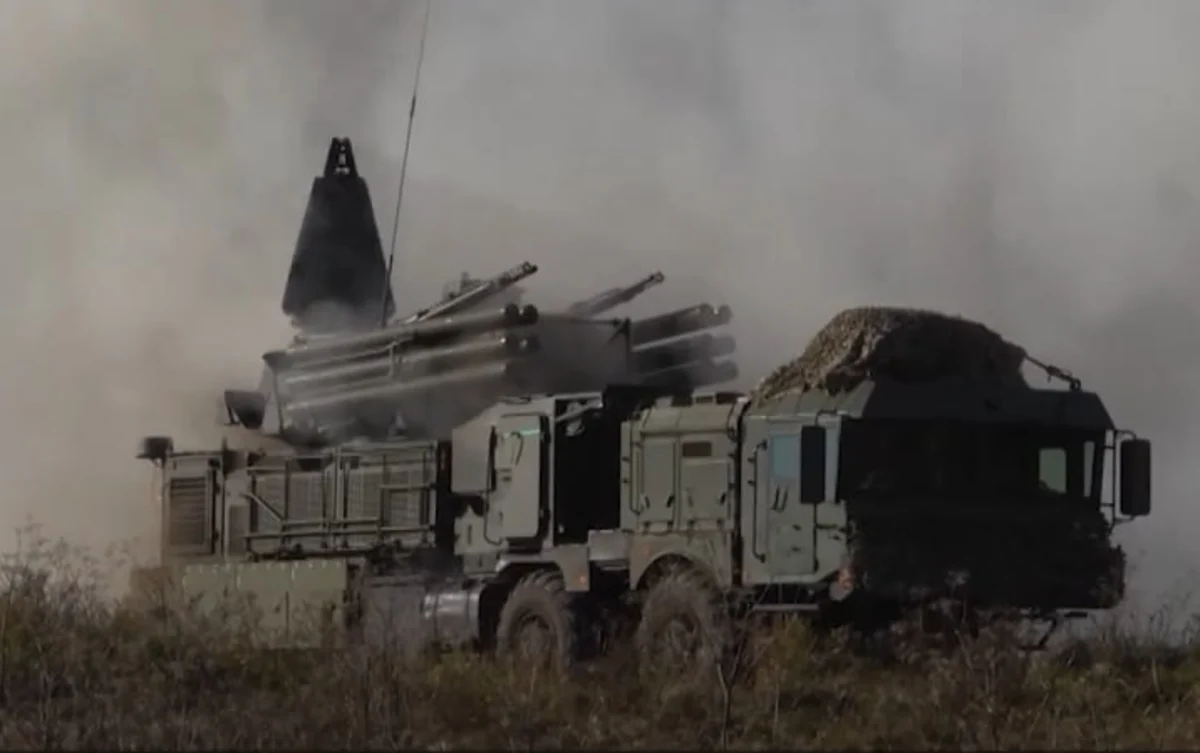
Russia displayed a Pantsir short-range air defense system mounted on a Belarus-built MZKT-7930-312 8×8 chassis during its Tsentr-2026 strategic command-and-staff exercise, which concluded October 3, 2026, at the Chebarkul training range in the Chelyabinsk region. The appearance is the first official confirmation that the gun-missile system now rides on the heavy Minsk-built platform.
Until now, the configuration was documented only through leaked procurement records and a single vehicle that Ukrainian drone operators destroyed in Mariupol on February 27, 2026. The Russian Ministry of Defense said more than 47,000 troops and over 2,000 pieces of equipment took part in Tsentr-2026, which ran from September 28, with its main stage on October 2, when President Vladimir Putin observed the drills. Rostec, parent of Pantsir developer KBP Instrument Design Bureau, confirmed that Pantsir systems were demonstrated. Moscow has not disclosed how many vehicles have been built on the new chassis, which units operate them, or whether the change will extend across the fleet.
Pantsir Air Defense Moves From KamAZ to the MZKT-7930 Chassis
The standard Pantsir-S1 in Russian service rides on the 8×8 KamAZ-6560 truck, with export variants on the German MAN SX45 and a small number on Bryansk-built BAZ chassis. The MZKT-7930 Astrolog, produced by the Minsk Wheel Tractor Plant, belongs to a heavier class. Publicly available specifications indicate an empty mass of 20.5 tonnes, a payload of 22.4 to 24 tonnes, a 500 hp YaMZ-846 V12 diesel and a road speed of 70 km/h, against roughly 400 hp for the KamAZ-6560. Russia already uses it for the 9K720 Iskander-M launcher, the K-300P Bastion coastal defense system and elements of the S-400. The Pantsir pairing first appeared only as a mock-up at the MAKS air show in 2009.
That changed in early 2024. Procurement documents published by BelPol, a Belarusian opposition initiative, show Russia ordered 18 MZKT-7930-312 chassis for Pantsir systems, with deliveries due that year. The paperwork specifies the 72V6 combat module, the index used for Pantsir-S1 vehicles built for the Russian Armed Forces rather than export customers, and indicates that some vehicles may have been completed as an MZKT-7930-415 variant with an armored cab and a two-piece windshield in place of the standard three-panel layout. KBP reportedly completed chassis trials in summer 2024.
The motive appears practical. According to the leaked material, the KamAZ-based vehicles suffered from limited off-road mobility and a tendency to roll over, a consequence of the high center of gravity created by a turret carrying 12 missiles, two cannons and two radars. The heavier chassis also offers margin for protection: the vehicle struck at the Azovstal steel plant by the 413th Separate Unmanned Systems Regiment carried add-on screens against drone attack; Ukrainian forces valued it at about $15 million.
Pantsir-S1M Engagement Envelope and the 57E6M Missile Upgrade
The Pantsir-S1M is KBP’s modernized iteration of the system, unveiled at IDEX 2019 and placed under Russian Ministry of Defense contract at the Army-2021 forum in August 2021. Its core change is the 57E6M missile. Publicly available specifications indicate that a shortened airframe accommodates a larger booster, raising maximum speed from 1,300 m/s to 1,700 m/s, slant range from 20 km to 30 km and engagement ceiling from 15 km to 18 km. Missile weight grows from 98 kg to 115 kg and warhead mass from 20 kg to 25 kg, with a curtain-type kinetic design that projects a dense fragment cloud ahead of the target on uplink command. Existing Pantsir-S1 vehicles can fire both the 57E6M and the baseline 57E6.
Sensors were upgraded in parallel. The S1M pairs an L-band phased-array search radar, which manufacturer data credits with detection out to 80 km and simultaneous tracking of 40 targets, with an EHF multifunction fire-control radar able to engage four targets at once. A modernized infrared tracking station with a laser rangefinder provides a passive channel when radars are jammed. Gun armament remains two 2A38M twin-barrel 30 mm cannons with about 1,400 rounds, covering the inner zone out to roughly 4 km. Russia’s official export catalog lists 12 ready missiles, a three-person crew and a reaction time of up to 6 seconds.
Whether the exercise vehicle carries the full S1M package or the baseline 72V6 module named in the 2024 contract has not been confirmed. Either way, the chassis does not change Pantsir’s core constraint: 12 ready missiles deplete quickly against massed one-way attack drones.
Analysis: The chassis switch matters less for what Pantsir can hit than for how long it survives. Open-source loss tracking documents at least 52 Russian Pantsir systems destroyed or damaged, and Ukrainian officials claim about half the deployed fleet has been knocked out, a figure that has not been independently verified. Moving the system onto a heavier platform with an armored cab is a survivability adaptation driven by drone attrition. It also deepens Moscow’s reliance on a single Belarusian supplier that already builds chassis for Iskander and Bastion, illustrating how far Russian and Belarusian defense production has merged on NATO’s eastern flank.
Key unknowns remain the size of the MZKT-based fleet beyond the 18 chassis in the 2024 order, whether follow-on contracts exist, and whether the Pantsir-SM, with its reported 40 km missile, will migrate to the same platform. With Ukrainian drone units treating Pantsir batteries as priority targets, the first real test of the heavier configuration will come from frontline loss data rather than exercise footage.