The Defence Intelligence of Ukraine (DIU) on October 28, 2026, published data on 49 Russian and Belarusian enterprises building Rassvet, the low Earth orbit (LEO) broadband constellation Moscow is fielding as a domestic substitute for SpaceX’s Starlink. DIU identified Bureau 1440, a subsidiary of the IT conglomerate X Holding, as the prime contractor and said 23 of the 49 entities, including the state space corporation Roscosmos, remain unsanctioned by every country in the sanctions coalition.
The disclosure comes nearly nine months after Russian forces lost their most important commercial satellite link. On February 5, 2026, a SpaceX whitelist admitting only verified terminals cut off the unregistered Starlink units Russian troops relied on for front-line communications and fitted to long-range strike drones. DIU describes Rassvet as primarily a military communications system whose planned coverage centers on Ukraine and the European Union.
Bureau 1440 and the Industrial Base Behind the Rassvet Constellation
According to DIU, the production network combines IT firms, microelectronics manufacturers, research centers, Roscosmos-affiliated entities and Russian Ministry of Defense structures. Bureau 1440 leads the program, while other X Holding companies produce solar panels, user equipment, printed circuit boards and electronic modules. Bureau 1440 began in November 2020 as a project office of mobile operator MegaFon, joined X Holding in 2022 and opened a Belarusian research subsidiary, Aerospace Instruments CJSC, the same year.
Roscosmos and other aerospace enterprises supply launch vehicles, upper stages, electric propulsion engines and other satellite components, and handle integration, launch preparation and orbital deployment. DIU said Roscosmos Director General Dmitry Bakanov oversees Rassvet personally. Bakanov, who took over Roscosmos in February 2025, previously ran Satellite System Gonets, including during its cooperation with British operator OneWeb on a joint venture to sell LEO services in Russia.
Defense ministry structures run the spaceport, coordinate the work and support integration of the network into Russia’s military communications architecture, per DIU. Both operational Rassvet-3 launches flew from the military-run Plesetsk Cosmodrome in Arkhangelsk Oblast. DIU named state-controlled VTB Bank as a financial backer. Public money is also documented: draft federal budget amendments in June 2024 allocated 9.35 billion rubles for the development and launch of 66 Bureau 1440 spacecraft.
Rassvet-3 Satellites: Orbit, Propulsion, and Laser Link Architecture
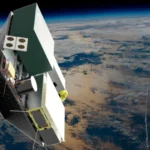
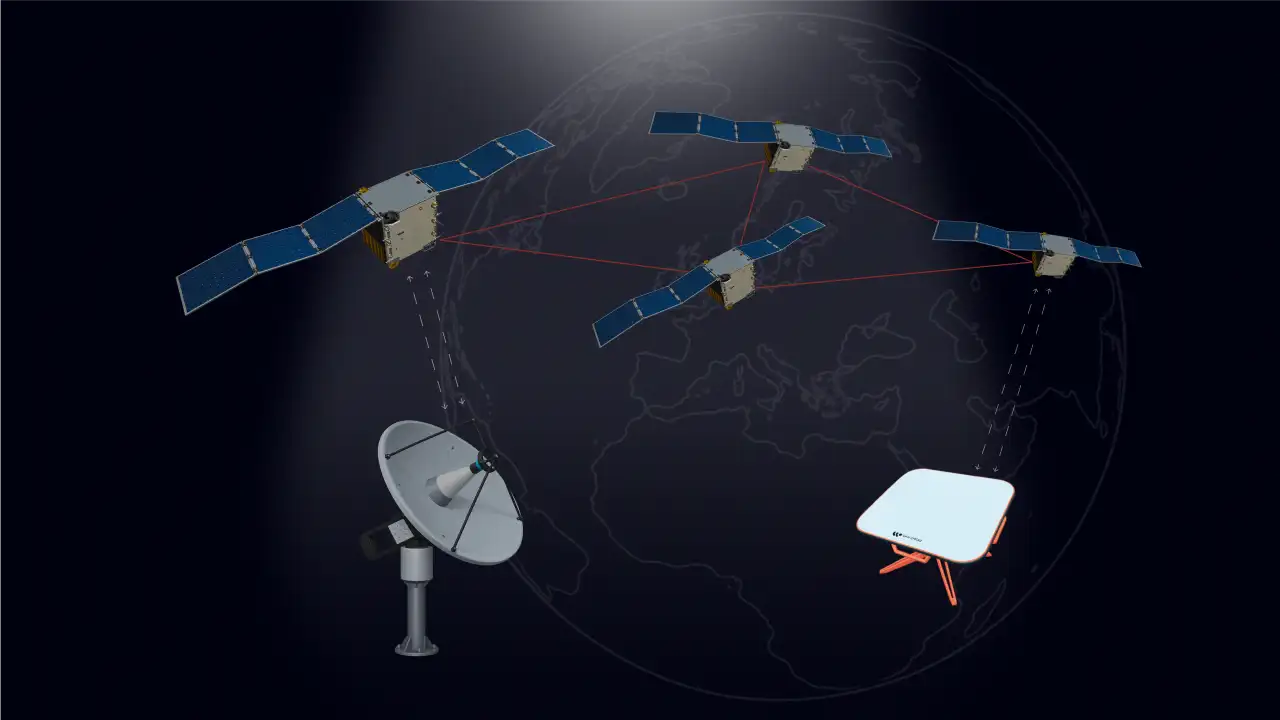
Publicly available specifications indicate the serial Rassvet-3 satellite has a mass of about 370 kg and flies a near-polar orbit inclined at 82.3 degrees, extending coverage into the Arctic. Each spacecraft carries krypton-fueled electric thrusters, optical inter-satellite links and a Ku- and Ka-band communications payload reportedly based on the 5G Non-Terrestrial Network (NTN) standard. The laser crosslinks matter militarily: they can route traffic through the constellation rather than requiring a gateway on Russian soil in view of each satellite, which is what would allow service over Ukraine or EU territory.
The design follows two test campaigns: three 80 kg Rassvet-1 satellites launched in June 2023, and three larger Rassvet-2 spacecraft in May 2024 that validated laser terminals and 5G NTN links. Operational deployment began on March 23, 2026, when a Soyuz-2.1b placed 16 Rassvet-3 satellites in orbit; a second batch of 16 followed on July 19, 2026.
Deployment has lagged the plan. One satellite decayed in June 2026, and Russian sources reported in July that the target altitude had been cut from 800 km to roughly 500 km. As of early October 2026, open-source tracking showed 17 satellites near 510 km, nine between 446 and 498 km and five between 253 and 375 km. Bureau 1440’s published schedule calls for 156 satellites in orbit by the end of 2026, 292 by 2027 and about 900 by 2035, with partial service targeted for 2027.
From Iskander-M Command Vehicles to Drones: Rassvet’s Military Role
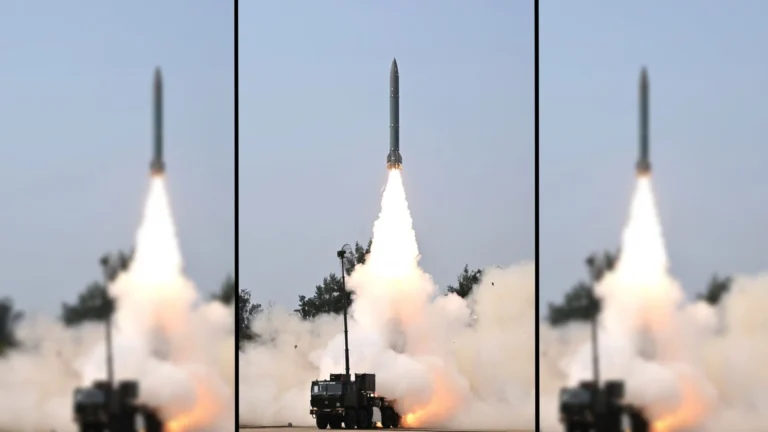
DIU lists the intended military uses: strategic communications, troop command and control, control of strike platforms, terminals on command posts and vehicles, support for unmanned systems and connectivity for defense ministry facilities. Plans already exist, the agency said, to integrate Rassvet into a space-based targeting system for missile weapons and to fit terminals to command vehicles of the 9K720 Iskander-M operational-tactical missile system, whose 9M723 ballistic missile has a publicly reported range of about 500 km.
Satellite links at Iskander-M command level would shorten the sensor-to-shooter chain, especially where strikes or electronic warfare degrade terrestrial networks. For unmanned operations, a sovereign LEO network would restore the beyond-line-of-sight connectivity Russian drone units lost under the Starlink whitelist.
Current capability remains thin. In August 2026, DIU Deputy Chief Vadym Skibitskyi said Russian forces could use Rassvet only intermittently, during satellite passes over Ukraine, and a senior DIU official said total usage over Ukraine amounted to several hours by the end of July.
Analysis: Rassvet’s binding constraint is industrial, not conceptual. Bureau 1440 has demonstrated 16 satellites per Soyuz-2.1b and two operational launches in seven months; reaching 156 satellites by year-end would require at least eight more launches, and no third launch had been publicly scheduled as of late October. That cadence gap, combined with dependence on microelectronics, circuit boards and electronic modules, gives Western export-control authorities leverage the coalition has not used systematically. For NATO, a functioning Rassvet would give Russia a command-and-control layer over Ukraine and EU territory that no commercial provider can switch off, the exact vulnerability Moscow discovered in February 2026.
The next indicators are a third Rassvet-3 launch from Plesetsk, completed orbit raising by satellites still below 500 km and terminal deliveries ahead of the 2027 service target. DIU has called for every listed company to be blacklisted nationally, with banks and businesses barred from dealing with them. Whether the EU, the United Kingdom and the United States act on the list will help determine how fast Moscow can close the gap between 31 serial satellites tracked in early October and its 292-satellite target for 2027.