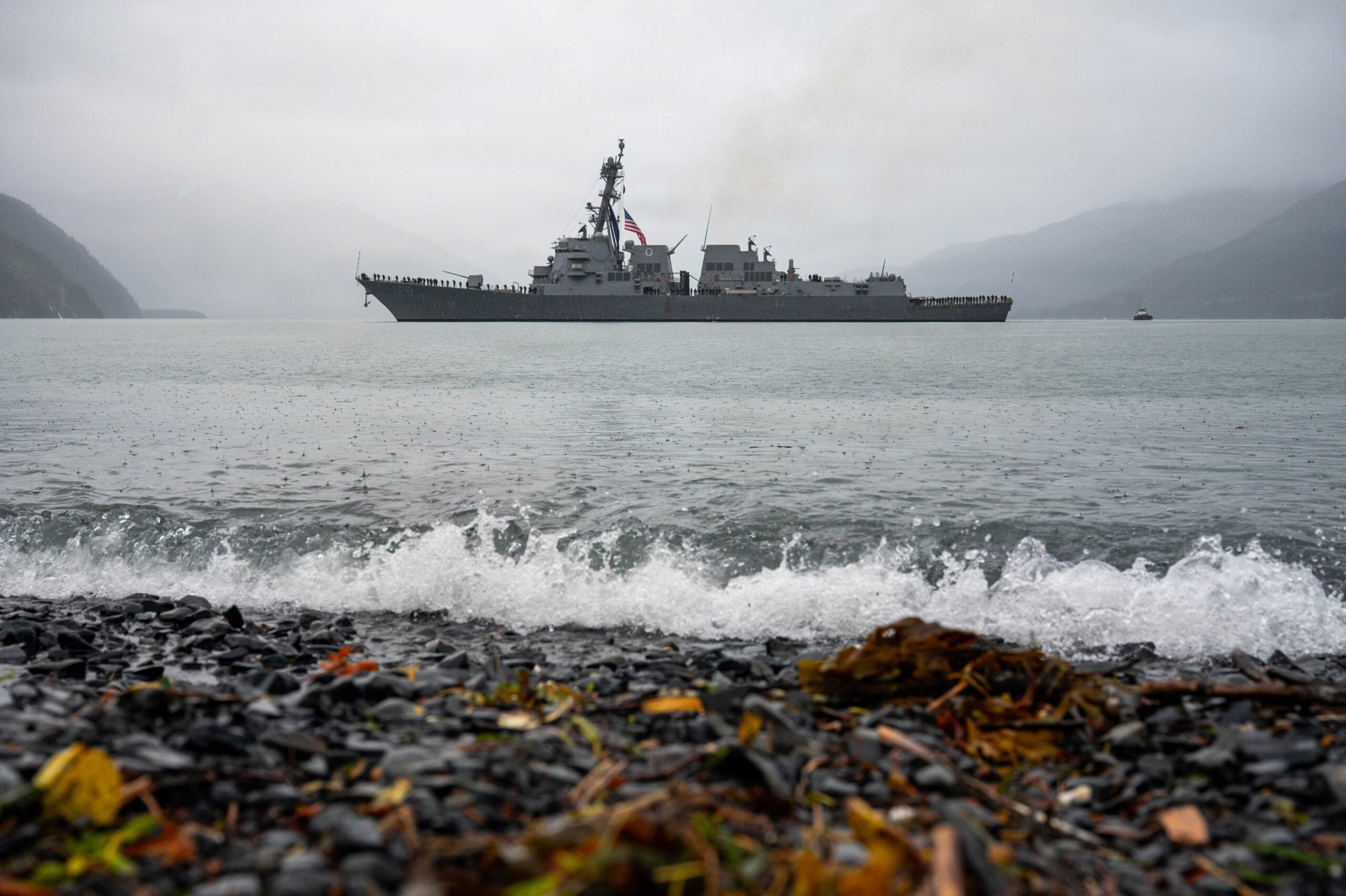
The U.S. Navy commissions the Flight III Arleigh Burke-class guided-missile destroyer USS Ted Stevens (DDG 128) on October 3, 2026, in Whittier, Alaska. The third Flight III hull and the second built by Huntington Ingalls Industries (HII), it becomes the second Flight III destroyer in active service. Commanded by Capt. Mary Katey Hays, the ship will then sail for its homeport at Naval Station Norfolk, Virginia.
The ceremony is the first Navy commissioning in Alaska since USS Anchorage (LPD 23) in 2013. Then-Secretary of the Navy John Phelan approved the Prince William Sound port as the venue in March 2026. The ship honors Senator Ted Stevens, a World War II Army Air Corps transport pilot awarded the Distinguished Flying Cross for missions over “The Hump” in the China-Burma-India theater, who represented Alaska in the Senate for four decades. Flight III remains the Navy’s only large surface combatant in serial production.
USS Ted Stevens Flight III Radar, Power, and Weapons Architecture
The defining change is the Raytheon AN/SPY-6(V)1 Air and Missile Defense Radar, a four-faced, fixed S-band active electronically scanned array that replaces the passive AN/SPY-1D(V) of Flight IIA ships. Publicly available specifications indicate each array is assembled from 37 Radar Modular Assemblies, 2-by-2-by-2-foot building blocks, and that the radar offers roughly 30 times the sensitivity of SPY-1D(V). Raytheon states it can detect targets half the size at twice the distance. Paired with the Aegis Baseline 10 combat system, it is designed to handle ballistic missiles, cruise missiles, aircraft and surface threats simultaneously.
That radar drove the rest of the redesign. Publicly available specifications indicate Flight III carries three Rolls-Royce AG9160 generator sets rated at 4 megawatts each, up from the 3-megawatt AG9140 units in Flight IIA, plus higher-capacity 300-ton air conditioning plants to cool the array electronics. Propulsion remains four General Electric LM2500 gas turbines driving two shafts at roughly 100,000 shaft horsepower for speeds above 30 knots. Open-source figures put the hull at about 510 feet and roughly 9,700 tons full load. The trade-off, flagged in congressional oversight reporting, is a reduced service life allowance for weight and stability.
Armament follows the Flight IIA baseline: a 96-cell Mk 41 Vertical Launching System compatible with Standard Missile-2, SM-3 and SM-6 interceptors, the Evolved SeaSparrow Missile, Tomahawk land-attack missiles and the Vertical Launch Anti-Submarine Rocket. A 5-inch/62-caliber Mk 45 Mod 4 gun, Mk 32 torpedo tubes and a hangar for two MH-60R Seahawk helicopters complete the fit. Chief of Naval Operations Adm. Daryl Caudle said in an August 27 Navy statement that the ship’s “advanced sensors, weapons, and air and missile defense capabilities” give the fleet “greater capacity to find, track, and defeat threats across the maritime domain.”
DDG 128 Build Timeline and the Ingalls Flight III Pipeline
HII built Ted Stevens at its Ingalls Shipbuilding division in Pascagoula, Mississippi, following the lead Flight III ship, Jack H. Lucas (DDG 125). Secretary of the Navy Richard V. Spencer named the destroyer on January 4, 2019, the first Navy warship to bear the senator’s name. Its sponsors are Catherine Ann Stevens, the senator’s widow, and his daughters Susan Stevens Covich and Lily Stevens Becker. The keel was authenticated on March 9, 2022, the hull was christened on August 19, 2023, and the Navy accepted delivery on December 29, 2025. Capt. Hays, a former commanding officer of USS Decatur (DDG 73), reported as the first crewmember on March 27, 2023. The crew sailed the ship to Norfolk, arriving May 15, 2026, then took it to Alaska, mooring in Whittier on September 27. More than 300 sailors serve aboard.
At delivery, HII reported four more Flight III destroyers in fabrication at Pascagoula and seven more in early pre-planning. General Dynamics Bath Iron Works in Maine runs a parallel Flight III line that began with Louis H. Wilson Jr. (DDG 126).
The homeport assignment carries operational weight. Jack H. Lucas, commissioned in Tampa on October 7, 2023, operates from San Diego with U.S. 3rd Fleet, and Navy manning documents list San Diego as the eventual duty station for Louis H. Wilson Jr. Ted Stevens therefore extends SPY-6(V)1 capability to the Atlantic-based surface force under Commander, Naval Surface Force Atlantic. Norfolk-based destroyers including USS Gravely (DDG 107) and USS Mason (DDG 87) intercepted Houthi missiles and drones in the Red Sea during 2024.
Analysis: Ted Stevens matters less as a single hull than as a marker that Flight III is shifting from a West Coast lead-ship capability toward a fleet-wide standard. Every SPY-6(V)1 destroyer that reaches the Atlantic reduces dependence on SPY-1D(V) ships for the high-tempo air and missile defense missions that consumed interceptor inventories and maintenance availability during the Red Sea campaign. The constraint is pace: two yards deliver Flight III at a measured rate, and reduced growth margins leave the hull near the ceiling of what the 1980s-era Arleigh Burke design can absorb. Flight III is a bridge, and its value depends on how quickly the Navy fields enough of them.
After the ceremony, Ted Stevens is scheduled to call at Juneau before transiting the Panama Canal to Norfolk. Next milestones include combat system qualification trials, post-shakedown maintenance and integration into a Surface Force Atlantic training cycle; the Navy has not published a first deployment window. The open question is whether Flight III deliveries can offset the air defense capacity leaving the fleet as Ticonderoga-class cruisers retire.