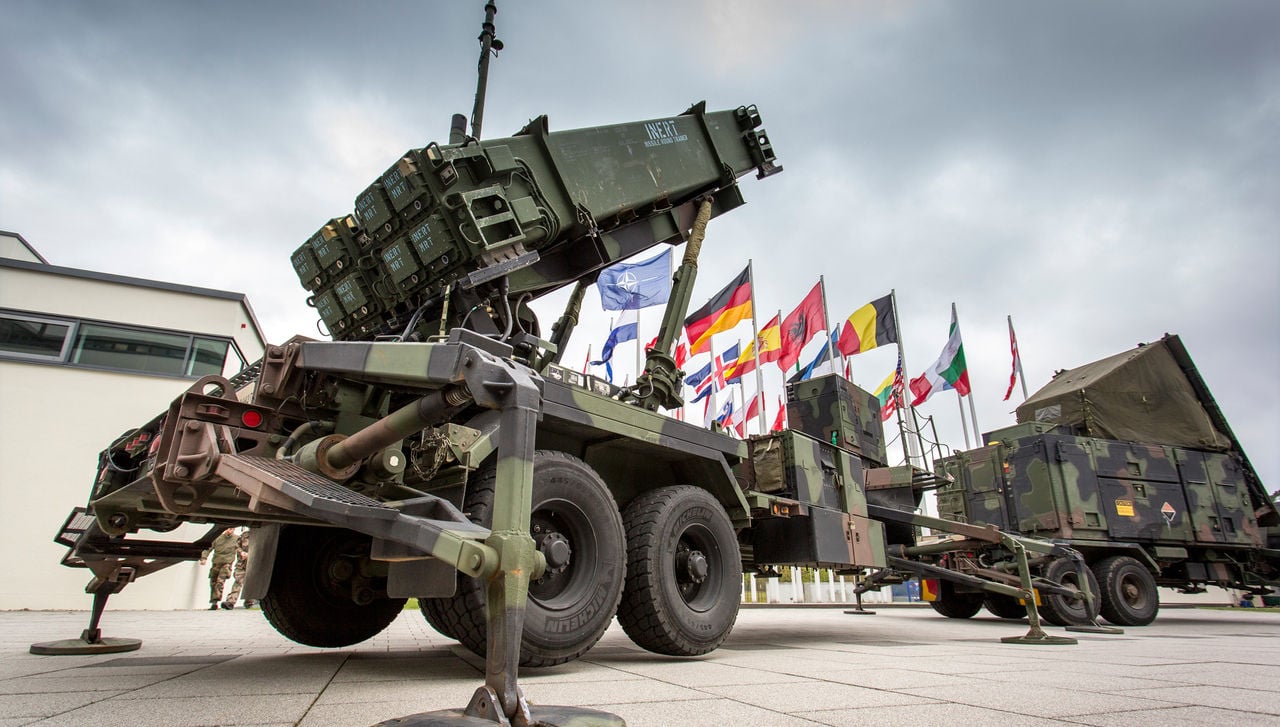
NATO has formally converted its Air Policing mission, in continuous operation since 1961, into a comprehensive NATO Air Defense posture that places quick-reaction fighters, sea- and surface-based air and missile defense systems, and counter-drone capabilities under a single 24/7 mission commanded by the Supreme Allied Commander Europe (SACEUR). The change, implemented throughout 2026 and detailed in Alliance documentation updated September 29, 2026, folds the Eastern Sentry activity and the IAMD Rotational Model into one standing framework built to counter aircraft, drones and cruise missiles.
Allies took the decision at the Ankara Summit on July 7-8, 2026, where they updated the operational plan for NATO Integrated Air and Missile Defense (IAMD). The groundwork was laid after at least 19 Russian drones crossed into Polish airspace on the night of September 9-10, 2025, prompting NATO to launch Eastern Sentry on September 12.
How NATO Air Defense Differs From the 1961 Air Policing Mission
Air Policing was built around a single effector: Quick Reaction Alert (QRA) fighters scrambled to identify and, if required, escort aircraft violating Allied airspace. That model, optimized for crewed aircraft that respond to interception procedures, served the Alliance for 65 years. It was never designed for low, slow and numerous targets.
NATO Air Defense widens the threat set to include crewed and uncrewed aerial systems and cruise missiles, and widens the mission to all five operational domains: air, land, maritime, space and cyberspace. Three capability families now sit under the same peacetime mission: QRA aircraft, sea- and surface-based air and missile defense (SBAMD) systems, and counter-uncrewed aerial systems (C-UAS). NATO describes the result as a multi-layered, 360-degree posture built to respond faster as the threat picture shifts.
Integration runs through the NATO Integrated Air and Missile Defense System (NATINAMDS), the network of national and Alliance sensors, command and control nodes and weapons under SACEUR’s authority. Its lineage traces back to the 1961 NATO Integrated Air Defense System (NATINADS), a largely static belt facing Soviet bombers. The current architecture must track threats from any axis, a requirement underscored by Russian strike packages mixing one-way attack drones, decoys and cruise missiles over Ukraine.
The economics explain why fighters alone no longer suffice. During the September 2025 incursion, Polish and Allied aircraft, including Royal Netherlands Air Force F-35As, downed only a handful of the intruders. Reports indicated that AIM-9X Sidewinder missiles, which open-source estimates price at roughly $400,000 per round, were used against drones valued at around $10,000. A posture that answers every drone with an air-to-air missile exhausts its magazines long before it exhausts the attacker.
How Eastern Sentry Bridged the Gap to a Permanent Posture
NATO characterizes Eastern Sentry as a bridging mechanism that reinforced Air Policing on the eastern flank while the Alliance designed a more permanent solution. The activity paired traditional assets with newer technologies, including anti-drone capabilities. The additional fighters, surveillance aircraft, tankers, transport aircraft and air defense systems first deployed under its banner have now been integrated into NATO Air Defense along the eastern flank. The pressure has not eased: on August 12, 2026, the North Atlantic Council met after fresh airspace violations over Poland and Romania and further drone incidents, with Allies judging that Moscow shows a growing appetite for risk.
The second building block is the IAMD Rotational Model, agreed at the 2023 Vilnius Summit. It provides regular training and the rotational presence of modern air defense systems across SACEUR’s Area of Responsibility, with an initial focus on the eastern flank. At the 2024 Washington Summit, Allies endorsed an updated IAMD Policy and the Enhanced Operational Capability of NATO Ballistic Missile Defense (BMD). Ankara completed the sequence by merging these strands with Air Policing into a single operational plan covering the entire Euro-Atlantic area.
Funding and industrial depth were addressed in parallel. At Ankara, Allies launched Drone Edge, committing more than $40 billion over five years to counter-drone capabilities, alongside offensive uncrewed systems intended as a deterrent. NATO is also setting up a procurement marketplace for counter-drone systems, while Allies announced more than €50 billion in procurement deals spanning IAMD, deep precision strike, uncrewed systems and intelligence.
Command Centers, Regional Missions and the Iranian Missile Intercepts
The command structure is unchanged. Allied Air Command (AIRCOM) at Ramstein, Germany, oversees the mission through three Combined Air Operations Centers (CAOCs): Torrejón, Spain, south of the Alps; Uedem, Germany, north of the Alps; and Bodø, Norway, covering the Nordic region and the Arctic. With overlapping areas of responsibility for redundancy, they monitor up to 30,000 air movements across European NATO airspace every day. NATO’s Air Command and Control systems cover 81 million square kilometers, from northern Norway to the Mediterranean and from eastern Türkiye to the North Atlantic.
Alongside the reinforced eastern flank, four other regional activities carry over. In the Baltics, the four-month rotation through Šiauliai in Lithuania, Ämari in Estonia and, since 2024, Lielvārde in Latvia continues, now with additional assets beyond fighters. Hungary and Italy cover Slovenia, while Greece and Italy cover Albania, Montenegro and North Macedonia. Allies deploy fighters to Keflavík three times a year for three to four weeks to protect Iceland. Belgium and the Netherlands, which have shared Benelux QRA duty since January 1, 2017, announced at Ankara that they will jointly acquire multi-layered air defense systems, including radars and surface-to-air missile launchers.
The southern axis has already been tested. Between March 4 and March 30, 2026, NATO air and missile defense assets in the Eastern Mediterranean intercepted at least four ballistic munitions launched from Iran toward or into Turkish airspace, according to Türkiye’s Ministry of National Defense, amid the US-Israeli air campaign against Iran. The interceptor types have not been officially disclosed. NATO then reinforced regional BMD, including a US Patriot deployment to Malatya protecting the Kürecik early-warning radar, a key node of the US European Phased Adaptive Approach (EPAA).
Analysis: The transition matters less for the hardware it adds than for the burden-sharing model it retires. Air Policing let a handful of fighter-operating Allies secure the skies of members without combat aircraft. That model scales for fighters, because two jets on alert can cover a Baltic state. It does not scale for drones and cruise missiles, which demand dense, distributed sensors and short-range effectors along borders and around critical sites. The Belgian-Dutch decision to buy ground-based layers, in a region where air policing long meant two fighter fleets sharing one alert roster, shows the requirement now extends well beyond QRA. As European Allies and Canada assume more of their own defense under what Secretary General Mark Rutte calls NATO 3.0, the binding constraints become interceptor stocks, cost per engagement and production rates. Drone Edge, at roughly $8 billion a year across 32 Allies, is a start rather than a solution.
Upcoming four-month Baltic rotations will show which assets Allies actually commit beyond fighters. The Drone Edge marketplace and the Belgian-Dutch program should yield selected systems and delivery schedules, neither yet public. NATO has also yet to disclose force levels, C-UAS composition or peacetime engagement rules. Further incursions on the eastern flank will remain the real test of whether a single 24/7 mission can defeat cheap mass without draining the interceptor stocks needed for war.