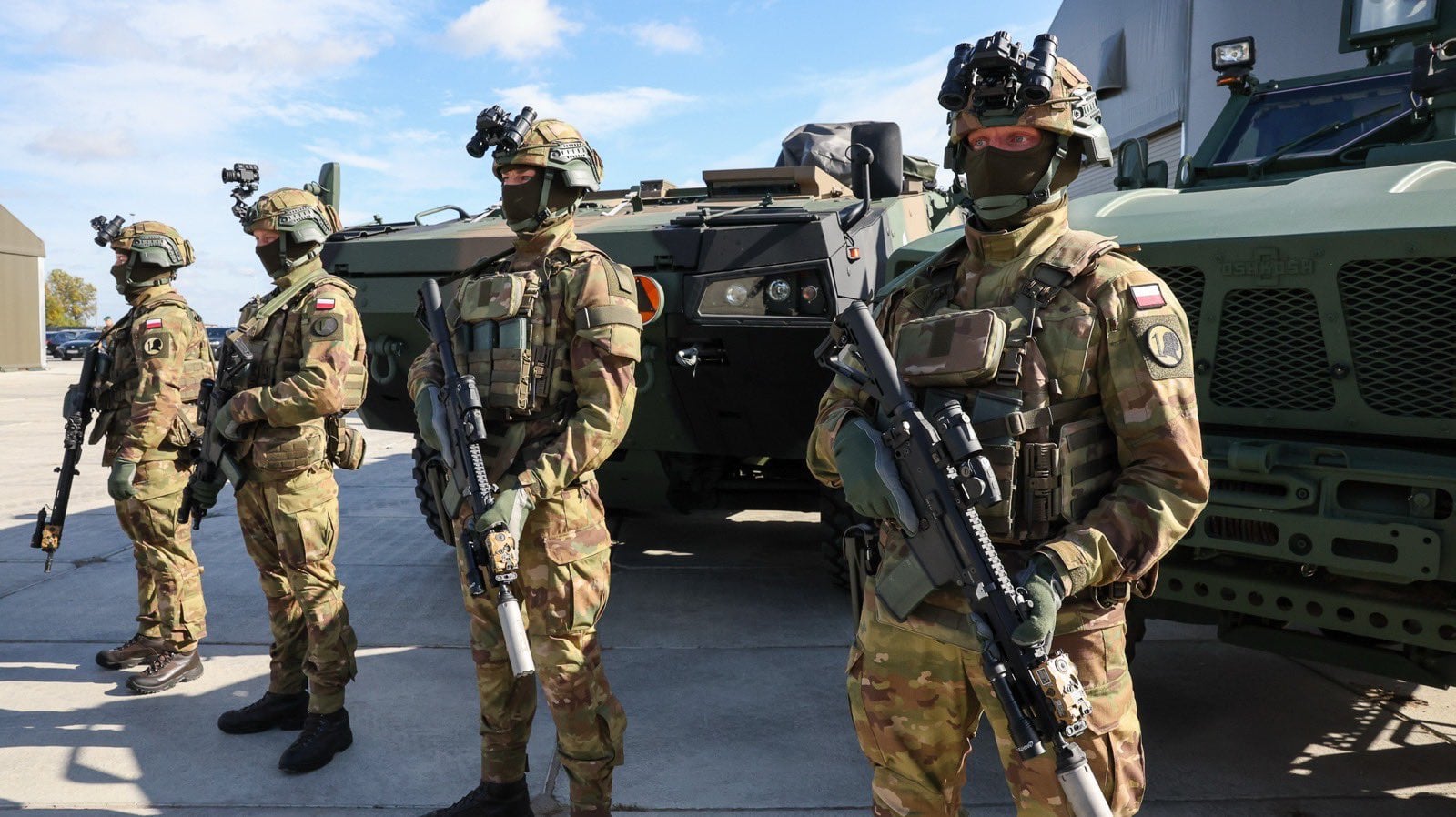
Poland’s Ministry of National Defence unveiled a new field uniform in the five-color K-03 Ryś (Lynx) camouflage pattern on October 5, 2026, at the headquarters of the 1st Legions Infantry Division in Ciechanów. The uniform will progressively replace the wz. 93 Pantera pattern, in service for 33 years, along with its later Pantera M variant. Deputy Prime Minister and Defence Minister Władysław Kosiniak-Kamysz said the uniform will be produced in Poland and that the first deliveries will reach troops before the end of 2026.
The launch ends a long search for a Pantera successor. The ministry commissioned the Military Research and Development Center for Uniformed Services (WOBWSM) in Łódź to compare candidate patterns in early 2018, and Kosiniak-Kamysz first used the Ryś name publicly in December 2025. At that time, Deputy Defence Minister Cezary Tomczyk said the armed forces had bought more than 200,000 Kevlar helmets, 100,000 ballistic vests, and over 1 million uniform and equipment items. The uniform is the most visible element of that drive, which parallels Poland’s expansion of its land forces on NATO’s eastern flank.
Five-Color K-03 Pattern Behind the New Polish Army Uniform
K-03 Ryś uses irregular patches in five colors, varied in size and shape and joined by soft color transitions. According to the ministry, the patch sizes reproduce the colors and shadows of terrain undulations, grass, shrubs, and forest undergrowth typical of Poland, and the pattern is intended to conceal soldiers in both woodland and built-up areas. The stated design goal is silhouette disruption rather than color matching alone.
WOBWSM designed the pattern with input from Polish Special Forces (Wojska Specjalne) personnel, drawing on their operational and overseas deployment experience. Trials ran across several seasons, including at the Nowa Dęba training area, and the Chief of the General Staff, Gen. Wiesław Kukuła, approved the selected variant. Officials presented it as the best-performing candidate for infantry, snipers, and designated marksmen.
Officials claim roughly 30 percent better concealment than Pantera, and Tomczyk said daytime detectability falls by nearly one-third. Preserving concealment under night-vision observation was a stated requirement, and Kosiniak-Kamysz said comparative night-vision imagery showed Ryś outperforming the other uniforms evaluated. The ministry has not published its test methodology, the competing patterns, or any thermal signature data.
At the ceremony, Kukuła described camouflage as one side of a long race between observation and strike systems and the measures armies use to avoid detection, identification, and targeting. He argued that the battlefield has become fully transparent and that artificial intelligence now sharply improves the detection and engagement of personnel.
Fabric, Cut, and Fit: Redesigning the Field Uniform Around Body Armor
The new fabric is lighter, more elastic, and more breathable, with officials citing 30 percent greater tear resistance, up to seven times the abrasion resistance of the previous material, and up to double the air permeability. It is also UV-resistant and can be laundered at 60 degrees Celsius. Fiber composition and fabric weight have not been disclosed.
The cut is built around the realities of wearing a plate carrier. Button closures give way to zips covered by flaps with hook-and-loop fasteners on both jacket and trousers. Sleeves and pockets were redesigned for access while a tactical vest is worn, and pass-through upper pockets on the jacket can double as an improvised arm sling for casualty care. The left thigh pocket was reworked, and the trousers include features that stop the legs riding up in firing positions.
For the first time, the Polish Armed Forces will issue a dedicated women’s cut alongside the men’s version, shaped to female body proportions rather than scaled from male sizing. Under body armor, a poor fit creates pressure points and restricts movement, so the separate cut bears directly on endurance and load carriage.
Kosiniak-Kamysz tied the final design to troop trials. “It was they who tested them, and it was their opinions that determined the final shape of the new field uniform,” he wrote on X.
Rollout to 2028: Production, Cost, and the PLN 1 Billion Budget
Kosiniak-Kamysz said more than 10,000 items will reach the armed forces in 2026, while figures presented at the launch put the first tranche at about 7,500 uniforms. Selected units will be equipped first, followed by the remaining branches. The ministry aims to issue the uniform to every professional soldier by the end of 2028, and Tomczyk said it will become standard across practically all branches.
Each set costs about PLN 1,000. Kosiniak-Kamysz pledged no less than PLN 1 billion for new uniforms in 2027. The ministry has not said how that sum splits between field uniforms and other clothing, or how many sets each soldier will receive.
The ministry has not named the manufacturers or the contract structure, nor confirmed whether Territorial Defence Force (WOT) soldiers and reservists fall within the 2028 target. Nor has it said when helmet covers, plate carrier covers, and packs will follow in K-03.
Analysis: K-03 brings Polish uniform design in line with the battlefield conditions seen in Ukraine, where persistent drone surveillance has turned individual signature management into a survivability requirement. A five-color pattern tuned to Polish terrain and screened against night-vision devices addresses the visual and near-infrared bands, but the ministry’s public data stops there. The AI-assisted detection Kukuła described increasingly draws on thermal and multispectral sensors, against which a printed pattern is only one layer; signature-reducing materials, overgarments, and field discipline carry much of the load. Domestic production backed by a PLN 1 billion budget line also gives Poland’s textile base a sustained order book and reduces exposure to foreign supply disruption.
Initial deliveries to selected units are due before the end of 2026, followed by the 2027 funding tranche and full issue to professional soldiers by the end of 2028. Open questions include production capacity, the wider K-03 equipment family, thermal performance data, and how long Pantera stocks will remain in mobilization reserves.