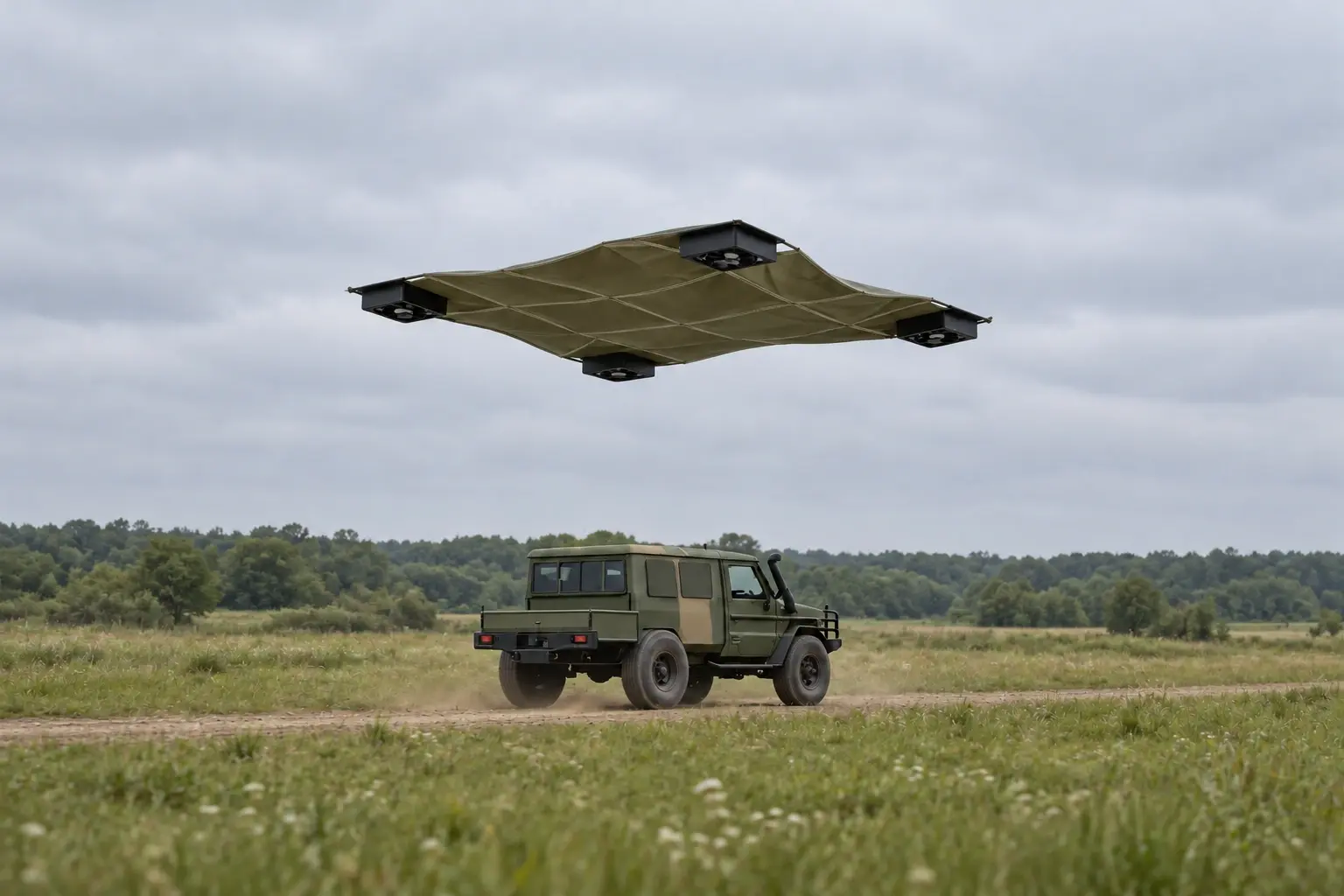
Vigil Autonomy, an Austin, Texas-based defense technology company, has introduced Air Cover, an autonomous camouflage system that deploys a signature-management canopy over vehicles and equipment and can lift that payload into the air to act as a decoy. The company announced the platform on October 13, 2026, and offers it in three sizes, from a 2 by 2 meter personal cover to a 10 by 10 meter canopy covering 100 square meters.
The launch comes as concealment has become a survival requirement for ground forces. In Ukraine, persistent coverage by small uncrewed aircraft carrying thermal cameras, combined with military and commercial synthetic aperture radar (SAR) satellites that image through cloud and darkness, has compressed the time between detection and strike to minutes. Conventional camouflage nets still require crews to unpack, drape, and stake fabric by hand, then strip it before moving, leaving vehicles exposed when they are most vulnerable. Air Cover is an attempt to automate that cycle.
Vigil Autonomy Air Cover Configurations and Flight Endurance
All three configurations share the same autonomous deployment architecture and interchangeable camouflage payloads, according to the company. The Personal variant carries a 2 by 2 meter mesh covering 4 square meters, with an active flight target of four hours. The Unit variant scales to a 3 by 3 meter mesh and 9 square meters, with a three-hour target. The Asset variant, sized for vehicles, carries a 10 by 10 meter mesh covering 100 square meters, with a two-hour target.
Vigil Autonomy lists a maximum operating altitude of 10 meters and an autonomous flight duration of 120 minutes, the latter matching the Asset configuration. The per-configuration endurance figures are presented as targets, not demonstrated performance. In all three sizes, the deployed cover is described as persistent, meaning it can remain over a static asset without continuous flight; active lift is optional and reserved for repositioning and decoy work.
The inverse relationship between canopy size and endurance is consistent with a battery-powered lift platform carrying progressively heavier and more wind-sensitive loads. The company has not disclosed the lift mechanism, rotor configuration, power source, system weight, canopy material, or wind limits. Those parameters will decide whether a 100 square meter canopy stays stable over a moving vehicle.
Company imagery, which Vigil Autonomy largely credits as renderings, shows the cover over vehicles, including a Humvee, in desert and grassland settings, and deployed on its own in a snow-covered forest.
Stealth and Decoy Modes Target Thermal and Radar Detection
Air Cover operates in two modes. In Stealth Mode, the canopy is positioned over the asset for thermal infrared and SAR signature management. Operators can reorient the cover without handling the fabric, reassign it to another vehicle as priorities change, and swap camouflage payloads to match the environment. In Decoy Mode, the system uses temporary active lift to move a selected signature payload away from the protected asset, presenting a false target to enemy sensors. Both roles run on the same lift platform.
Control runs through ISR Control, Vigil Autonomy’s software layer, which the company says links command-and-control platforms to cover deployment, position, and orientation. Operators set tracking offsets relative to the vehicle and switch between modes from one interface. Open interfaces are intended to let third-party camouflage suppliers integrate their own signature payloads, positioning Air Cover as a carrier rather than a proprietary material.
Vigil Autonomy has published no measured signature-reduction data, and the radar panels on its website are labeled as illustrations, not measured sensor results. Pricing, customers, production status, and government test activity have not been disclosed.
Analysis: Air Cover targets a real gap: mobile concealment that does not force a crew to dismount under threat. Vehicle-mounted solutions such as Saab’s Barracuda Mobile Camouflage System bond signature-management material to the hull, keeping protection on the move but tying it to one platform. Vigil Autonomy decouples the cover from the vehicle and adds deception, which matters where drawing loitering munitions onto false targets has become a tactic in its own right. The physics cut both ways, however. A powered lift platform holding fabric above a vehicle carries its own thermal, acoustic, and radio-frequency signature, and a large airborne canopy presents a substantial sail area. Until independent test data emerges, the airborne mode remains a claim rather than a validated capability.
The milestones to watch are field evaluations with military users, publication of thermal and SAR performance data under controlled conditions, and disclosure of the lift system’s specifications. Vigil Autonomy is soliciting inquiries for field evaluation and payload integration, which places the platform in the demonstration phase rather than production. Adoption by US or allied ground forces will hinge on performance in wind, rain, and contested electromagnetic environments, conditions the company has yet to address publicly.