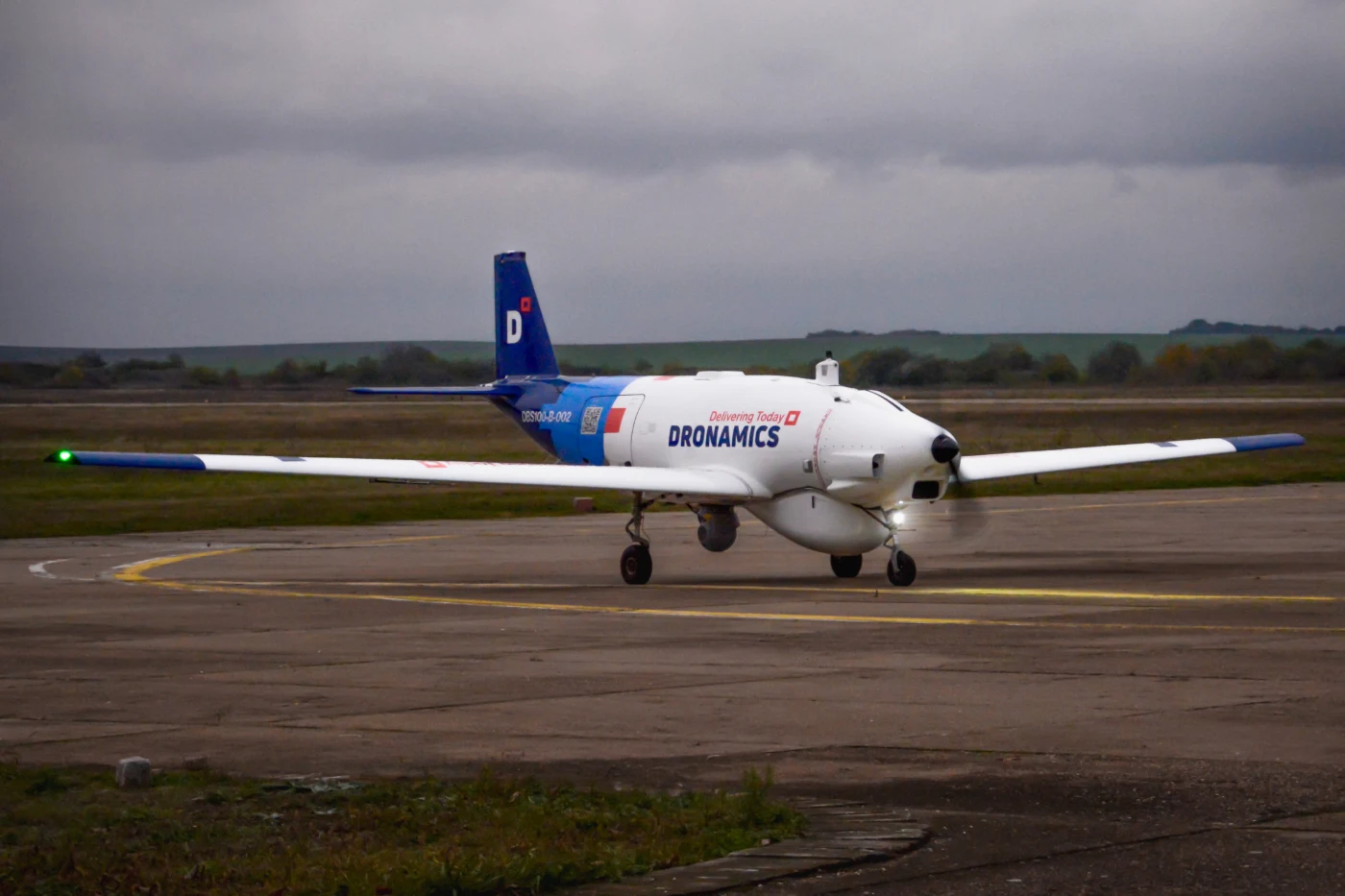
HENSOLDT and Bulgarian drone maker Dronamics announced on November 10, 2026, that a full-scale Black Swan UAV has flown and demonstrated HENSOLDT’s ISTAR and airborne early warning (AEW) suite in Bulgaria. The flights took place before end users from several armed forces and government agencies, and the companies describe the result as Europe’s first unmanned AEW system combined with intelligence, surveillance, target acquisition and reconnaissance (ISTAR) capability. The Black Swan carries a 350 kg payload over a 2,500 km range, with endurance claimed to exceed 24 hours in its defense configuration.
The flight campaign closes a nine-month cycle that began on February 12, 2026, when the two firms announced their partnership and Dronamics launched a “Detect & Defend” defense variant of its cargo drone. Sensor integration and flight validation followed in the third quarter. The timing tracks European priorities: since Russian drones entered Polish airspace in September 2025, persistent low-altitude surveillance along NATO’s Eastern Flank has moved up the agenda, and the European Union has made Eastern Flank Watch one of its flagship defense projects. Alliance AEW coverage, by contrast, still rests on a small number of high-value manned aircraft such as NATO’s E-3A Sentry fleet.
Black Swan UAV Sensor Suite: PrecISR Radar, Argos and MDOcore
The campaign marked MissionGrid’s first flight on an unmanned platform as a fully integrated solution. MissionGrid combines the MissMarvin mission management software, the PrecISR radar and the Argos electro-optical sensor, fusing radar and electro-optical tracks so one aircraft can cover several mission types per sortie.
PrecISR is an X-band multi-mission surveillance radar built around a gallium nitride (GaN) active electronically scanned array (AESA) on a 360-degree gimbal. Publicly available HENSOLDT specifications list air moving target indication (AMTI) for the air picture, ground moving target indication (GMTI) and spot and strip synthetic aperture radar (SAR) over land, and maritime moving target indication, inverse SAR and range profiling at sea, with simultaneous tracking of more than 1,000 targets. HENSOLDT has cited a radar weight below 58 kg, and its catalog lists a detection range of up to 370 km over 360 degrees for the PrecISR 1000 variant. Neither company has disclosed which PrecISR variant or which Argos model flew on the Black Swan, nor any detection ranges achieved during the trials.
HENSOLDT also flew its MDOcore software suite, which provided secure, real-time, cross-domain networking in multi-domain operations scenarios. That layer decides whether the aircraft operates as an isolated sensor or as a node feeding air defense and maritime command networks.
The demonstrated mission sets covered air-to-ground detection and tracking of moving vehicles and stationary assets, target geolocation, and air-to-maritime detection of vessels on the Danube River. The published account does not describe an air-to-air serial against aircraft or drones, which is the core AEW function.
From Cargo Drone to NATO Class III Surveillance Platform
The Black Swan was designed as a long-range cargo UAV. Dronamics specifications list a 16 m wingspan, an 8 m fuselage, a 350 kg payload with 3.5 cubic meters of internal volume, a 2,500 km range, a 200 km/h cruise speed and a 20,000 ft operating altitude from a single piston engine. For the defense configuration, the companies claim endurance exceeding 24 hours and classify the aircraft as a NATO Class III unmanned aircraft system. Dronamics also markets it as payload-agnostic and free of International Traffic in Arms Regulations (ITAR) content, a selling point for European buyers seeking to avoid US export controls.
Altitude drives the AEW case. At 20,000 ft, the radar horizon against surface and very low-flying targets extends to roughly 320 km under standard propagation, far beyond what ground-based radars achieve against the same targets. Practical detection range will be set by radar power and aperture rather than geometry; no trial figures have been released.
The firms position the system against four of the five European Defence Projects of Common Interest: Drone and Counter-Drone European Resolve, Integrated Maritime and Seabed Defence, EU Federated Integrated Air and Missile Defence including Early Warning, and Eastern Flank Watch. Its EU origin could also qualify it for “Made in EU” procurement under the Security Action for Europe (SAFE) loan instrument.
Dronamics co-founder and president Svilen Rangelov pitched the platform as delivering airborne early warning “for a fraction of the price of manned AWACS platforms.” No unit or operating cost has been published.
Analysis: The campaign validates integration and ground and maritime ISR on a European unmanned airframe; it does not yet validate AEW. A piston-engine UAV carrying an X-band ISR radar will not replace large manned AEW aircraft. Its realistic role is a persistent gap-filler: low-cost orbits over border segments, river lines and the Black Sea littoral, cueing ground-based air defenses against low-altitude drones and cruise missiles that surface radars cannot see below the horizon. That role depends on two unpublished variables: air-to-air detection performance against small, low-signature drones, and survivability of a slow, non-stealthy aircraft that must orbit over friendly territory.
HENSOLDT and Dronamics say they will continue toward operational deployment, with a focus on the Eastern Flank and the Black Sea. No customer, contract, production rate or price has been announced. The next markers are a demonstration with published air-target detection results, a first government order, and confirmation that MDOcore links can feed NATO air command and control systems.