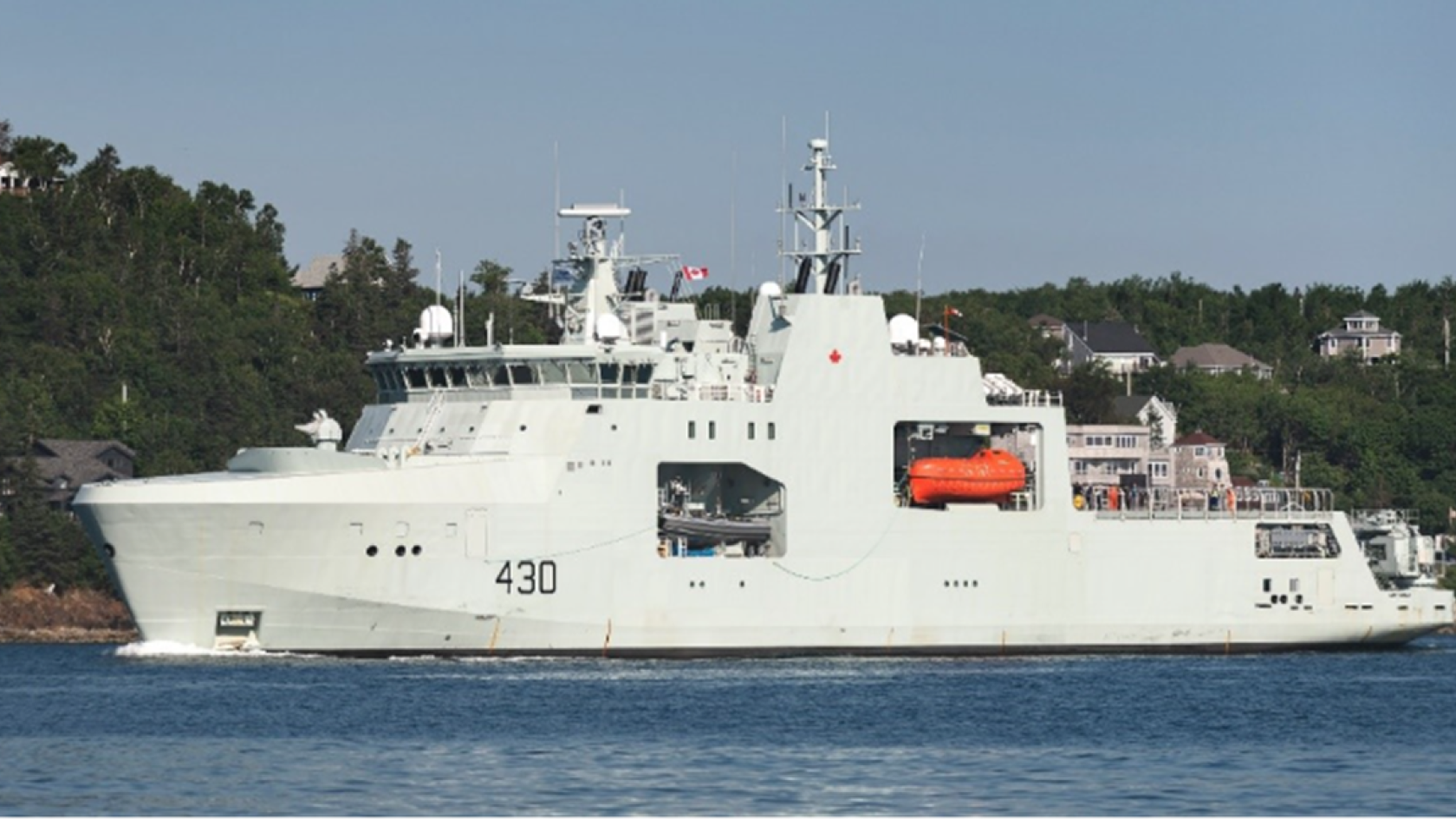
Thales Canada and Toronto-based Cohere will introduce agentic artificial intelligence (AI) into the Royal Canadian Navy’s (RCN) maintenance and support activities under a new task order awarded to Thales through the Arctic and Offshore Patrol Vessels and Joint Support Ships In-Service Support (AJISS) contract, the companies announced in Montreal on October 6, 2026. Backed by cortAIx, Thales’ Montreal-based AI accelerator, the work is the first integration of agentic AI into the navy’s in-service support (ISS) chain, according to Thales. Neither company disclosed the task order’s value or duration.
The award turns a December 2025 partnership into funded work on a live sustainment program. It follows Ottawa’s first Defence Industrial Strategy, published February 17, 2026, which named AI a key sovereign capability and targets 70% of defence acquisitions for Canadian firms within a decade. It also tests the March 2024 AI strategy of the Department of National Defence (DND) and Canadian Armed Forces (CAF), which targets an AI-enabled organization by 2030.
What the AJISS Task Order Means for Royal Canadian Navy AI
Thales frames the task order around administrative load, not combat systems. The agentic tools will automate selected support functions, coordinate workflows and assist with routine maintenance and logistics activities, with RCN personnel retaining oversight, according to the company. The stated aims are faster maintenance and logistics cycles, more capacity within the AJISS program and the right ship ready when the navy needs it. Thales Canada CEO Ian Krepps tied the award to the navy’s push to adopt AI and to keeping the forces focused on asset availability.
Agentic AI goes beyond the predictive analytics most navies have trialed. Instead of flagging an anomaly for a technician, an agent can chain tasks, such as retrieving technical documentation, drafting work packages, checking parts status and routing approvals across separate systems. In ISS, much of the friction sits there rather than in the repair itself.
Predictive maintenance, knowledge management and faster operational planning appear only as candidate follow-on uses. The announcement does not say which ships host the first deployments or which Cohere software components are involved. The navy has worked this problem before, asking Defence Research and Development Canada (DRDC) for a machine-learning system to predict warship machinery failures, according to the DND/CAF AI Strategy.
Harry DeWolf and Protecteur Classes: The Fleets Under AJISS Support
Canada awarded AJISS to Thales in August 2017, covering ISS, refit, repair, maintenance and training for two new fleets. The initial eight-year period was valued at up to CAD 800 million, with options extending to 35 years and CAD 5.2 billion. Thales committed to more than CAD 250 million in Canadian research and development over the contract’s life, naming predictive maintenance among target areas.
The first fleet is complete. The RCN accepted the sixth and final Harry DeWolf-class Arctic and offshore patrol vessel, the future HMCS Robert Hampton Gray, on August 21, 2025. Built by Irving Shipbuilding in Halifax, the class measures 103.6 meters by 19 meters and displaces 6,615 tonnes, according to publicly available specifications. A diesel-electric plant delivers 17 knots in open water and a range of 6,800 nautical miles at 14 knots. Armament is limited to one 25 mm autocannon and two 12.7 mm machine guns, and a flight deck and hangar accommodate a CH-148 Cyclone or CH-149 Cormorant helicopter.
The second fleet is still in the yard. The two Protecteur-class joint support ships, 173.7-meter derivatives of the German Navy’s Type 702 Berlin class built by Seaspan in Vancouver, have slipped: DND now plans to deliver the future HMCS Protecteur in 2027, citing first-of-class outfitting challenges, and the future HMCS Preserver in 2027 or 2028. Until then, the six Harry DeWolf-class ships are the only AJISS hulls in service. Their long Arctic patrols far from dockyards, with a core crew of 65, are where support efficiency converts most directly into sea days.
Disconnected Operations, Human Oversight and the Sovereign AI Requirement
Cohere co-founder Ivan Zhang said the work shows agentic AI can support ship readiness securely, including in disconnected environments, while keeping RCN personnel “firmly in control.” That requirement is operational: a patrol vessel in the Northwest Passage cannot count on bandwidth to a commercial cloud. Cohere markets its platform for cloud, private on-premises and fully air-gapped deployment. Neither company has said whether the AJISS tools will run aboard, ashore or in a hybrid configuration, or at what classification level.
Oversight matters as much. The DND/CAF AI Strategy warns against inappropriate reliance on automated decision systems. Whether oversight takes the form of approval gates on each agent action or of sampling and audit will determine how much administrative load the tools actually remove.
Sovereignty completes the case. cortAIx, created in 2024, groups more than 800 AI specialists across France, the United Kingdom, Canada and Singapore, according to Thales. Pairing its Montreal hub with a Canadian model developer lets Thales link the work to Canada’s Industrial and Technological Benefits (ITB) Policy. Cohere runs a parallel naval track with ThyssenKrupp Marine Systems (TKMS), which signed a teaming agreement in January 2026 tied to the Canadian Patrol Submarine Project, then a June 2026 contract to deploy Cohere’s North platform internally.
Analysis: The task order matters less for its technology than for where it sits. Embedding agentic AI in a prime contractor’s sustainment workflow, rather than a standalone pilot, gives DND a measurable test: if the tools shorten maintenance and logistics cycles, the gain should show up in Harry DeWolf-class availability, the outcome AJISS exists to deliver. It also gives Ottawa an early proof point for its sovereign AI ambition. The weakness is opacity. With no disclosed value, ship assignment or performance baseline, outsiders cannot yet verify whether administrative relief becomes more sea days.
The next markers are practical: which Harry DeWolf-class ships receive the tools first, whether the RCN publishes availability or turnaround data, and whether the capability extends to the Protecteur class once it enters service from 2027. How the task order fits within the AJISS option periods also remains undisclosed.