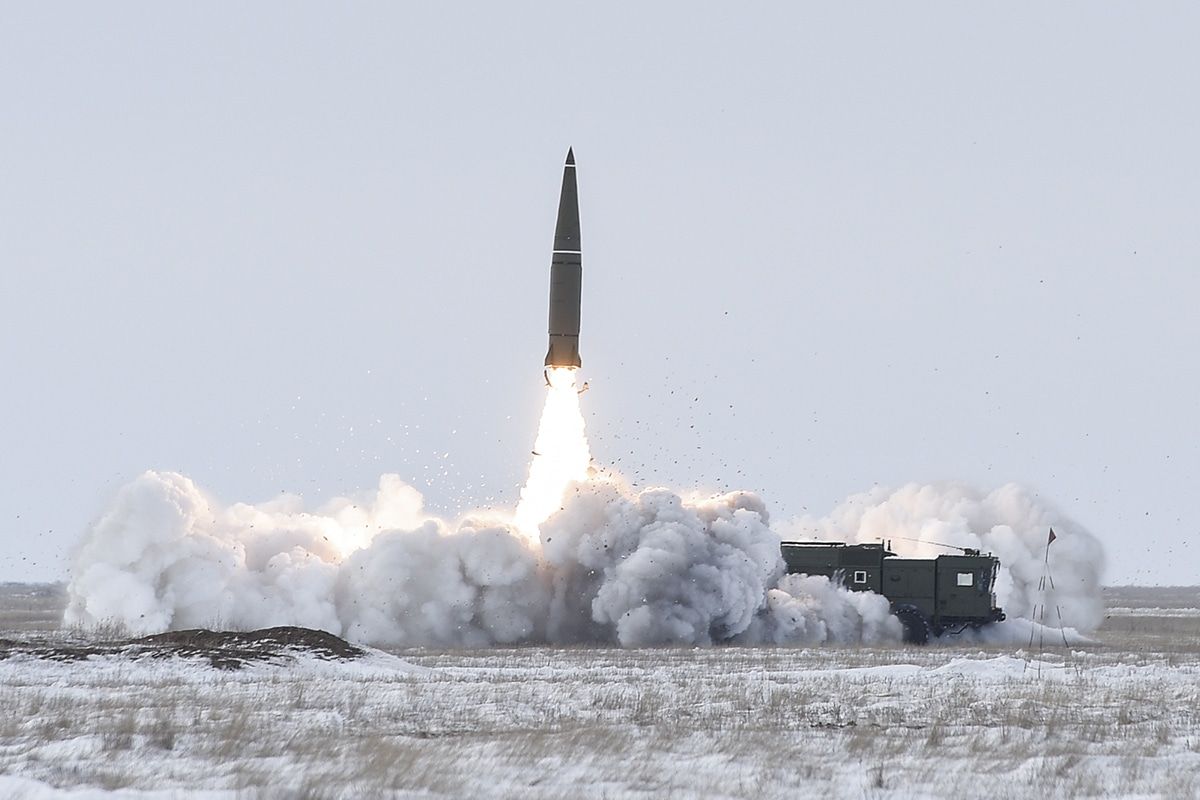
Russian President Vladimir Putin warned on October 1, 2026, that any direct attack on the Baltic exclave of Kaliningrad would put the use of all weapons in Russia’s arsenal “inevitably and immediately” on the agenda, capping three weeks of escalating Russian nuclear threats against Poland and NATO. The rhetoric coincides with a September 24 assessment by the Danish Defence Intelligence Service (DDIS) warning of a “low but growing risk” that Moscow could launch a limited military attack on one or more NATO members bordering Russia in the coming months.
The sequence matters. On September 15, presidential aide Nikolai Patrushev threatened Poland with destruction. On September 30, Moscow delivered a diplomatic note to NATO tying the defense of Kaliningrad explicitly to nuclear use, while Russian embassies in at least three European countries accused the alliance of preparing an air and naval blockade of the exclave. Putin endorsed that line the next day at the Valdai Discussion Club, after condemning allied Baltic drills and interceptions of Russian vessels.
Russian Nuclear Threats Escalate From Warsaw to Kaliningrad
The Polish front opened first. At the Yalta European Strategy conference in Kyiv in mid-September, Polish Foreign Minister Radosław Sikorski argued that NATO would defeat Russia “quite quickly” if Moscow attacked the alliance, citing roughly 2,500 military aircraft fielded by European allies. Patrushev, a former secretary of Russia’s Security Council, replied in an interview with Russian media that Moscow would employ its entire arsenal of forces and means if Poland entered hostilities, and that “Polish statehood will cease to exist within two or three days.” He did not explicitly mention nuclear weapons. Sikorski countered that Russian generals had threatened Poland with nuclear war for 20 years.
The Kaliningrad track followed. The September 30 note, delivered as an informal non-paper, stated that Russia would be ready to use its full arsenal, “including nuclear weapons,” if NATO attempted to isolate the region from the rest of the country, and reportedly warned of strikes on decision-making centers in NATO states at the outset of any conflict. NATO’s written reply stated that none of its exercises or activities threaten Russian territory and urged Moscow to end its “irresponsible nuclear rhetoric.”
At Valdai, Putin confirmed that “everything is written correctly” in the note. He acknowledged that France and the United Kingdom are nuclear powers but argued that no other state possesses the weapons Russia fields today, calling them competitive advantages against an alliance he described as twice Russia’s size. He paired the warning with a disclaimer that Russia has no plan to attack Europe, whether in 2029, 2030 or 2050.
Why Kaliningrad and the Suwałki Gap Anchor Moscow’s Nuclear Signaling
Kaliningrad is both Russia’s most exposed territory and its most forward military bastion. The exclave, wedged between Poland and Lithuania, hosts the Baltic Fleet’s main base at Baltiysk and a dense anti-access/area denial (A2/AD) network. Its signature strike asset is the nuclear-capable 9K720 Iskander-M short-range ballistic missile system. Publicly available specifications indicate a range of about 500 kilometers, a quasi-ballistic trajectory with terminal maneuvering, and a warhead in the 480 to 700 kilogram class, which places Warsaw, Vilnius and Riga within reach from launch sites in the region.
The exclave’s weakness is geography. Its overland links to the Russian mainland run through Lithuania, and its southeastern flank faces the Suwałki Gap, the roughly 65-kilometer stretch of Polish-Lithuanian border that forms the only land corridor between the Baltic states and the rest of NATO. That symmetry explains Moscow’s framing: the terrain that would let NATO isolate Kaliningrad would also let Russian and Belarusian forces sever the Baltic states. By defining any blockade as an attack on Russian territory, Moscow seeks to place sub-threshold measures such as maritime interdiction or airspace restrictions under a nuclear umbrella.
Doctrine reinforces the signal. Russia’s November 2024 revision of its nuclear deterrence policy extended potential nuclear use to conventional aggression posing a critical threat to the sovereignty or territorial integrity of Russia or Belarus, and treats aggression by a non-nuclear state backed by a nuclear power as a joint attack. Moscow also says it has stationed nonstrategic nuclear weapons in Belarus since 2023, adding a second launch geography adjacent to the corridor. Russian officials cite allied drills, including exercises under the UK-led Joint Expeditionary Force, as blockade rehearsals, a claim NATO rejects.
Danish Intelligence Maps Russia’s Limited Attack Options Against NATO
The DDIS assessment, presented by intelligence chief Thomas Ahrenkiel and Defense Minister Jeppe Bruus, judges that Russia may see the coming years as a window to reshape Europe’s security order before European capabilities mature, particularly if Moscow concludes Washington is unable or unwilling to back its European allies. Crucially, it assesses that such an attack could come even while the war in Ukraine continues. Ahrenkiel listed the options: isolated drone or missile strikes on infrastructure supporting Ukraine, false-flag operations using Ukrainian-made drones, or a small troop insertion, possibly without insignia, into a NATO border area under the pretext of protecting Russian minorities. “The aim is not to take over the country, but to divide NATO,” he said.
Recent incidents fit that pattern. On September 14, a Russian frigate in international waters off Gedser, Denmark’s southernmost town, fired two signal flares toward a Royal Danish Air Force AS550 Fennec helicopter photographing the ship; Bruus said one passed within meters of the aircraft without prior radio contact, and Copenhagen summoned the Russian ambassador. A day earlier, a Russian drone struck a locomotive at Yahodyn station, about 2 kilometers from the Polish border, shortly after a diplomatic train carrying former UK Prime Minister Boris Johnson and European security advisers left early. Ukraine’s state railway operator said that train may have been the intended target; Russia’s Ministry of Defense said it hit infrastructure used for European military cargo.
Elena Grossfeld, a researcher at the King’s Centre for the Study of Intelligence in London, has argued that Moscow’s rhetoric could provide cover for a limited incursion modeled on the 2014 seizure of Crimea, possibly preceded by a staged provocation on Russian soil, including in Kaliningrad. She nonetheless judges nuclear escalation improbable: “I still consider the likelihood of nuclear weapons use to be low.”
Analysis: Nuclear signaling and sub-threshold action serve the same objective. The Kaliningrad red line is built to deter the European responses most likely to impose costs on Russia short of war, from Baltic interdiction to Sikorski’s proposal to intercept Russian drones over Ukraine before they reach allied airspace. Deniable or limited actions are calibrated to stay below the level that would force a consensus Article 5 decision. The decisive variable is therefore not nuclear use, which most assessments rate as unlikely, but the speed of allied attribution and collective decision-making under nuclear pressure, and the credibility of the US backing on which the DDIS explicitly conditions its risk estimate.
Three markers will show whether Moscow is preparing action or managing escalation rhetorically: further claims of blockade planning around Kaliningrad, the frequency of unsafe intercepts in the Baltic, and any formal codification of a Kaliningrad blockade as a nuclear threshold. Open questions remain over whether other allied services share the DDIS timeline and whether NATO will adjust force posture along the Suwałki corridor before winter.