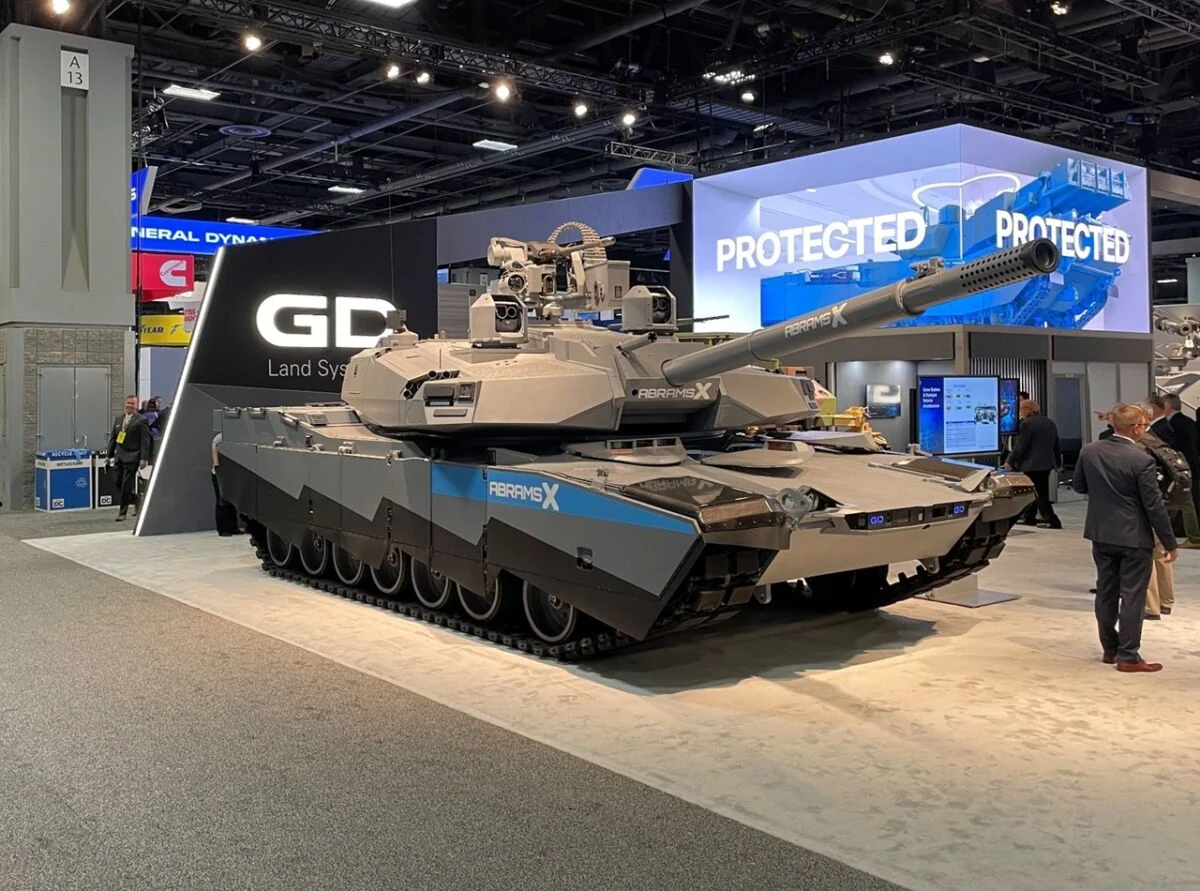
General Dynamics Land Systems (GDLS) and Primordial Labs announced a master teaming agreement on October 7, 2026, to integrate natural language command and control into US ground combat vehicles, naming the Abrams main battle tank and GDLS’s next-generation combat vehicles as target platforms. Primordial Labs will extend its Anura software across GDLS vehicles, letting crews direct on-board systems by describing the outcome they want and the limits that apply, rather than stepping through menus and manual controls.
The agreement lands five days before the Association of the United States Army (AUSA) Annual Meeting opens in Washington on October 12, and as both GDLS flagship development vehicles move toward troop evaluation. GDLS delivered its first M1E3 Abrams prototype in early December 2025 and its Wolf prototype for the XM30 Mechanized Infantry Combat Vehicle competition, where it faces American Rheinmetall, at the end of August 2026. The 1st Cavalry Division at Fort Hood, Texas, is slated to evaluate both this fall ahead of a National Training Center rotation in spring 2027.
How Anura Natural Language Control Works Inside a Combat Vehicle
Anura is Primordial Labs’ Natural Language Command and Control (NLC2) software. Company material describes two subsystems: a Conversational Human-Machine Interface (C-HMI) that interprets mission-type orders phrased in military vernacular, and an Autonomous Mission Execution (AME) engine that converts that intent into platform and sensor behaviors. A plug-in for the Android Tactical Assault Kit (ATAK) or a common operating picture gives the software a spatial model of the battlefield, so an instruction can reference terrain, friendly positions or a target without a crew member building the task by hand.
Inside a vehicle, the partners say Anura will work through subsystems such as sensors, displays, communications and uncrewed systems that would otherwise demand dedicated operator stations. One spoken instruction would replace a chain of inputs spread across separate consoles.
The architectural point that matters most is that Anura runs entirely at the edge, with no cloud reachback. Processing happens on hardware inside the vehicle, so the capability remains available in contested, communications-denied environments where jamming would sever any link to a remote server. The partners have not disclosed the processor, power draw, response latency or model architecture behind the system, and those parameters will decide whether Anura keeps pace with a crew in contact.
M1E3 Crew Reduction Raises the Stakes for Human-Machine Interfaces
The workload problem is concrete. The M1E3 cuts the four-person crew of the M1A2 System Enhancement Package version 3 (SEPv3) to three, replacing the loader with an autoloader serving an unmanned turret, and is projected to weigh roughly 25% less than current variants. The commander, gunner and driver sit in the hull and absorb tasks once spread across four soldiers, while handling a growing roster of networked capabilities that includes uncrewed air and ground teammates.
GDLS has spent years preparing its vehicles for continuous software insertion. Its Katalyst Next Generation Electronic Architecture, introduced at AUSA 2021, follows a Modular Open Systems Approach aligned with the NATO Generic Vehicle Architecture standard and served as the electronic backbone of the AbramsX demonstrator. The announcement does not say whether Anura will run on Katalyst, but the two concepts are complementary: an open backbone lets new subsystems plug in, and a language layer lets crews use them without learning a new control scheme for each.
Each capability added to a combat vehicle has traditionally brought its own interface and training burden. The partners argue that a single conversational front end can take on every added subsystem or software release, so the Army and Marine Corps can push new technology across fleets at the speed it is developed. Keith Barclay, vice president and general manager of US operations at GDLS, called natural-language control “a critical enabler of greater lethality with a smaller crew size.”
Primordial Labs Moves Anura From Special Operations Drones to Armor
Primordial Labs, founded in 2021 by Lee Ritholtz and Adrian Pope and headquartered in New Haven, Connecticut, built Anura on small drones. In August 2023, it received a Direct to Phase II Small Business Innovation Research (SBIR) award, executed as an Other Transaction Authority agreement with US Army Special Operations Command, to give special operators voice control of drones. In early 2025, the company flew Teal Drones’ Black Widow and Skydio’s X10D by voice in demonstrations and reported contracts with four program executive offices and five manufacturers across air and ground platforms.
The ground push accelerated in 2026. On July 31, American Rheinmetall named Primordial Labs on its team for an 18-month Army contract under Project Sustainment, which calls for autonomous, hybrid-powered uncrewed ground vehicles with voice control. The GDLS agreement moves Anura from robotic logistics carriers into crewed armored platforms. Ritholtz said Army formations are becoming software-defined and dense with robotics, and that Anura is meant to give a small armored crew one intuitive way to command everything from mission systems to uncrewed teammates.
Analysis: The agreement positions Primordial Labs as a vendor-neutral interface layer that sits across competing primes rather than inside one. Anura is now teamed with American Rheinmetall, the rival GDLS faces for the XM30, and with GDLS itself, a pattern consistent with the Modular Open Systems Approach the Army demands of its ground vehicle programs. For GDLS, the payoff is crew workload, the variable that matters most once crews shrink. The release lists sensors, displays, communications and uncrewed systems, but not fire control. The harder question is assurance: the Army has not published how it will test, certify and bound a language-driven interface on armored platforms where a misread order carries tactical consequences.
Neither company disclosed a contract value, an integration schedule or which Abrams variant will receive Anura first. The next markers are whether the capability appears at AUSA from October 12 to 14, how the 1st Cavalry Division evaluations proceed this fall, and the spring 2027 National Training Center rotation, where crew workload data will show whether spoken command earns a place in the Army’s next armored fleet.