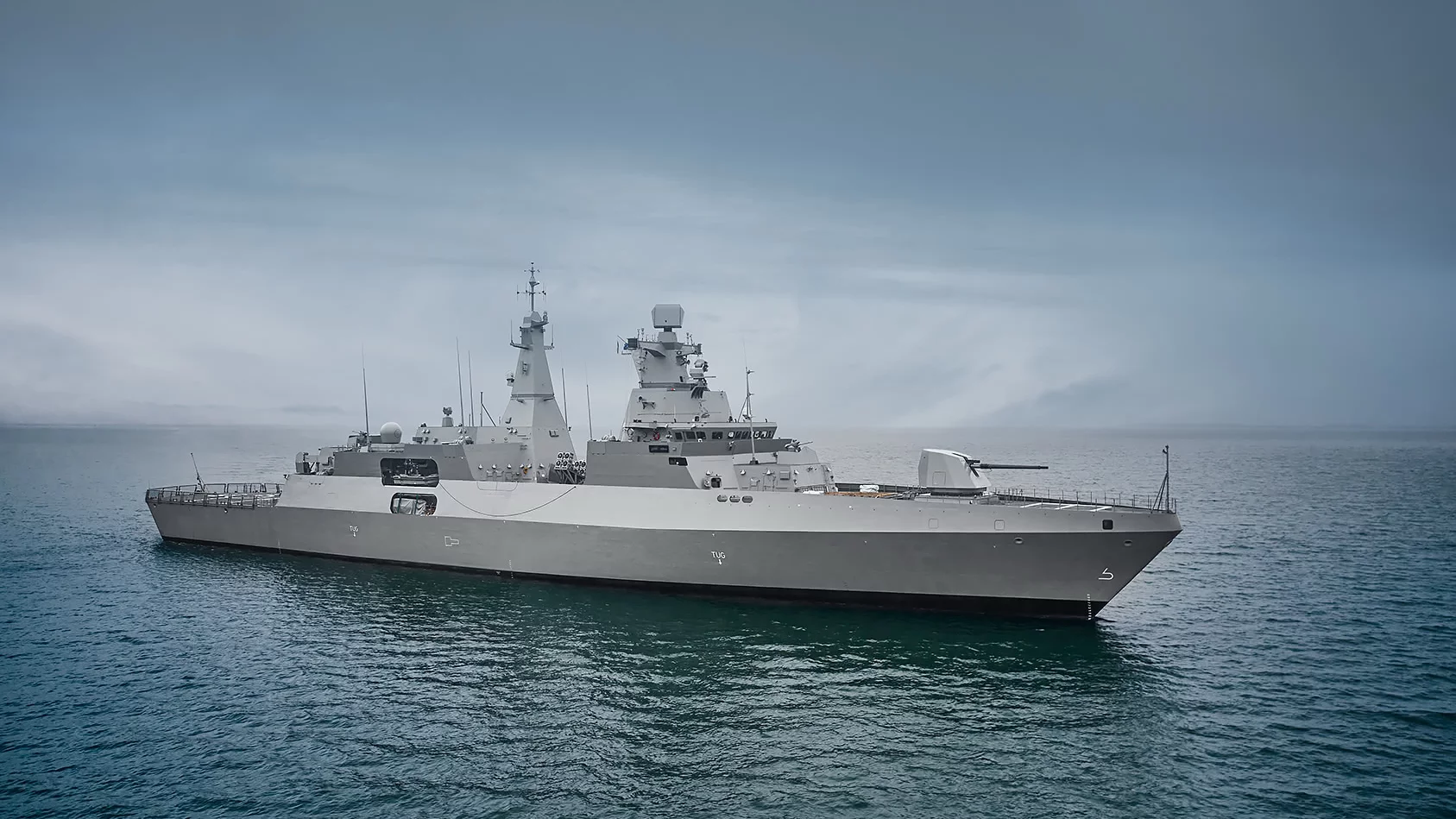
Germany’s Bundestag Budget Committee on October 8, 2026, approved four more MEKO A-200 DEU frigates from TKMS, doubling the German Navy’s order to eight anti-submarine warfare (ASW) ships. The Federal Ministry of Defence (BMVg) priced the option at about €5.3 billion; the first frigate is due in December 2029.
The vote completes the replacement of the F126 program, terminated on June 24, 2026; lawmakers approved the first four ships, worth about €6.3 billion, on July 8, 2026. Berlin has pledged sea-based ASW forces to NATO for the North Sea, the Baltic, the Atlantic and the High North.
MEKO A-200 DEU Replaces the Collapsed F126 Frigate Program
The F126 was conceived as the Navy’s primary ASW combatant. The BMVg contracted Damen Schelde Naval Shipbuilding (DSNS) of the Netherlands as general contractor in 2020 for six ships at a total of about €10 billion, with the first frigate due to reach initial capability in mid-2028 and all six available by 2033. DSNS later informed the ministry it could meet neither the agreed schedule nor the agreed price.
Beginning in 2025, the ministry studied transferring the program to Naval Vessels Lürssen (NVL). That assessment priced a new NVL contract at roughly €15.2 billion, pushing total F126 funding needs above €18 billion once work already performed and supporting contracts were included. A change of prime contractor would also have required Berlin to waive potential damages claims against DSNS, which the ministry refused; the size of those claims remains under legal review.
The arithmetic favored the MEKO. Eight ships at a combined €11.6 billion work out to about €1.45 billion per hull on a straight division of the published figures, against more than €3 billion per F126 under the NVL scenario. The comparison is imperfect: the MEKO construction contract bundles an industry training package for crews, and the F126 was a ship of roughly 10,000 tons designed for global deployment with modular mission bays. The BMVg attributed growth in the MEKO price over the original budget line to the conversion of an industry cost estimate into a binding offer, adding that Navy-mandated additions account for only about 5% of total cost.
Sonar, Torpedoes and Sea Tiger: The MEKO Frigate ASW Configuration
The MEKO A-200 DEU retains the TKMS export hull, a design dating to the 1990s and refined since, while the combat system is tailored to German requirements; the DEU suffix denotes that national fit. According to the Bundeswehr, the ship measures 121 meters long, with a 16.3-meter beam and a 6.1-meter draft, and displaces about 4,000 tons in operational condition. Top speed exceeds 27.5 knots, endurance is 28 days, and the core crew numbers 121, with berths for 35 additional personnel.
Propulsion keeps the established MEKO arrangement of two diesel engines plus a gas turbine driving a supplementary waterjet. The procurement office’s project lead said changing the plant would have forced redesign work incompatible with the 2029 date. TKMS cites a range of more than 6,500 nautical miles at 16 knots.
The ASW suite combines a bow-mounted sonar, a towed sonar and torpedo tube sets for MU90 lightweight torpedoes. An embarked Sea Tiger, the Navy’s NH90-based maritime helicopter, extends the search and attack radius with its own sonar and torpedoes. A vertical launch system for air-defense missiles, launchers for anti-ship and land-attack missiles, and several guns complete the armament. The BMVg has not publicly confirmed missile types or sonar suppliers.
The Navy has acknowledged the compromises. The compact hull offers limited growth margin, so integrating future systems will be costly and constrained. Crews will live in 12-person berthing compartments with narrow passageways. Variants of the design have served with the South African Navy since 2006 and now also equip Algeria and Egypt.
Saab 9LV Combat System and a Nine-Month Delivery Cadence
TKMS, the Kiel-based shipbuilder formerly known as thyssenkrupp Marine Systems, is prime contractor. On July 16, 2026, Saab announced a contract worth approximately SEK 8.7 billion, about €790 million, to deliver and integrate the 9LV combat management and fire control system, the long-range Sea Giraffe 4A Fixed Face surveillance radar, the lightweight Sea Giraffe 1X multi-mission radar, passive sensors and composite superstructures for the first four ships. Saab deliveries run from 2029 to 2032, and the contract includes an option to equip further hulls. To simplify logistics and training, the Navy aligned the combat system with equipment planned for its modernized F123 Brandenburg-class frigates.
The schedule is compressed by German standards. The Navy began examining the MEKO option in August 2025. A preliminary contract, funded by the Budget Committee in January 2026, let TKMS secure yard capacity and order long-lead material before a construction contract existed. Steel work on the first hull started in February 2026 at a Bremerhaven yard, identified in open-source reporting as Stahlbau Nord, which built three hulls for Egypt’s MEKO A-200EN frigates between 2019 and 2023. The keel was laid in May 2026.
The Federal Office of Bundeswehr Equipment, Information Technology and In-Service Support (BAAINBw) says a program of this size typically takes about ten years; this one targets just over four. A ministry decree on accelerated procurement limits requirements to those mandated by law, ending the practice of applying civilian shipping standards where warship exemptions exist. TKMS has agreed to deliver one frigate every nine months.
Analysis: Berlin has traded capability headroom for schedule certainty: eight smaller ASW hulls from a proven production line, for under two-thirds of the projected F126 bill. The binding constraint now shifts from shipyards to people: eight core crews total 968 sailors, and the Navy must stand up a new crew every nine months while personnel growth is still underway.
Next, the BAAINBw must exercise the option in its construction contract with TKMS, and Saab has yet to announce combat system orders for hulls five through eight. Live-fire acceptance of the first ship follows in early 2030; at a nine-month cadence, the eighth would arrive around 2035. Missile selections, ship names and the DSNS damages review remain open.