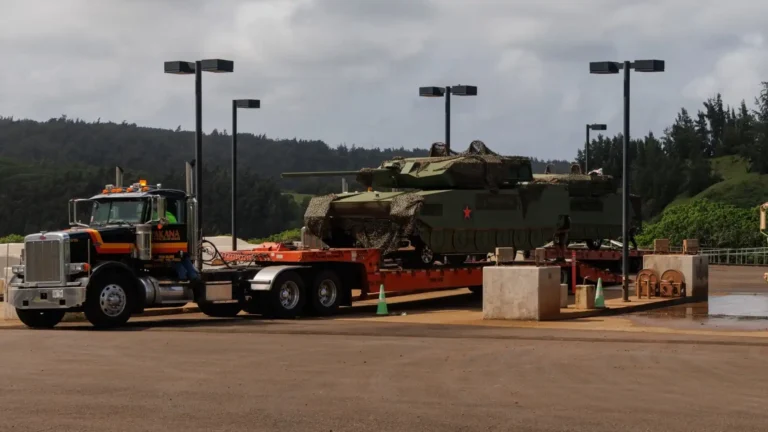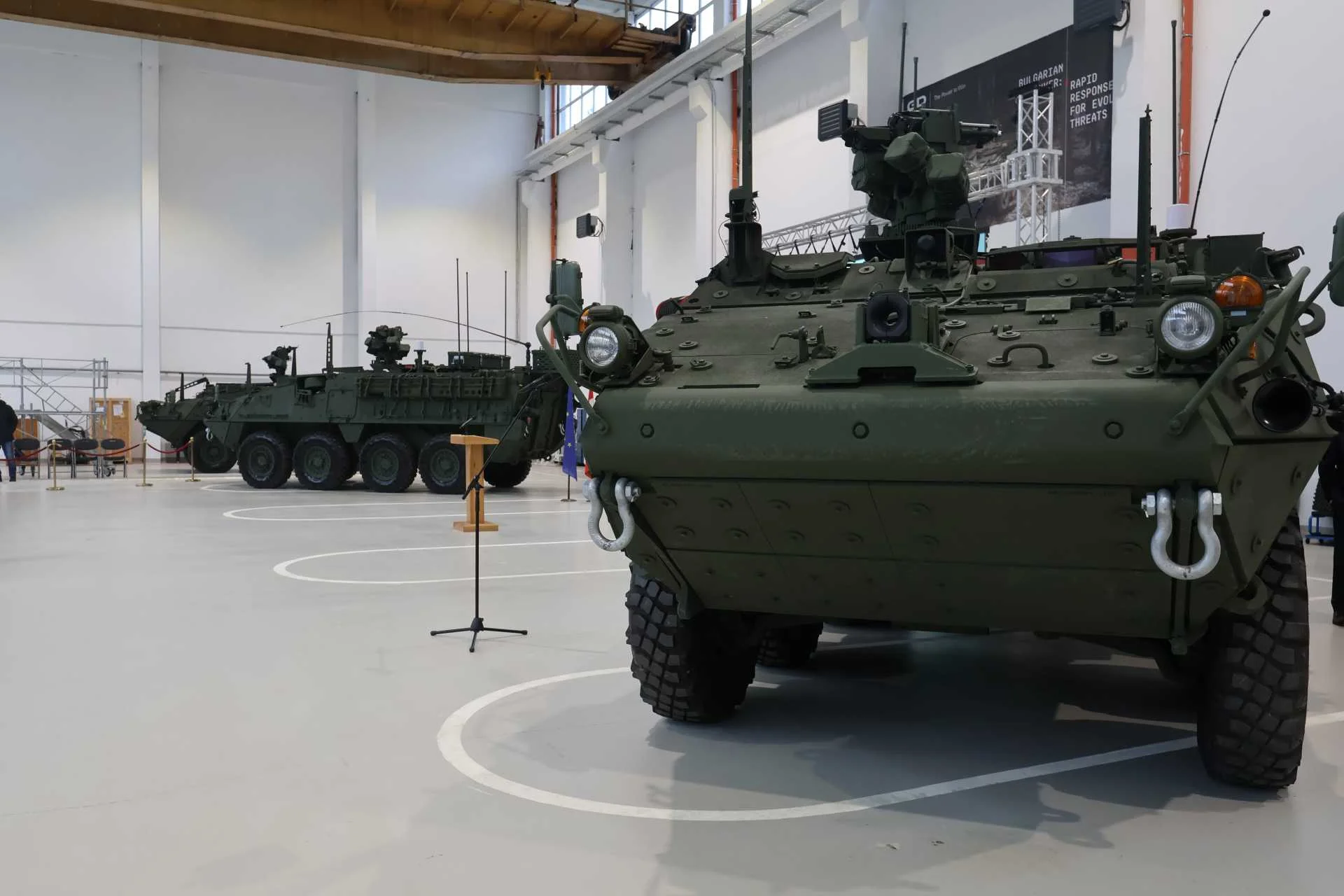
Bulgaria commissioned its first five Stryker 8×8 armored vehicles into Land Forces service on November 3, 2026, at the state-owned TEREM-Ivaylo plant in Veliko Tarnovo, where the vehicles completed final assembly, communications integration and acceptance testing. The vehicles go to the 61st Stryama Mechanized Brigade in Karlovo, the first formation slated to convert to the platform. Eight vehicles have been assembled so far, and three more await acceptance.
The handover opens deliveries under a 2023 Foreign Military Sales package of 198 vehicles: 183 Strykers and 15 Heavy Expanded Mobility Tactical Trucks (HEMTT). Signed at roughly $1.37 billion, the program rose to about $1.414 billion after the National Assembly approved an increase in July 2026, citing inflation and higher prices for electronic components, raw materials and transport. Defense Minister Dimitar Stoyanov acknowledged a delay of about one year, driven largely by shortages of imported communications equipment, but said deliveries and payments now track the revised schedule. Prime Minister Rumen Radev, outgoing Chief of Defence Adm. Emil Eftimov, Deputy Assistant Secretary of State David Baker, Maj. Gen. Christopher R. Norrie of US Army Europe and Africa, and Canadian Ambassador Kevin Rex attended. “An ally that can plug in seamlessly with its partners makes the alliance stronger,” Baker said, according to the U.S. Embassy in Bulgaria.
Bulgarian Stryker Vehicles: Dragoon Cannons and Support Variants
The order spans six Stryker configurations. The largest share, 90 vehicles, are M1296 Dragoon infantry combat vehicles armed with the 30 mm Mk 44 Bushmaster II cannon in a Kongsberg turret. The remainder comprises 17 M1126 Infantry Carrier Vehicles, 33 M1130 Command Vehicles, 24 M1133 Medical Evacuation Vehicles, nine M1132 Engineer Squad Vehicles and 10 M1135 Nuclear, Biological and Chemical Reconnaissance Vehicles. The HEMTT package adds heavy recovery, load-handling, wrecker and fuel tanker trucks.
Publicly available specifications indicate the baseline Stryker, derived from the General Dynamics LAV III, uses a 350 hp Caterpillar C7 diesel paired with an Allison automatic transmission, reaches about 100 km/h on roads and offers a nominal range near 500 km, with combat weights of roughly 18 to 20 tonnes depending on variant and armor package. The Dragoon’s stabilized cannon gives the brigade direct fire against light armor that the 12.7 mm M2 machine gun or 40 mm Mk 19 grenade launcher on conventional Strykers cannot match. Bulgaria is separately acquiring FGM-148F Javelin missiles for heavier armored threats.
The mix reshapes the brigade. Dragoons will make up 90 of its 107 infantry vehicles, and their turrets reduce troop space compared with the M1126, which carries two crew and nine dismounts. Crews began preparing early: Bulgaria received eight secondhand Strykers through the US Excess Defense Articles program in February 2026, and a Washington National Guard mobile training team worked with soldiers in Karlovo from March to June 2026.
How TEREM-Ivaylo Plans to Become a Regional Stryker Hub
General Dynamics Land Systems-Canada manufactures the vehicles, while TEREM-Ivaylo handles final assembly, installation of communications suites, functional checks of fire control and onboard systems, and acceptance preparation. The government invested more than 17 million leva in the site, refurbishing workshops, building three new facilities and training staff. A Harris service center for onboard radios, a capability Bulgaria previously lacked, is planned at the plant, which reportedly targets an assembly rate of 10 vehicles per month.
Stoyanov wants the plant to service Strykers beyond Bulgaria’s own fleet. “We are working hard to make Bulgaria a hub for servicing Stryker vehicles,” he said, noting that North Macedonia and Ukraine also operate the platform. He said Bulgaria has the capacity to acquire first-, second- and third-level maintenance capabilities, while stressing that assembling Bulgarian vehicles remains the priority.
Key dependencies remain. Bulgaria does not produce Stryker ammunition, which the United States supplies, and Stoyanov urged a technology transfer that would allow domestic production, calling on private industry in particular to adapt faster to NATO standards.
Analysis: The strategic value of the program lies less in five vehicles than in whether TEREM-Ivaylo becomes a working sustainment node on NATO’s Black Sea flank. A Bulgarian brigade on a common platform with US Army Stryker formations in Europe simplifies interoperability, spares and training, and third-level maintenance in Veliko Tarnovo would shorten repair loops for regional operators. Yet with five of 183 Strykers in service, a year of slippage behind it, and ammunition and radios still imported, the capability will be measured by assembly throughput and sustained funding rather than ceremonies.
Some 25 vehicles are in assembly, the Dragoon production phase is reportedly scheduled to start in early 2027, and full delivery is planned for 2028. Stoyanov also said equipping the Second Mechanized Brigade would require around 200 more vehicles and about EUR 1.4 billion over five to six years, a project with no funded contract that will depend on Bulgaria’s finances.