The Norwegian Defence Materiel Agency (Forsvarsmateriell, FMA) has handed over a new NASAMS IV air defense battery to the Royal Norwegian Air Force, the agency announced on November 3, 2026. The handover took place at Ørland Air Station, home of the 132nd Air Wing, in the presence of Prime Minister Jonas Gahr Støre and FMA Director Gro Jære. It marks the start of a broader recapitalization of Norway’s National Advanced Surface-to-Air Missile System (NASAMS) force.
The program traces directly to Ukraine. Norway donated air defense equipment to Kyiv in spring 2023 and began replacement work immediately; in January 2024, roughly nine months later, FMA signed its first contract for new batteries, a Kongsberg Defence & Aerospace order valued at approximately NOK 1.4 billion for multi-missile canister launchers and Fire Distribution Centers. The delivery comes as NASAMS continues to defend Ukrainian cities against Russian missile and drone attacks, experience Støre cited as essential to the future development of Norway’s own air defense.
NASAMS IV Battery Program: Replacing Ukraine Donations and Adding Capacity
FMA now holds contracts for four new NASAMS batteries with a combined cost framework of close to NOK 7 billion in 2026 kroner. Two batteries replace equipment donated to Ukraine and are funded through the Nansen Support Programme for Ukraine. The other two are financed from the Norwegian Armed Forces’ investment budget and add net capacity. FMA’s Air Capabilities division runs both projects as a single acquisition stream.
The contracting sequence moved fast. After the January 2024 replacement order, FMA signed a larger contract with Kongsberg in June 2024 that carried a fixed-price option for additional air defense, and exercised that option in December 2024. Norway thus secured equipment for four complete batteries in under a year.
Jære framed the handover as proof of execution. “This delivery shows that we are able to turn political decisions and appropriations into actual defense capability,” she said, pointing to high demand for materiel, strained production capacity and long lead times. She added that the battery arrived on plan and within budget, and stressed that the agency was delivering “more than a replacement for what we gave away.” (Quotes translated from Norwegian.)
To support integration, FMA has set up a local receiving organization at Ørland coordinating the Armed Forces, the project office and suppliers. The ceremony also opened a new building that consolidates the air defense batteries, battalion command and the Air Defence Tactical School.
Launchers, Fire Distribution Centers and the AMRAAM-ER Missile Mix
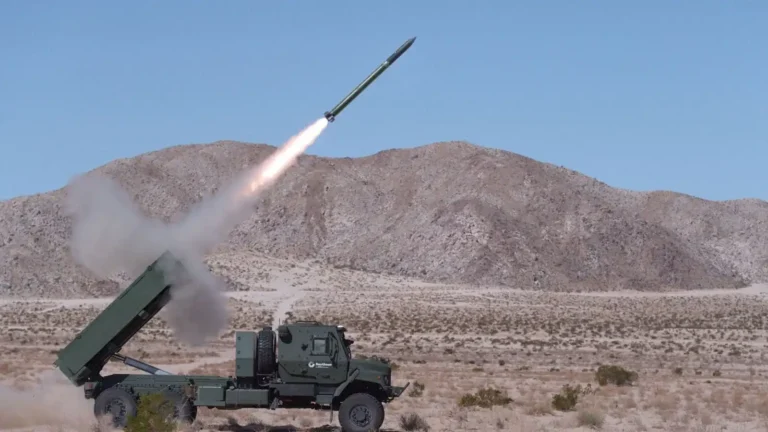
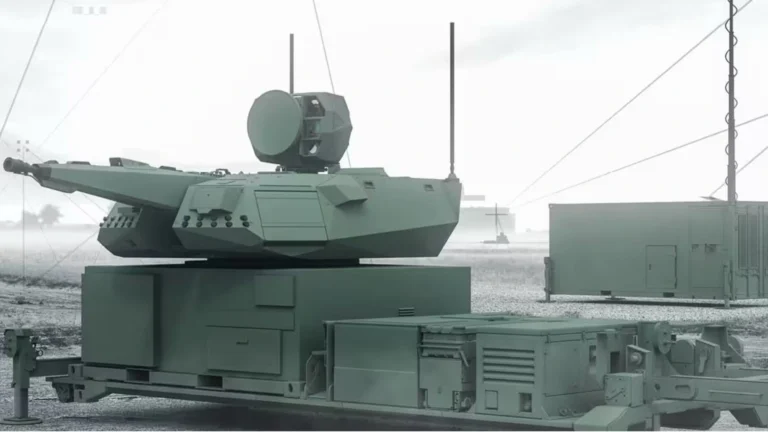
FMA describes NASAMS IV as a generational shift, with modernized launchers and Fire Distribution Centers (FDCs), improved performance, greater flexibility against varied threats, and new vehicles and trailers for mobility. The agency has not published detailed performance data for the configuration.
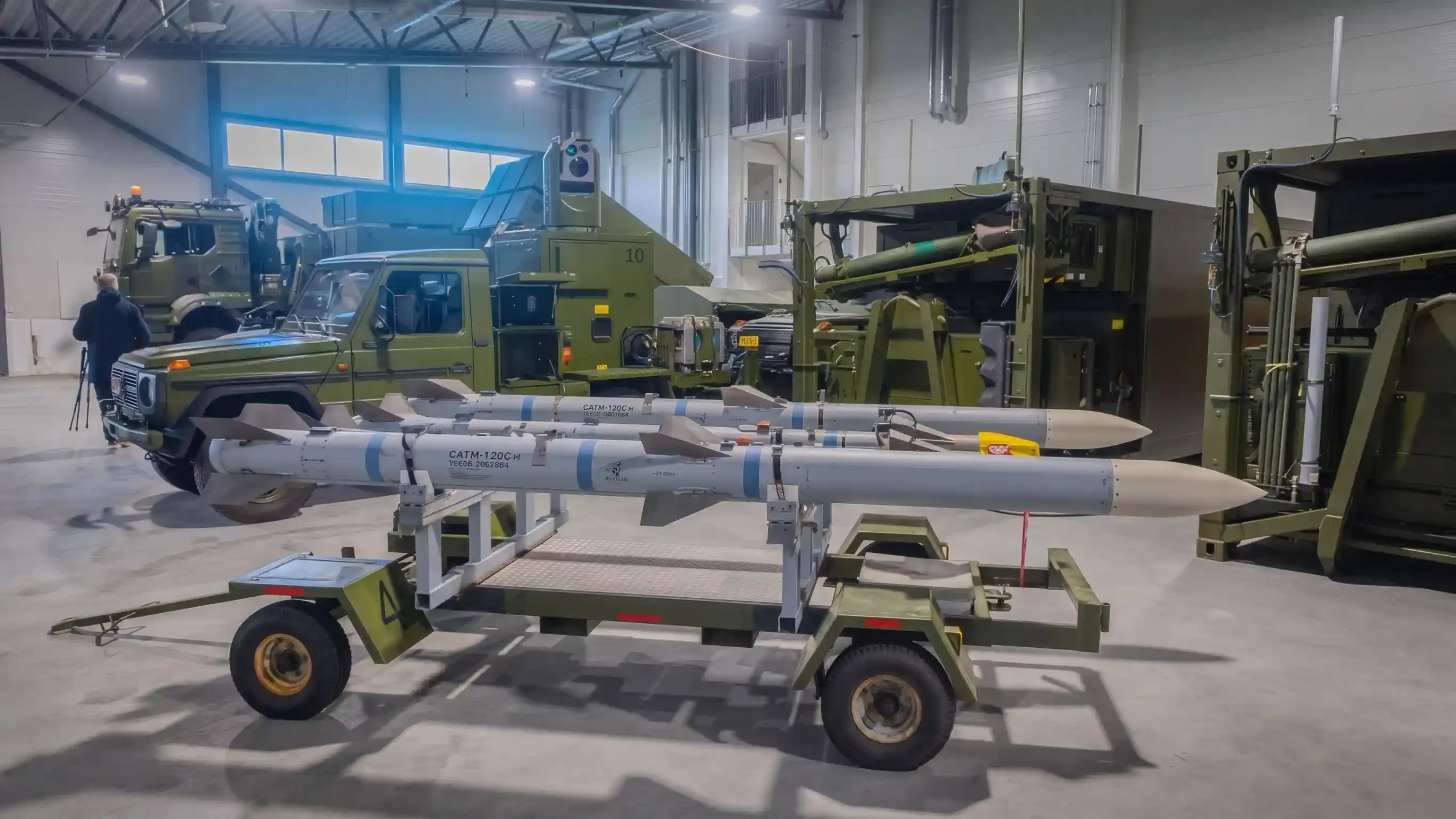
Publicly available specifications for the latest NASAMS standard indicate that the multi-missile canister launcher fires three Raytheon interceptors from the same unit: the AIM-120 Advanced Medium-Range Air-to-Air Missile (AMRAAM), the extended-range AMRAAM-ER, and the infrared-guided AIM-9X Sidewinder Block II, with up to six missiles per launcher. AMRAAM-ER mates the AMRAAM guidance section and warhead with the larger Evolved Sea Sparrow Missile rocket motor, which the manufacturers credit with roughly 50 percent more range and 70 percent more altitude than baseline AMRAAM. Open-source estimates place surface-launched AMRAAM reach near 30 km and AMRAAM-ER near 50 km.
The mix has direct operational value. AIM-9X handles short-range, high-agility engagements against drones and cruise missiles, while AMRAAM-ER pushes the envelope outward and upward against aircraft and standoff weapons. A battery can tailor its magazine to the threat without changing launchers.
The FDC fuses sensor data and assigns targets across launchers over Link 16 and other datalinks, keeping NASAMS plugged into allied air command and control. Sensors come next: FMA lists new radars, missiles, electro-optical sensors and training systems among parallel projects. Raytheon is developing a GhostEye-family radar for NASAMS, with Kongsberg co-developing key subassemblies, as the successor to the AN/MPQ-64F1 Sentinel.
How Kongsberg and Raytheon Sustain NASAMS Production for Norway
NASAMS IV is the product of a long-running Norwegian-American industrial partnership, with Kongsberg as prime contractor and Raytheon as missile supplier. Originally built to Norwegian requirements, the system is now operated by more than a dozen countries, according to the manufacturer, including the United States.
Jære tied that industrial base to wartime resilience. “In today’s security situation, this is not only about technology, but also about preparedness and security of supply,” she said. Støre likewise highlighted Kongsberg’s growing role as demand for modern air defense rises worldwide.
The June 2024 contract was structured partly to expand Kongsberg’s production capacity and lock in long-lead components, a hedge against the backlog created by Ukraine aid and export demand. In October 2025, FMA added contracts worth just over NOK 1 billion for new command posts, wheeled communication nodes and radios, aimed at faster displacement, better dispersal and higher survivability for the batteries.
Analysis: Norway is using the Ukraine donation cycle as a modernization accelerator rather than absorbing it as a capability gap. By funding replacements through the Nansen Programme while buying the newest launcher and FDC standard, Oslo emerges with a more capable force than it gave away, and Ørland, the main operating base of Norway’s F-35A fleet, gains denser protection at a key northern NATO air hub. The binding constraint is now interceptors and sensors rather than money: the batteries’ real reach depends on AMRAAM-ER deliveries and on the replacement radar, both drawing on a US missile and radar industrial base stretched by allied demand.
New NASAMS command posts are scheduled for delivery between late 2027 and 2029, and FMA plans to acquire four more batteries beyond the four on contract. The agency has not published delivery dates for the remaining batteries, nor when the Ørland battery will reach operational status with the 132nd Air Wing. Radar timelines and Norway’s separate long-range air defense requirement will determine how quickly the expanded NASAMS force reaches its full potential.