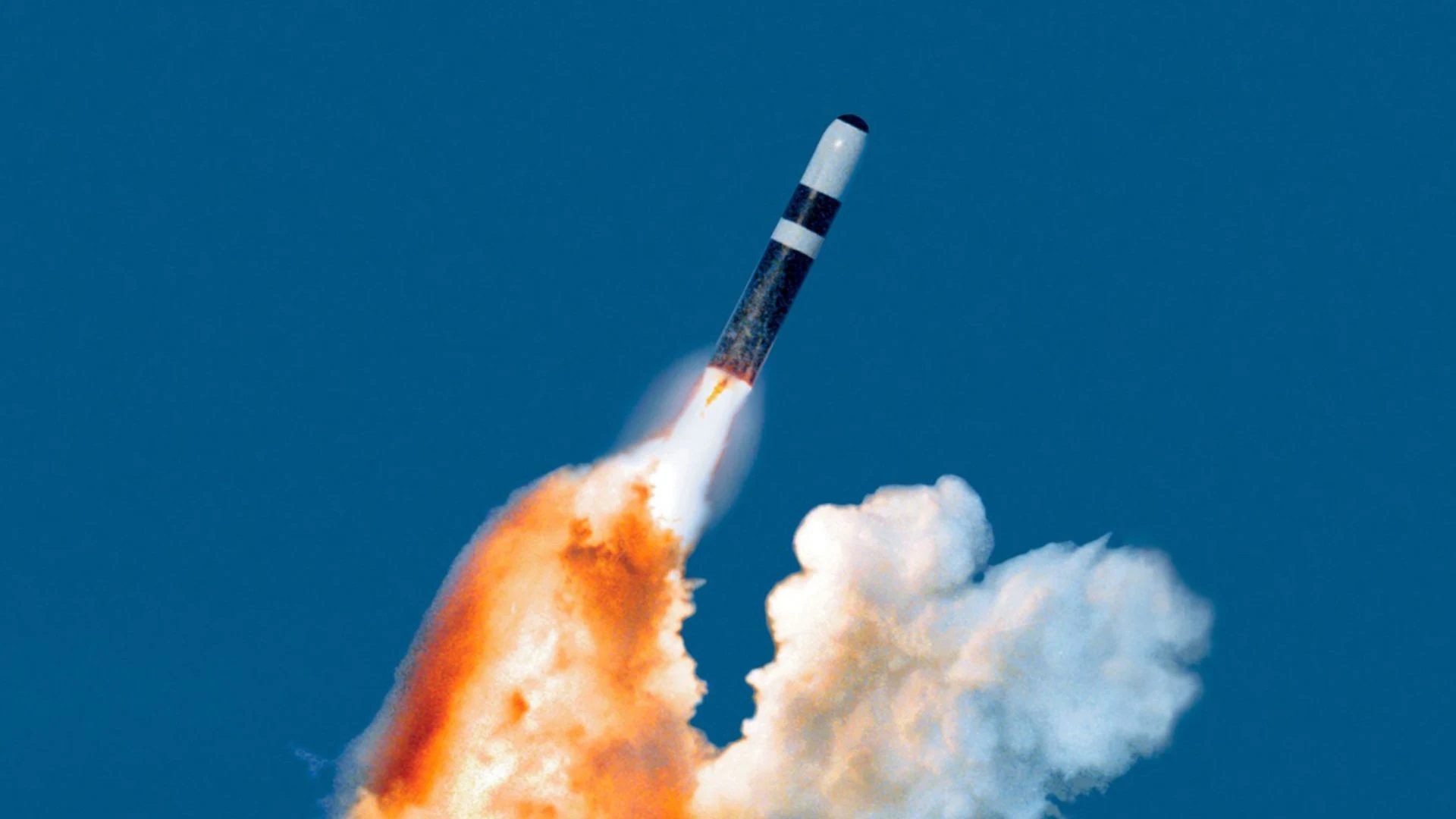
The US Navy awarded Systems Planning and Analysis (SPA), Inc., of Alexandria, Virginia, a $55,670,496 cost-plus-fixed-fee term task order on November 10, 2026, to support the Trident II Strategic Weapons System (SWS). The order, N0003027F3024, includes optional line items and benefits a Foreign Military Sale (FMS) to the United Kingdom. It covers technical assessments and studies, systems engineering and analysis, and program integration and schedule support through September 30, 2031.
The value is modest by Strategic Systems Programs (SSP) standards, but the FMS clause points to a structural fact: the Royal Navy’s continuous at-sea deterrent (CASD) rides on an American weapon system sustained by American engineers. Under the 1963 Polaris Sales Agreement (PSA), amended in 1982 to cover Trident, London buys the missile and its supporting systems from Washington while building its own submarines and warheads. That model carries over to the Dreadnought-class ballistic missile submarines (SSBNs), which the Ministry of Defence (MoD) expects to enter service in the early 2030s.
Trident II Support Order Spans the US Strategic Weapons Industrial Base
Most of the work sits in the program office ecosystem: 60% in Washington, D.C., and 32% at SPA’s Alexandria headquarters. The remaining 8% is split in 1% shares across eight sites that map the Trident enterprise: the Strategic Weapons Facilities at Kings Bay, Georgia, and Bangor, Washington; Sunnyvale, California; Denver, Colorado; Titusville, Florida, near the Cape Canaveral flight test range; Valley Forge, Pennsylvania; Magna, Utah, a solid rocket motor center; and Pittsfield, Massachusetts, home to Trident fire control work. Several of these locations also appear in Lockheed Martin’s D5 production and life extension contracts.
Only $1,699,197 is obligated at award: $200,981 in fiscal 2026 research, development, test and evaluation (RDT&E) funds, expiring at the end of fiscal 2027; $150,000 in fiscal 2027 RDT&E; and $1,348,216 in fiscal 2027 Navy operations and maintenance funds. That is roughly 3% of the ceiling. The Navy awarded the order sole source under 15 U.S. Code 638, the Small Business Innovation Research statute. The announcement does not break out the UK share, and no UK funds appear among the obligated amounts.
Polaris Sales Agreement Ties Dreadnought to the American Trident Pipeline
Britain does not own individual Trident II D5 missiles. Under the PSA’s mingled-asset arrangement, UK boats draw rounds from a common pool at Strategic Weapons Facility Atlantic, Kings Bay, against an entitlement publicly reported at 58 missiles. UK-built warheads are stored at Coulport in Scotland, where they are loaded onto the boats, and missiles return to Kings Bay for periodic reprocessing.
Dreadnought deepens that interdependence. Each boat’s Common Missile Compartment (CMC), a joint US-UK design shared with the 16-tube Columbia-class, has 12 tubes, eight of them operational. Both fleets will field the D5 Life Extension 2 (D5LE2) missile, for which Lockheed Martin holds an $850 million design and development modification. Even the sovereign Astraea A21/Mk7 warhead, built by the Atomic Weapons Establishment (AWE), is developed in parallel with the US W93/Mk7 and is reported to share the US-supplied Mk7 aeroshell, which constrains its size, mass and weight distribution.
The sovereign elements are real. The UK government maintains that it retains full operational control over any launch decision, BAE Systems builds the boats at Barrow-in-Furness, and the Dreadnought program carries a £31 billion budget backed by a £10 billion contingency.
Analysis: Britain holds sovereignty over employment, not over sustainment. The missile body, rocket motors, aeroshell, launcher architecture and the engineering analysis that keeps them certified all flow through SSP’s contracting pipeline. The practical risk is less a political cutoff than schedule coupling: Dreadnought’s timeline depends on US priorities for Columbia, D5LE2 and a stretched solid rocket motor base. Program integration and schedule support, the core of this order, is the function that manages that coupling, and an American firm performs it on American soil.
Next markers include HMS Dreadnought’s sea trials under the £8.4 billion Delivery Phase 4 package announced on July 30, 2026, D5LE2 design maturation, and progress on the W93 and Astraea warheads. SPA’s options run through September 2031, overlapping Dreadnought’s entry into service. How much of the $55.7 million ceiling covers UK-specific engineering remains unpublished.