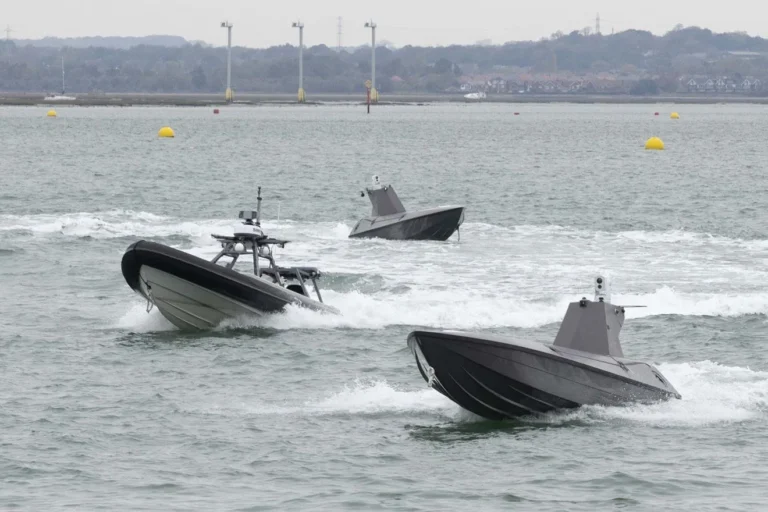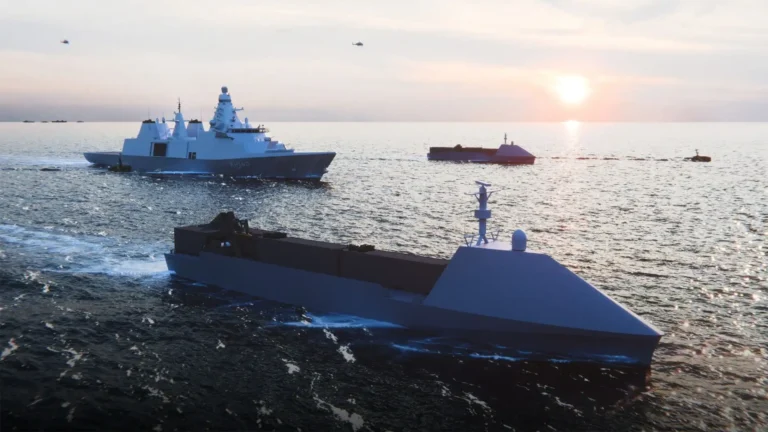
British uncrewed surface vessel (USV) maker Kraken Technology Group and Norwegian composite shipbuilder Umoe Mandal AS signed a Letter of Intent on November 10, 2026, aboard the Royal Navy aircraft carrier HMS Prince of Wales in Oslo, during the International Sea Power Conference. The document sets out a framework for future cooperation on autonomous and uncrewed maritime platforms for the British, Norwegian and wider European markets.
The agreement pairs a fast-scaling drone boat company with one of Europe’s most experienced naval composite yards. Kraken closed a $175 million Series B round led by DTCP on July 9, 2026, at a $1 billion valuation, and is scaling output to 1,000 vessels per year. Its production network already runs through Rheinmetall in Germany, Davie in Canada and Anduril Industries in the United States. Norway is the next node, under the UK-Norway Lunna House Agreement, which commits both governments to deeper defence-industrial collaboration and to leading NATO’s adoption of autonomous systems in the High North.
Kraken Umoe Mandal Cooperation Builds on Skjold Composite Pedigree
Umoe Mandal brings more than 30 years of composite design and construction at its yard in southern Norway. It delivered the six Skjold-class coastal corvettes to the Royal Norwegian Navy, from the 1999 prototype to five series vessels completed by 2012.
Publicly available specifications describe the Skjold as an air-cushion catamaran, a form of surface effect ship, built from glass fibre and carbon composite. The hull measures 47.5 m with a 13.5 m beam and displaces about 274 tonnes at full load. Gas turbines driving waterjets give a reported top speed of up to 60 knots, and draught falls to about 1 m on cushion, opening shallow littorals to a platform armed with eight Kongsberg Naval Strike Missiles and an Oto Melara 76 mm Super Rapid gun. The composite structure also reduces radar and infrared signatures.
The yard also sits inside the Royal Navy supply chain. Under contract to BAE Systems, Umoe Mandal builds the composite mast structures, sponsons, bulwarks and life raft platforms for the Type 26 City-class frigates, covering the first three ships and a follow-on batch of five.
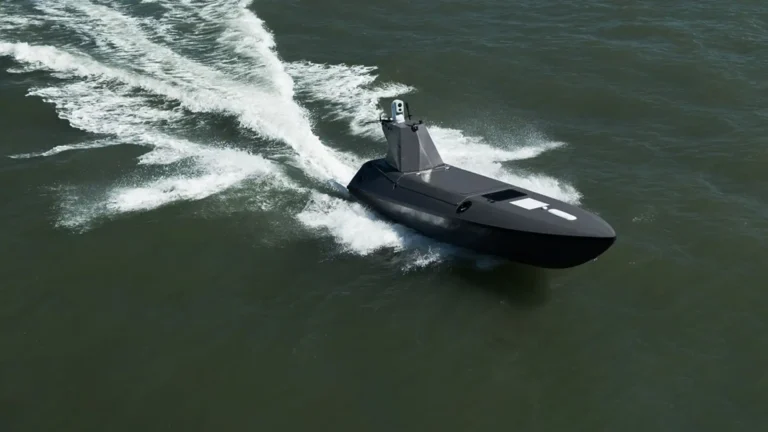
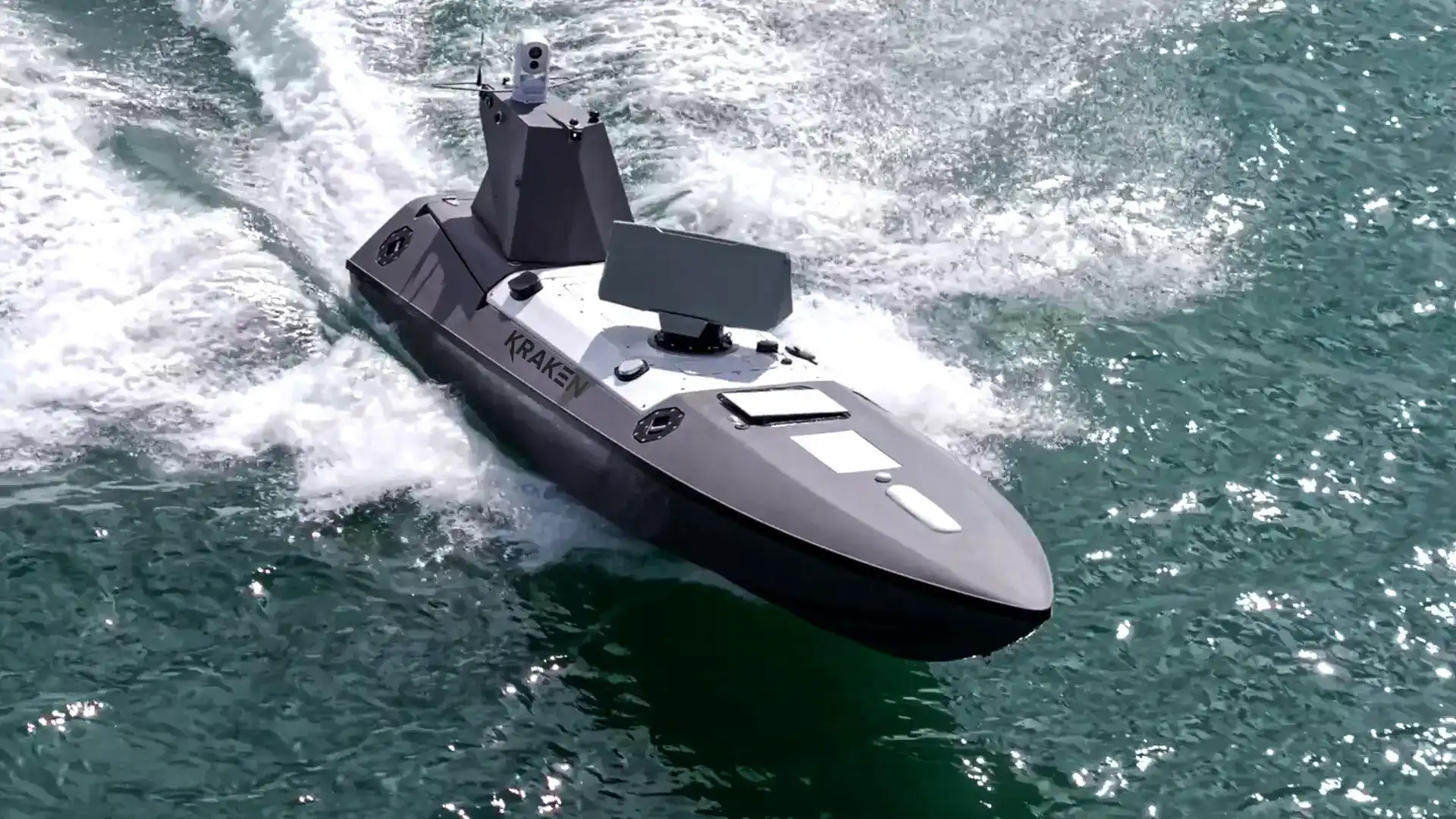
Under the Letter of Intent, the two firms will examine how that expertise could support development of Kraken’s platforms, alongside integration and support in Norway and continental Europe. Kraken’s range covers the K3 SCOUT, K5 KRAKEN and K7 SABRE USVs and the K4 MANTA surface and subsurface craft. The K7 SABRE, unveiled at Euronaval in early November, is the largest: company figures give a 26.5 m length, 84 tonnes displacement, 24 tonnes of payload and a 35 knot top speed, with a prototype expected in early 2027. Neither company has said which platforms the cooperation would cover.
Lunna House Agreement Anchors UK-Norway Uncrewed Industrial Ties
The deal extends Kraken’s industrial footprint to Norway, a fellow member of the UK-led Joint Expeditionary Force. Signed on December 4, 2025, the Lunna House Agreement builds on Norway’s £10 billion Type 26 deal and establishes an interchangeable fleet of at least 13 anti-submarine frigates. It also brings the UK into Norway’s programme for offshore support vessels acting as motherships for uncrewed mine hunting and undersea warfare systems.
Beyond naval requirements, the companies will assess joint opportunities in maritime surveillance, offshore energy and critical infrastructure protection, areas where European demand for low-cost uncrewed capability is growing. Subsea pipelines and cables linking Norway to the UK and continental Europe make that last category a direct concern for both governments.
Mal Crease, chief executive and founder of Kraken, said: “Umoe Mandal has a long record of building novel and complex naval vessels in Norway. This agreement allows us to explore how we combine our expertise as we support closer UK-Norway industrial cooperation while defending our seas.”
Analysis: The Letter of Intent gives Kraken something its German, Canadian and US partnerships do not: a Norwegian industrial base with Royal Norwegian Navy credentials in composite hulls. Reaching 1,000 vessels per year depends on repeatable composite production, and Umoe Mandal’s experience with 47.5 m Skjold hulls is most transferable to the larger end of Kraken’s range, where the K7 SABRE sits. Politically, an in-country integration and support partner strengthens Kraken’s position if Oslo procures USVs under the Lunna House framework; industrial return to Norway was already a factor in the Type 26 selection.
A Letter of Intent is not a contract. Neither company has disclosed a financial value, a workshare split, a target platform or a timeline for a definitive agreement. The next indicators are whether the framework converts into a binding production or support arrangement, whether Norway opens a USV acquisition or folds uncrewed surface craft into its mothership programme with the UK, and whether the K7 SABRE prototype enters the water on schedule in early 2027.